
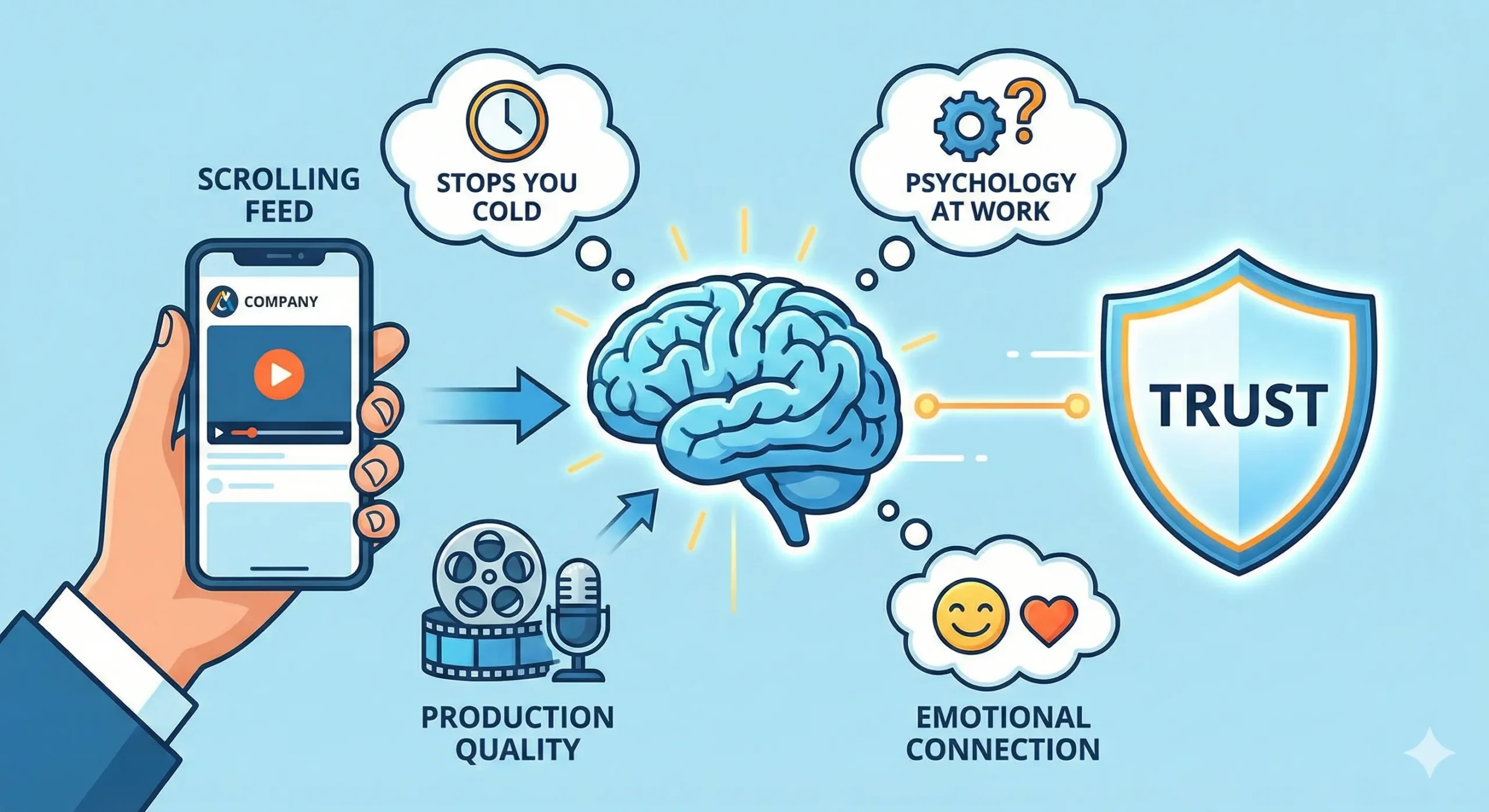
You know that feeling when you’re scrolling through videos and one just stops you cold? Not because it’s flashy or loud, but because something about it just… clicks. You watch it all the way through. Maybe you even replay parts of it. That’s not luck. There’s actual psychology of brand videos at work.
Trust is kind of a strange thing when you really think about it. We’re essentially deciding to believe in companies we’ve never physically walked into, run by people whose faces we’ve never seen, trying to sell us stuff through a glowing rectangle. Sounds weird when you put it like that, right? And yet the right video can make that whole leap feel completely natural.
The psychology of brand videos isn’t just about having decent production quality or some catchy background music. It goes way deeper – into how our brains actually process what we’re seeing, what makes us feel emotions, and why certain combinations of sights and sounds make us think “yeah, I can trust this.”
Let’s dig into what’s really happening in your head when a brand video makes you go from skeptical to sold.
1. The Power of Storytelling in Building Trust
Here’s something interesting: when someone tells you a story, the parts of your brain that light up are completely different from when they’re just throwing facts at you.
Stories aren’t just nice to have. They’re literally how humans have passed down important stuff for thousands of years. Your brain is wired to pay attention when someone starts with “So there was this person who…” That’s why video storytelling for brands hits so hard.
When you watch a brand video with a story you relate to – maybe someone dealing with a problem you’ve dealt with, or working toward something you want – your brain actually releases oxytocin. That’s the same hormone that bonds mothers to babies and makes friends feel close to each other. Pretty wild.
Research shows story-driven content gets retained up to 95% better than straight facts. You’ll probably forget the specific specs they mentioned, but that story about the person who used their product? That sticks around.
The brand videos that work best don’t feel like you’re being sold to. They feel like someone’s sharing an experience with you over coffee. That emotional connection? That’s what turns casual viewers into actual customers.
2. Leveraging Social Proof to Enhance Credibility
Let’s just admit it – we’re all kind of followers when it comes to this stuff. If a bunch of other people are doing something, we figure it’s probably fine for us to do it too.
That’s social proof in action, and honestly it’s one of the strongest psychological tricks in the book. When you see other people backing a brand, your brain goes “well if they trust it, I should probably trust it too.”
Testimonial videos work because they’re basically future-you telling present-you that it’s going to work out. Someone else had the exact doubts you’re having, gave it a shot anyway, and hey look – they’re happy about it now. That’s incredibly convincing.
User-generated content is different though. When real customers (not paid actors reading scripts) talk about their experiences, there’s an authenticity there that polished marketing just can’t fake. Your brain picks up on that realness.
Influencer endorsements work off the same principle. We trust people we look up to or relate to, so when they say something’s good, we’re way more inclined to believe them.
The data backs this up too. People trust video testimonials significantly more than text reviews. Actually seeing and hearing real people makes all the difference.
3. Emotional Triggers and Their Impact on Audience Engagement
Logic might help you rationalize buying something after the fact, but emotions? That’s what actually gets you to click “buy now.”
Good brand videos hit emotional buttons strategically. Joy, empathy, excitement, maybe a touch of FOMO or urgency – these emotional triggers push engagement harder than any rational argument could.
Think about videos that actually made you feel something. Maybe one made you smile with a heartwarming story, or you found yourself rooting for someone in an underdog narrative. That emotional investment doesn’t just disappear when the video ends. It transfers to how you feel about the brand.
The psychology of brand videos here isn’t complicated: emotions create memories, memories shape future choices. When a brand makes you feel good, that feeling sticks with you. Later when you’re deciding what to buy, that positive association bubbles back up.
Getting these emotional responses doesn’t have to feel manipulative. It’s really about tapping into genuine human experiences. Real struggles, real wins, real moments people can actually see themselves in.
Corporate videos that build trust nail this balance. They make you feel something without making you feel like you’re being played.
4. Visual and Auditory Elements That Influence Perception
Your brain processes visuals something like 60,000 times faster than text. Just think about that for a second.
Every single thing in a brand video – colors, music, lighting, even which angle the camera’s shooting from – is quietly working on your subconscious, shaping how you feel about what you’re watching.
Color psychology is legit. Blue makes you think trust and stability (ever notice how many banks use blue?). Warm colors like orange and yellow feel energetic and optimistic. Green says growth and health. These choices aren’t random.
Music might be even more powerful, honestly. The same visual content can feel completely different depending on what’s playing in the background. Upbeat music makes you feel positive and energized. Slower, emotional music pulls at something deeper. Your brain soaks up these audio cues without you consciously noticing.
Camera angles play their part too. Eye-level shots feel like a conversation between equals. Low angles make whoever’s on screen seem more powerful or authoritative. High angles can make them seem more vulnerable or relatable. Directors use these subtle cues to nudge how you emotionally respond.
Lighting sets everything. Bright, natural lighting feels open and honest. Dramatic lighting adds intensity or seriousness. These visual trust factors work because they connect to associations your brain’s been building your whole life.
A smart corporate video strategy thinks through all these elements deliberately. Nothing happens by accident when you understand the psychology of brand videos underneath.
5. Authenticity and Relatability as Trust Builders
Polished production is great. Too polished though? That actually makes people suspicious.
There’s this perfect middle ground where videos feel professional but still real. When companies show what happens behind the scenes, feature actual employees instead of hired actors, or even admit when something didn’t go according to plan – that authenticity builds trust in ways perfectly scripted content just can’t match.
Humans are really good at spotting fake. We’ve spent our entire evolutionary history learning to read micro-expressions, voice tones, body language. When someone in a video is reading off a script they don’t really believe, we can tell. Our brains register something’s off even if we can’t quite put our finger on why.
Real people, real stories, real moments – that’s what makes brands feel human. It makes them approachable instead of this distant corporate entity. When you can see yourself or people like you in a brand’s video, that relatability creates an instant connection.
This is exactly why employee spotlights work. Or videos showing how products actually get made. Or founders being honest about why they started the company and what they care about. These genuine moments signal honesty in ways marketing language never can.
The effect on how audiences see brands is massive. Authenticity equals trustworthiness, which is literally the whole point.
6. Featuring Credible Talent to Boost Brand Authority
Who’s doing the talking matters almost as much as what they’re actually saying.
When brands bring in credible talent – industry experts, recognizable personalities, or just people who clearly know their stuff – some of that credibility rubs off on the brand.
Your brain has this thing called “authority bias.” Basically, we’re way more likely to trust information when it comes from someone who seems like an expert. That’s why professional endorsements work, why certifications matter, why credentials get displayed so prominently.
In videos, this shows up in who you feature and how you present them. A doctor talking about health products carries more weight than some random person. A tech expert walking through software feels more credible than a straight-up sales pitch.
But here’s the catch – the talent needs to actually align with what the brand stands for. If there’s a mismatch between the brand’s values and who’s representing them, people notice. It can actually backfire and hurt credibility.
The goal is boosting viewer confidence through credible representation that feels genuine. Not just throwing a celebrity in because they’re famous, but choosing people who authentically connect with what you’re offering.
7. Educational and Positive Narratives to Foster Brand Loyalty
The brands people really stick with? They’re not just pushing products. They’re teaching things, inspiring people, helping them get better at stuff.
Educational video content works because it gives real value beyond just the transaction. When a brand teaches you something useful, you start associating them with being helpful, knowledgeable, genuinely caring about whether you succeed.
That’s why tutorials, how-to videos, and straight-up informational content perform so well. They’re not immediately asking you to buy anything. They’re giving you something valuable first, which builds goodwill and trust gradually.
Positive narratives do something similar. Instead of hammering on problems or playing on fear (though those have their moments), videos that inspire and lift people up create stronger, longer-lasting bonds. People want to associate with brands that make them feel good about themselves and their choices.
There’s this psychological thing about reciprocity. When someone gives you something valuable (like actually useful information or genuine inspiration), you naturally want to give something back. Maybe that’s your attention, your loyalty, or eventually your money.
Emotional storytelling in brand videos that educates while keeping you entertained hits multiple psychological buttons at once. You’re learning, you’re feeling good, and you’re building trust all at the same time.
Quality corporate videography knows how to balance giving people useful information with keeping them engaged, creating content that builds positive feelings about the brand over the long haul.
Putting Psychology of Brand Videos to Work
Understanding why audiences trust brand videos is one thing. Actually using these principles? That’s where it gets interesting.
The best brand videos don’t just pick one psychological trigger and call it done. They stack multiple elements together. A compelling story featuring authentic people, backed by social proof, delivered with deliberate visual and audio choices, wrapped up in something educational or inspiring. That’s when things really click.
Working with experienced corporate video production services means having people who get these psychological principles and know how to use them well. They’re not just making videos that look nice – they’re creating experiences designed to build real trust and connection.
The link between trust and sales is direct. Commercial video production that actually uses psychological principles doesn’t just perform well – it drives genuine business results.
So next time you watch a brand video that just hits different, you’ll know what’s going on. It’s not magic. It’s psychology of brand videos, strategy, and really understanding what makes humans trust each other. And when brands nail that, everything else tends to fall into place.
Ready to create brand videos that actually build trust? At Kween Media, we combine psychological insights with strategic storytelling to produce videos that connect with your audience on a deeper level. Whether you need corporate videos, brand films, or commercial content that converts, we’ve got you covered. Let’s talk about your next project.