
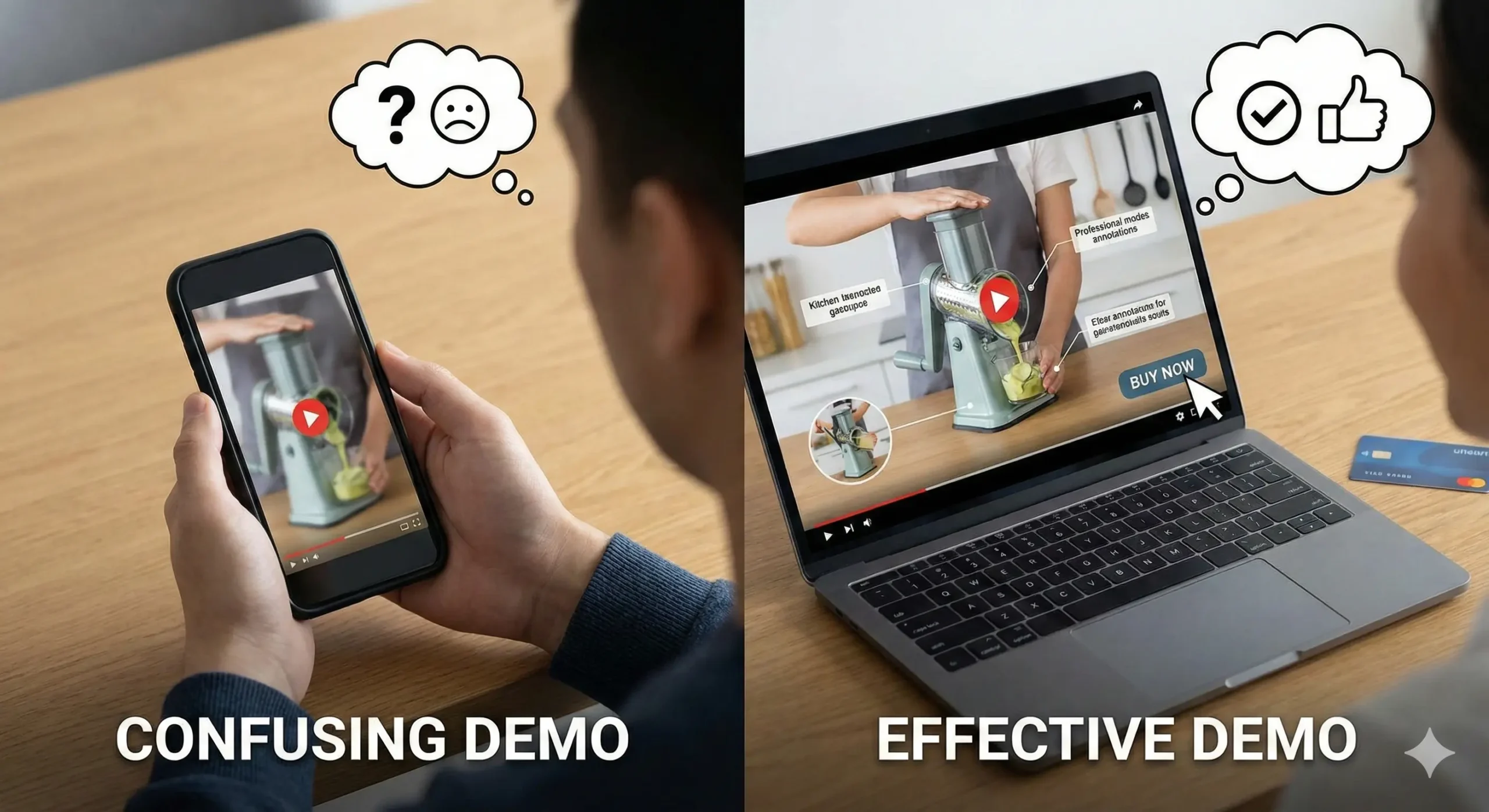
Think about the last time you bought something online. Chances are, you watched a few product demo videos first. Maybe it was a quick demo showing how the thing actually works. Or someone unboxing it and walking through the features. Whatever it was, that video probably played a bigger role in your decision than you realized.
Product demo videos have basically become the digital equivalent of picking something up in a store and checking it out from all angles. Except better, because you can see it actually being used by real people in real situations.
Here’s what’s interesting though – not all demo videos are created equal. Some make you want to buy immediately. Others leave you more confused than when you started. Let’s dive into what’s really happening when a product demo video turns viewers into buyers.
Understanding the Psychology Behind Buying Decisions in Video Marketing
Your brain processes video content way faster than text. Like, thousands of times faster. When you’re watching product demo videos, your brain is taking in visual information, listening to explanations, and making split-second judgments about trust and credibility.
There’s also this emotional component that’s hard to replicate with text alone. A good demo video makes you feel something – maybe relief that this product solves your annoying problem, or excitement about what you could do with it. Those emotional responses directly impact whether you buy or bounce.
Trust is the other big piece. Professionally produced commercial video production signals quality and credibility. If a company invests in showing you their product properly, your brain assumes the product itself is probably worth the investment too.
The psychology isn’t complicated – show me how it works, make me believe it’ll work for me too, and give me confidence that I’m making a smart choice. Demo videos that nail these three things convert beyond expectations.
The Role of Product Demo Videos in Overcoming Online Shopping Challenges
Shopping online has one massive disadvantage – you can’t touch the thing you’re buying.
That creates hesitation. Will it actually look like the photos? Will it fit? Is it really worth the money? These doubts kill conversions faster than anything else.
Product demonstration videos bridge that gap. They can’t replace physically holding something, but they can show you what holding it looks like. They show scale, texture, how it moves, how it sounds. All the sensory information you’re missing from not being in a physical store.
Good demos provide clear, detailed information without overwhelming you. They answer the questions you didn’t even know you had yet. “Oh, I was wondering how that part works” – and boom, the video just showed you.
The real-world use cases matter a lot too. Seeing someone actually use the product in a realistic scenario makes it tangible. You’re not just looking at a thing on a white background anymore. You’re seeing how it fits into actual life, which makes it way easier to picture it fitting into YOUR life.
This is where product videos that convert really shine – they eliminate doubt by showing instead of just telling.
Types of Product Demo Videos and Their Specific Uses
Not every demo video serves the same purpose. Knowing which type you need depends on what you’re selling and who you’re selling to.
- Explainer videos break down how something works, usually for more complex products. These are perfect when you need to educate before you can sell. Think software platforms or technical gadgets that require some understanding before someone can appreciate their value.
- Feature-focused demos zoom in on specific capabilities. “Here’s what this button does, here’s why this feature matters, here’s how it makes your life easier.” These work great when your product has standout features that differentiate it from competitors.
- Product launch videos are all about excitement and first impressions. They introduce something new to the market and create buzz. These typically have higher production values and focus more on the “wow factor” than detailed walkthroughs.
- Commercial product videos are the ones you see in paid ads – short, punchy, designed to grab attention and drive immediate action. They prioritize impact over exhaustive detail.
- For B2B product demo videos, the approach shifts. You’re often dealing with longer sales cycles, multiple decision-makers, and more complex products. These demos tend to be more detailed, focusing on ROI, integration capabilities, and business outcomes rather than just features.
- B2C demos can be more casual and emotion-driven because individual consumers make faster decisions based on different criteria. Understanding your audience determines which demo type makes sense.
Crafting Conversion-Focused Product Videos That Drive Sales
Length matters. A lot.
Most people won’t sit through a 10-minute product demo unless they’re already seriously considering buying. For maximum impact, stick to 1-2 minutes. Maybe a bit longer for complex B2B products, but generally, shorter wins.
The script needs to be tight. Start with the problem or need, show how your product solves it, demonstrate key features, prove it works, and end with a clear next step. That’s your basic structure. Everything else is refinement.
Storyboarding helps you visualize the flow before you shoot anything. What shots do you need? What angle shows the product best? Where should the camera focus? Planning this upfront saves time and money during production.
Production quality actually impacts perceived product quality. Shaky camera work, bad audio, poor lighting – these things make viewers subconsciously question whether your product is as low-quality as the video. High-quality visuals and sound signal professionalism and attention to detail.
This is where working with professionals who understand video storytelling for brands makes a real difference. They know how to show your product in ways that build desire, not just awareness.
Your call-to-action can’t be an afterthought. After watching your demo, what should viewers do next? Buy now? Start a free trial? Request a quote? Make it obvious and make it easy. The best demo in the world doesn’t convert if people don’t know what to do after watching.
Strategic Promotion of Product Demo Videos to Maximize Reach and Impact
Creating an amazing demo video is step one. Getting people to actually watch it? That’s where strategy comes in.
YouTube is obvious but powerful. It’s the second largest search engine, and people actively search for product reviews and demos there. Optimizing your video for search – good titles, descriptions, tags – helps people find you when they’re actively looking for solutions.
Social media platforms each work differently. Facebook and Instagram favor shorter clips with captions (most people watch without sound initially). LinkedIn works for B2B product demos with a more professional angle. TikTok and Reels? Perfect for quick, engaging product highlights that feel authentic rather than overly produced.
Influencer collaborations can expand your reach dramatically if done right. Someone trusted reviewing or demonstrating your product carries way more weight than you saying the same things about yourself. Their audience already trusts them, so that trust transfers to your product.
Your demo videos should live everywhere relevant – product pages, email campaigns, retargeting ads, sales presentations. They’re versatile assets that can work across your entire marketing ecosystem.
Measuring the Effectiveness of Product Demo Videos on Buying Decisions
If you’re not tracking metrics, you’re just guessing about what works.
View rates tell you if people are even watching. Low views might mean your distribution strategy needs work or your thumbnail and title aren’t compelling enough.
Engagement metrics – likes, comments, shares, completion rate – show whether the video itself resonates. If people are clicking away after 10 seconds, something’s wrong with your hook or content.
The metric that actually matters though? Conversion rate. How many people who watched your demo went on to buy, sign up, or take your desired action? That’s the number that impacts your bottom line.
Some interesting case studies show just how much demo videos move the needle. Electronics companies have seen purchase likelihood jump by 85% when customers watch product demos. Kitchenware brands report significant increases in cart additions after implementing demo videos on product pages. Health and wellness products often see 60-70% higher conversion rates with video versus without.
The impact isn’t just anecdotal – the data backs it up across industries. People who watch product demos are significantly more likely to buy than those who don’t.
Professional corporate videography brings the technical expertise to create demos that don’t just look good but actually drive measurable results.
Looking Ahead: The Evolution of Product Demo Videos
Demo videos keep evolving. What worked two years ago might feel dated now.
Interactive demos are getting bigger. Imagine watching a demo where you can choose which features to explore, or click to get more detail on specific aspects. That level of engagement and personalization creates stronger connections.
Personalized video content is another trend gaining traction. Instead of one generic demo for everyone, technology now allows for videos that adapt based on viewer behavior or characteristics. Someone interested in basic features sees one version, while power users see advanced capabilities highlighted.
AR and VR are starting to play bigger roles too, especially for products where seeing them in your actual space matters – furniture, home decor, even clothing. The line between demo video and virtual try-on is blurring.
360-degree product videos let viewers control the view, examining products from every angle. For certain categories like cars or fashion, this creates an experience closer to being there in person.
The future of product demo videos isn’t just about better production quality (though that helps). It’s about more interactive, personalized, immersive experiences that give viewers even more confidence in their buying decisions.
And honestly? The brands that adopt these innovations early will have a serious advantage over competitors still using basic, static demos.
Investing in Product Demo Videos is Investing in Sales
Product demo videos are a must for all businesses. Whether you’re selling physical products, software, services, or anything else, showing how it works and why it matters makes a measurable difference in conversion rates. The psychology is simple – seeing is believing, and believing leads to buying.
Production quality matters because it signals your brand’s overall quality. Strategic distribution matters because the best video in the world doesn’t convert if nobody watches it. And measuring results matters because continuous improvement comes from understanding what’s actually working.
Whether you’re working with explainer videos for complex products or high-impact ad film production for launches, the foundation stays the same – help people understand and believe in your product.
Corporate video production services that understand both the creative and strategic sides can help you build demo videos that turn viewers into customers.
Want product demos that don’t just sit there? Contact Kween Media for product videos that actually sell!