
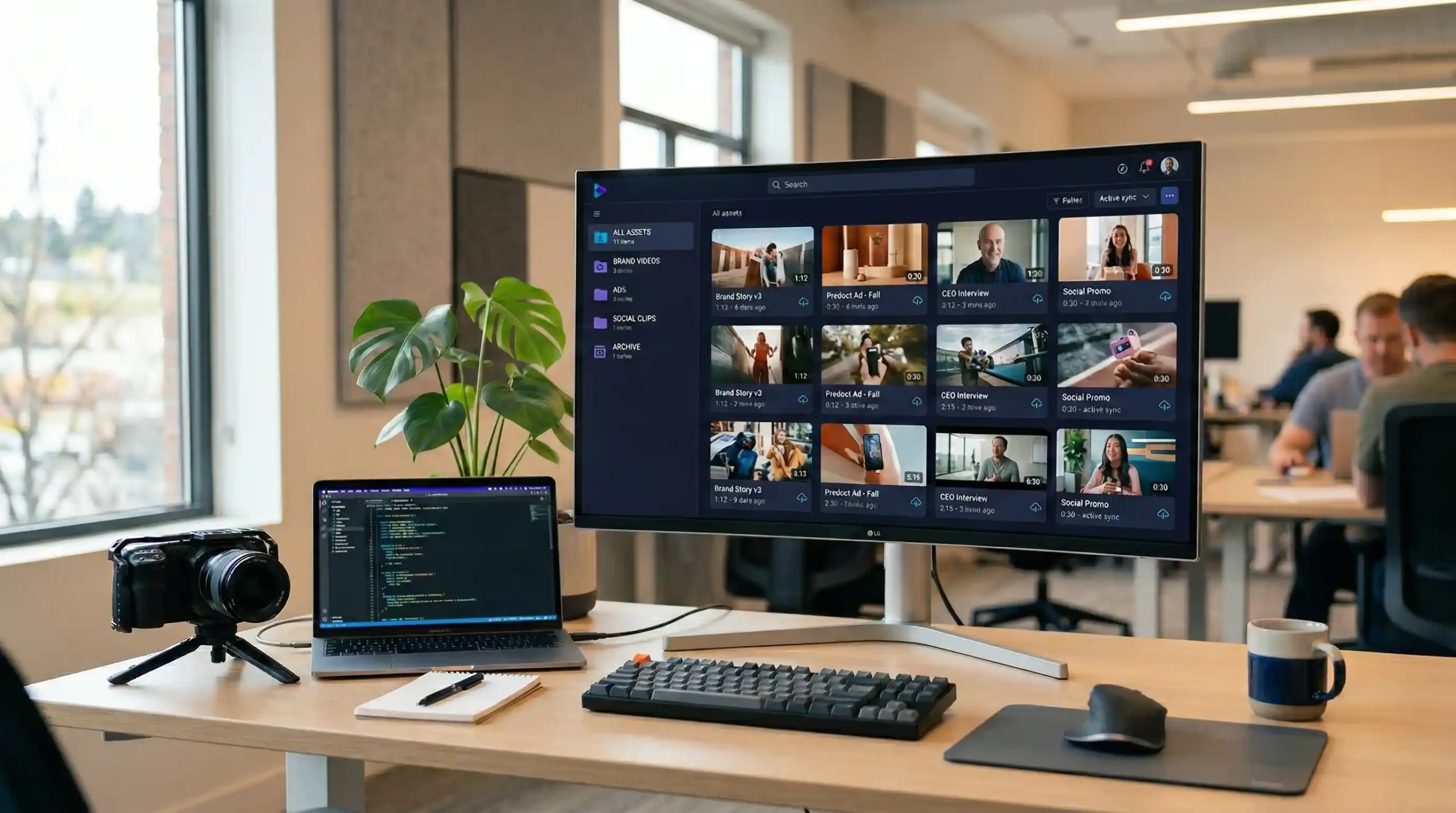
Let me paint you a picture. It’s Monday morning. Your marketing team needs a 30-second product demo for an email campaign going out tomorrow. Problem is, you don’t have one. You’ve got a 5-minute explainer from last year, some raw footage from a customer shoot, and a bunch of Instagram clips that don’t quite work. So now someone has to spend the entire day editing something together, or worse, you skip the video entirely. Simply because your startup doesn’t have a video asset library.
Sound familiar?
This happens constantly at startups. You need video assets for launches, social campaigns, sales presentations, investor decks, onboarding flows. But you either don’t have them at all, or you’ve got the wrong format, the wrong length, outdated branding, or footage that doesn’t match what you actually need right now.
Here’s the thing: every video you produce should be an asset working for you across multiple uses. Not a one-time thing you create for a single campaign and never touch again. When you build a collection of strategic video assets – different lengths, formats, and purposes – you stop scrambling and start scaling.
The startups moving fast aren’t the ones producing more video. They’re the ones building video assets strategically so they always have what they need when opportunities arise.
The startups that get this build systems to organize, protect, and leverage their video assets properly. The ones that don’t? They waste time, money, and opportunities recreating content they already paid for once.
What Is a Video Asset Library and Why It Matters for Startups
Think of every video you’ve created as an investment. You spent money producing it, time planning it, and resources distributing it. That’s not a disposable file – that’s a business asset that should keep delivering value.
A video asset library is basically a structured system where these valuable assets are organized, tagged, and accessible. Not just dumped in a cloud folder somewhere, but actually managed like the strategic resources they are.
For startups, this matters because you’re already resource-constrained. Every video asset you create should work harder for you. That brand film you produced for your Series A? It contains clips for social media, quotes for presentations, footage for onboarding materials. But only if you can actually find it and repurpose it efficiently.
A solid startup video content strategy treats video assets as long-term investments, not one-time expenses.
When your assets are centralized and organized, your entire team can access what they need without bottlenecks. Your sales team in Mumbai can grab demo videos while your marketing consultant in Bangalore pulls social clips – all without waiting for someone to dig through files or remember where things are stored.
The faster you can deploy your existing video assets, the quicker you move as a company. When opportunities arise – trending topics, partnership announcements, last-minute pitches – having assets ready to go makes the difference between capitalizing on the moment or missing it.
The Hidden Costs of Not Having a Video Asset Library
Here’s what actually happens when you don’t treat video content as valuable assets worth organizing.
You end up creating the same content twice. Someone needs footage of your product in use, doesn’t realize you already shot that six months ago, and schedules an entirely new production. That’s literal money down the drain.
Brand consistency falls apart. When different team members pull random versions of assets – outdated logos, old product footage, inconsistent messaging – your brand starts looking disjointed. Customers pick up on these inconsistencies even if they can’t articulate exactly what feels off.
Assets literally disappear. People leave. Subscriptions lapse. Hard drives crash. That video that cost ₹3 lakhs to produce? Gone forever. Now you either work without it or spend another ₹3 lakhs recreating what you already had.
Your team wastes valuable time. When people spend hours searching for assets instead of creating campaigns, you’re not operating at startup speed – you’re stuck in organizational quicksand.
The real cost isn’t just duplicate production expenses. It’s the lost opportunities. That competitor who moved faster? They might just have better systems for managing their video assets.
Types of Video Assets Every Startup Should Build
Not all video assets serve the same purpose, and understanding what to prioritize helps you build strategically.
Brand assets form your foundation. These tell your story, communicate your mission, and establish what makes you different. Usually longer-form, these assets get deployed across your website, investor materials, and major campaigns.
Explainer assets simplify what you do. For startups tackling novel problems or complex solutions, these assets answer “what is this?” in ways anyone can understand. Pure gold for conversion.
Product demonstration assets show your offering in action. For SaaS companies, this might be screen recordings with commentary. For physical products, it’s real people using your product in realistic scenarios.
Social content assets are the short-form pieces that maintain brand visibility. These might be excerpts from longer assets, quick insights, behind-the-scenes moments, or standalone pieces for Instagram, LinkedIn, or wherever your audience lives.
Social proof assets – testimonials and case studies – provide credibility. Real customers discussing real results carries exponentially more weight than self-promotion.
Advertising assets are specifically crafted for paid media channels. Usually shorter and conversion-focused, these assets are designed to perform within specific platforms like Facebook, YouTube, or LinkedIn ads.
The smart approach plans these assets with reusability built in. That 5-minute brand video? Shoot and edit it so you can extract 30-second clips, 10-second teasers, and still frames for multiple uses. Working with professionals who understand video storytelling for brands helps maximize value from every production.
How to Build a Scalable Video Asset Library Step-by-Step
Building an organized system doesn’t have to be overwhelming if you approach it methodically.
Step 1: Design your structure around how your team actually works. Do they search by campaign? By content type? By date? Your organization should match real workflow patterns, not some theoretical ideal that nobody follows.
Step 2: Establish naming conventions and enforce them consistently. “2025_ProductDemo_FeatureX_v3_Final” beats “newvid_edited_FINAL_FINAL_v2_actualfinal.mp4” every time. We’ve all seen the chaos of inconsistent naming.
Step 3: Tag everything with useful metadata. Each asset should be tagged with: creation date, campaign association, intended use, duration, featured subjects, products shown, and funnel stage. This makes searching functional instead of frustrating.
Step 4: Implement appropriate access controls. Not everyone needs access to everything. Your contractors don’t need your confidential investor pitch footage. Create sensible permission levels.
Step 5: Create a clear workflow for new assets. When someone produces or commissions new content, what’s the process for adding it to your system? Who’s responsible? What information must be documented? Without clarity here, your system degrades quickly.
Step 6: Develop an archiving strategy for outdated content. That product demo from two versions ago isn’t current anymore, but you don’t want to delete it entirely. Have a clear approach for archiving historically relevant but outdated assets.
The tools you use matter. Many startups start with Google Drive or Dropbox. That works initially, but as you scale, proper digital asset management platforms like Frame.io, Air, Widen, or Bynder become increasingly valuable.
The goal is building something that functions for your specific team, scales as you grow, and doesn’t require constant manual intervention to maintain.
Video Asset Library vs Cloud Storage: What Startups Get Wrong
Many startups assume “we use Google Drive, so we’re organized.”
Not quite. There’s a significant difference between storing files and actually managing assets strategically.
Cloud storage holds files. Asset management systems help you find, use, and leverage video content to drive business results. That distinction matters.
Basic cloud folders struggle with:
- Metadata-based searching (try finding “all videos featuring our CTO” without manually checking every folder)
- Version control (which file is actually the final version? Good luck figuring that out)
- Preview capabilities (your team downloads files just to see what they contain, wasting bandwidth)
- Granular access control (usually it’s all-access or no-access, nothing in between)
- Usage tracking (which assets perform best? You’ll never know)
- Workflow integration (connecting to editing tools, CRM systems, marketing platforms)
Proper asset management handles all of this. It’s purpose-built for managing video content at scale, not just preventing files from disappearing.
The cost difference? Often minimal, especially for startups. Many platforms offer startup-friendly pricing. Factor in time saved and duplicate work avoided, and they typically justify themselves quickly.
When Startups Should Invest in Professional Video Production
DIY video content has its place. Your founder recording a quick update on their phone? Often that authenticity performs better than overproduced content.
But certain moments demand investing in professional video production for startups.
- Fundraising moments. Investor-facing video assets need polish. You’re asking for significant capital – demonstrate that you take it seriously.
- Major launches. New products, rebrands, market entries – these pivotal moments deserve assets that match their importance.
- Competitive positioning. If everyone in your space has polished video assets and yours look amateur, you’re losing credibility by comparison.
- Long-term core assets. Some videos have short lifespans. Others need to work for years. Brand films, explainer videos, certain product demos – these are investments requiring quality from the start.
- Cost-benefit tipping points. Sometimes DIY actually costs more. Calculate the hours your high-value team members spend learning video editing instead of doing what they’re skilled at. Often professional production is cheaper.
Working with experienced commercial video production companies means getting assets designed for versatility and longevity – exactly what belongs in a strategic asset collection.
Professional production creates assets with staying power. They work across channels, represent your brand well, and remain valuable for years rather than looking dated within months.
Using Your Video Asset Library to Drive Marketing and Sales
Organizing video assets only matters if you’re actively leveraging them strategically.
The real power comes from smart asset reuse. That product demo you created for your website? Your social team extracts 15-second highlights for Reels. Sales incorporates sections into presentations. Customer success references it during onboarding.
Different customer journey stages require different assets. Brand-new prospects need awareness content – brand storytelling videos introducing who you are and why you matter. People evaluating options need consideration content like detailed demos and case studies. Ready-to-buy prospects need decision-stage assets addressing final concerns and facilitating conversion.
Organize your assets with this journey in mind. Tag by funnel stage, use case, and audience segment. This lets your team quickly deploy exactly what’s needed for any campaign or customer touchpoint.
Email campaigns with video assets perform better. Landing pages with video convert higher. Social posts with video generate more engagement. Sales outreach with personalized video gets better response rates. When you have organized assets ready to deploy, you can activate all these channels without starting from scratch each time.
ROI comes from leverage. One professional shoot creates assets fueling dozens of campaigns across months or years. But only if those assets are organized for accessibility and actual use.
Making Video Assets Work for Your Startup
No startup launches thinking “our competitive advantage will be how we manage video content.”
But in reality? Startups that move fast, maintain brand consistency, and extract maximum value from every video they produce are the ones with strong organizational systems behind the scenes.
Treating video as valuable assets isn’t flashy. It’s infrastructure. But infrastructure enables scaling without everything breaking down.
Start building your system now, even with just a handful of videos. Organizational habits established early become exponentially harder to implement later when you have hundreds of assets scattered everywhere.
Think through your structure, create systems matching how your team actually operates, invest in quality corporate videography for important assets, and maintain discipline as you grow.
For major campaigns, awareness initiatives, or product launches, working with teams experienced in ad film production ensures you’re adding high-quality, versatile assets to your collection, not just creating content that needs redoing in six months.
The startups winning with video aren’t necessarily spending the most. They’re being strategic about what they create, how they organize it, and how they leverage those assets across every channel and touchpoint.
That’s the real advantage of treating video as valuable assets – it transforms video from an expense into an investment that keeps delivering returns long after initial production.
Building a collection of strategic video assets doesn’t happen by accident. At Kween Media, we help startups create video content designed to work across channels and deliver value for years, not just weeks. From strategic planning to professional production, we ensure every asset you create actually moves your business forward.Let’s build assets that keep working for you.