
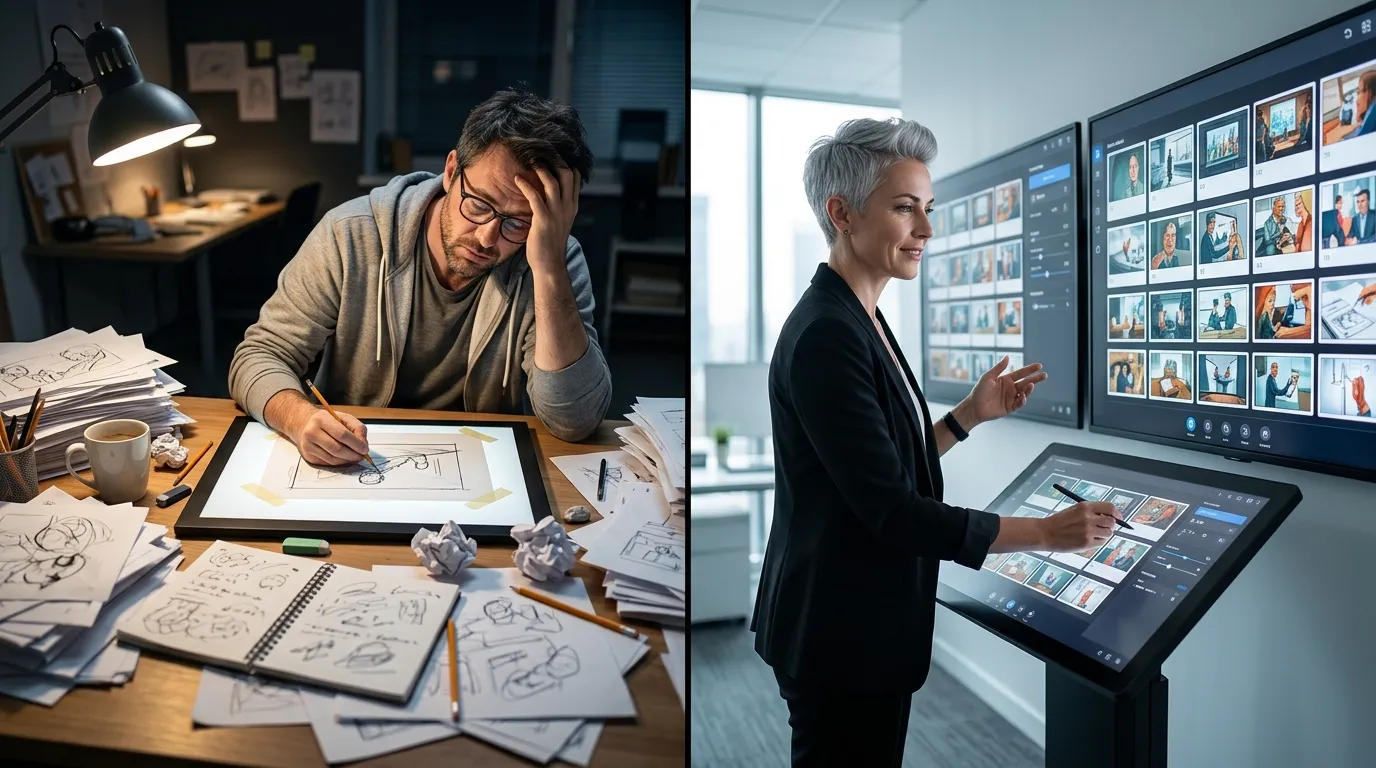
Pre-production has always been the part of video production that disappears into a black hole of time. You have a script. You have a shoot date. And somewhere between those two things sits storyboarding – the process of translating words into a visual plan, frame by frame, scene by scene. Done manually, that process can stretch across days of sketching, revising, getting feedback, revising again, and circling back on decisions that should have been settled weeks earlier. Generative AI in storyboarding is changing that timeline in ways the industry is still catching up to.
Tools that can take a script and return a full set of storyboard frames in minutes aren’t experimental anymore. They’re in active use across production companies, brand teams, and agencies. Platforms like Storyboarder.ai, Katalist.ai, and Adobe Firefly have moved well past novelty – they’re being used on real projects with real deadlines, and the teams using them are not going back.
The shift matters for a specific reason. When pre-production compresses, everything else follows. The edit starts sooner. Client feedback happens earlier. Teams are able to make creative decisions at the right stage, instead of in a last-minute rush. That’s not a minor efficiency gain – it’s a structural change in how production actually works.
Understanding the Traditional Storyboarding Process
To understand why AI matters here, it helps to be clear about what the old process actually involved.
A traditional storyboard starts with concept development – figuring out the visual approach to the script before a single frame gets drawn. That leads to a scene breakdown, where the script gets mapped to individual shots. Then rough sketches, usually done by a storyboard artist working from a brief. Then revisions based on director or client feedback. Next, for higher-budget projects, polished final frames that accurately represent the intended cinematography.
Each of those stages takes time independently. Combined with approval rounds, stakeholder feedback, and the back-and-forth that comes with any collaborative creative process, even a straightforward corporate video storyboard could easily consume a week or more before production began.
The cost layer compounds this. Skilled storyboard artists charge professional rates. Revisions aren’t free. If the concept changes significantly after the first round of frames, you’re often starting over rather than adjusting. For brands with fast-moving campaigns or tight production windows, that model has always been a friction point.
None of which means traditional storyboarding produced bad results. It often produced excellent ones. But the resource requirement was real, and for smaller productions or teams without dedicated illustrators, the quality ceiling was a practical constraint.
How Generative AI Accelerates Storyboarding
The core capability is straightforward: upload a script or scene description, and the AI generates visual frames.
What’s less obvious until you use the tools is how much further they go beyond that. Modern AI storyboarding platforms handle consistent character generation across frames – so the same character looks the same in scene one and scene seven. They offer style matching, letting teams specify whether the visual approach should feel cinematic, documentary, animated, or something else. They generate shot lists alongside the frames, and some platforms produce full animatics with timing built in.
Boords AI and Drawstory are strong for iterative workflows where multiple concept versions need to be explored quickly. Krea handles cinematic frame generation at a quality level that sits comfortably alongside traditional illustration for planning purposes. The common thread is speed – not just in the initial generation but in revision. Changing a camera angle or adjusting the emotional tone of a scene is a prompt adjustment, not a return to the illustrator.
For production teams, the practical effect is that creative exploration becomes genuinely affordable. Trying three different visual approaches to the same scene used to mean paying for three different versions. Now it means a few extra minutes of generation time. That changes how willing teams are to explore, which changes the quality of the decisions they eventually commit to.
Key Benefits of Generative AI in Corporate Video Storyboarding
The time savings are the headline, and they’re real – pre-production timelines that used to run a week or longer are compressing to a day or less for many projects. But the more durable benefits are slightly different.
Brand consistency is one. AI tools that are trained on or configured with specific brand guidelines – color palettes, visual style, character representation – maintain that consistency across every frame automatically. That’s something that’s historically required close supervision in traditional storyboarding, and something that AI handles without additional effort.
Client communication gets better. When a client can see a visual representation of every scene in the first week rather than the third, feedback is more specific, more actionable, and less likely to produce the late-stage surprises that make productions expensive. The storyboard becomes a shared reference point earlier.
The connection to shot composition is direct. AI storyboarding tools that generate precise camera angles and framing aren’t just producing reference images – they’re doing visual thinking that informs how the actual shoot gets planned. Directors and DPs can make better decisions faster when the visual groundwork is already laid. And because storyboards now exist earlier in the process, that thinking flows naturally into pacing in video editing – editors who can see the intended rhythm and structure of a piece before the shoot have a clearer framework to work within.
Popular Generative AI Storyboarding Tools in 2026
The tool landscape is developing fast, but a few platforms have established themselves as genuinely production-viable.
Storyboarder.ai handles the full pipeline from script to animatic, which makes it particularly useful for teams who want to move straight from written content to something they can review with a client. Katalist.ai is strong on the script-to-visual automation side, with good control over visual style and scene consistency. Boords AI has developed a solid reputation specifically for consistent character generation, which is one of the more technically demanding parts of AI storyboarding.
Krea is worth attention for projects where cinematic quality matters – the frame output sits at a level that works well for brand films and higher-end corporate content. Adobe Firefly’s advantage is integration: for teams already working inside the Creative Cloud ecosystem, it reduces friction significantly.
Most of these tools now support 3D camera angle visualization, export to PDF or MP4 for client review, and some form of brand safety filtering for corporate use. Video storytelling that needs to maintain emotional narrative flow across a full piece benefits from tools that track consistency between frames, which the better platforms handle well.
The right choice depends on the project type, the team’s existing workflow, and how much control over visual output matters for that particular production.
AI-Powered Storyboarding for Different Types of Corporate Videos
The tools adapt to format in ways that make them genuinely useful across different production types, not just one.
Testimonial videos have a natural arc that AI translates into visuals quickly. The before state, the shift, the outcome – that structure maps cleanly onto shot sequences that AI storyboarding tools can generate with minimal manual input. Emotional continuity across that arc is something the better tools maintain, keeping the visual register consistent with the emotional register of the story.
Product demos benefit from the ability to plan precise camera angles and framing around the product itself before the shoot happens. The storyboard becomes a production brief that the crew can actually follow, rather than a rough approximation of intent.
For company culture films, AI storyboarding is useful at the concept stage more than anywhere else. Generating multiple visual approaches to the same cultural theme lets creative teams and stakeholders make earlier, more informed decisions about direction. Within a brand video funnel, different stages need different visual languages – awareness content and decision-stage content have different jobs, and AI tools can generate distinct storyboard approaches for each.
Launch campaigns where speed matters most are where the time savings are most visible. Getting from script to approved visual plan within a day, rather than a week, can be the difference between a campaign that launches on schedule and one that doesn’t.
Maintaining Authenticity and Brand Voice with AI Tools
The concern that comes up most often with AI storyboarding is that it produces generic output – frames that look competent but feel like they could belong to any brand.
It’s a fair concern, and it’s more of a configuration problem than a fundamental limitation. AI tools produce generic visuals when the prompt lacks the details they need. When brand guidelines, visual references, tone direction, and specific character or environment parameters are properly fed in, the output becomes much more specific. Custom models trained on a brand’s existing visual identity produce results that feel like they belong to that brand.
The psychology of brand videos is relevant here. Audiences connect with content that feels considered and specific, not assembled from generic parts. AI storyboarding tools are capable of producing that kind of specificity, but only when the humans directing them have put in the strategic thinking first.
Human oversight at the approval stage also isn’t optional. AI generates options. People with knowledge of the brand, the audience, and the story make the final decisions. That division of labor is what makes the output good rather than just fast.
Future Trends in Generative AI Storyboarding for Corporate Video Production
The development trajectory points toward tools that are more integrated, more responsive, and more capable of producing full pre-visualizations rather than just frame references.
Voice-activated storyboarding is in development – the ability to describe a scene verbally and see it rendered in real time has obvious appeal for directors and creative directors who think in spoken terms rather than written prompts. AR pre-visualization, where storyboard frames are overlaid on actual locations during location scouting, is moving from prototype toward production reality.
Full AI animatics – where storyboard frames are automatically sequenced with rough timing, temp audio, and basic movement – are becoming more accessible and more polished. For client presentations and internal approvals, the difference between static frames and a moving animatic is significant.
The latest video editing trends reflect a broader shift toward AI being present at every stage of production rather than just post. AI-assisted color grading in post is now common. AI in pre-production is following the same path. The natural next step is tighter integration between these stages, where visual decisions made at storyboarding flow more directly into the edit.
The brands investing in this now are building workflows that are faster, more flexible, and more capable of producing polished output than what the old model allowed.
Conclusion: Accelerating Your Corporate Video Success with AI Storyboarding
Pre-production used to be where creative momentum went to slow down.
Storyboarding took time. Revisions cost money. Approvals stretched timelines. And by the time production actually started, some of the energy behind the original concept had already dissipated.
Generative AI doesn’t solve every problem in that process. But it removes the parts that were always friction without being creativity – the waiting, the back-and-forth on visuals that should have been faster, the gap between having an idea and being able to show someone what it looks like.
The results show up in production quality as much as in speed. When there’s more time for storytelling and less time spent on logistics, the work is better. That’s ultimately what corporate videos that connect are built from – not faster tools, but more space for the thinking that makes content worth watching.
Generative AI storyboarding creates that space. What you fill it with is still up to you and your creative team.
Want to move faster without losing what makes your videos work? Kween Media helps brands use AI where it adds value and human creativity where it counts. Let’s talk about your next production.