
For most of film and advertising history, getting a shot in a specific environment meant actually going there. Or building it. Or spending months in post trying to make green screen footage look like you did. Real-time virtual production changes that at a fairly fundamental level.
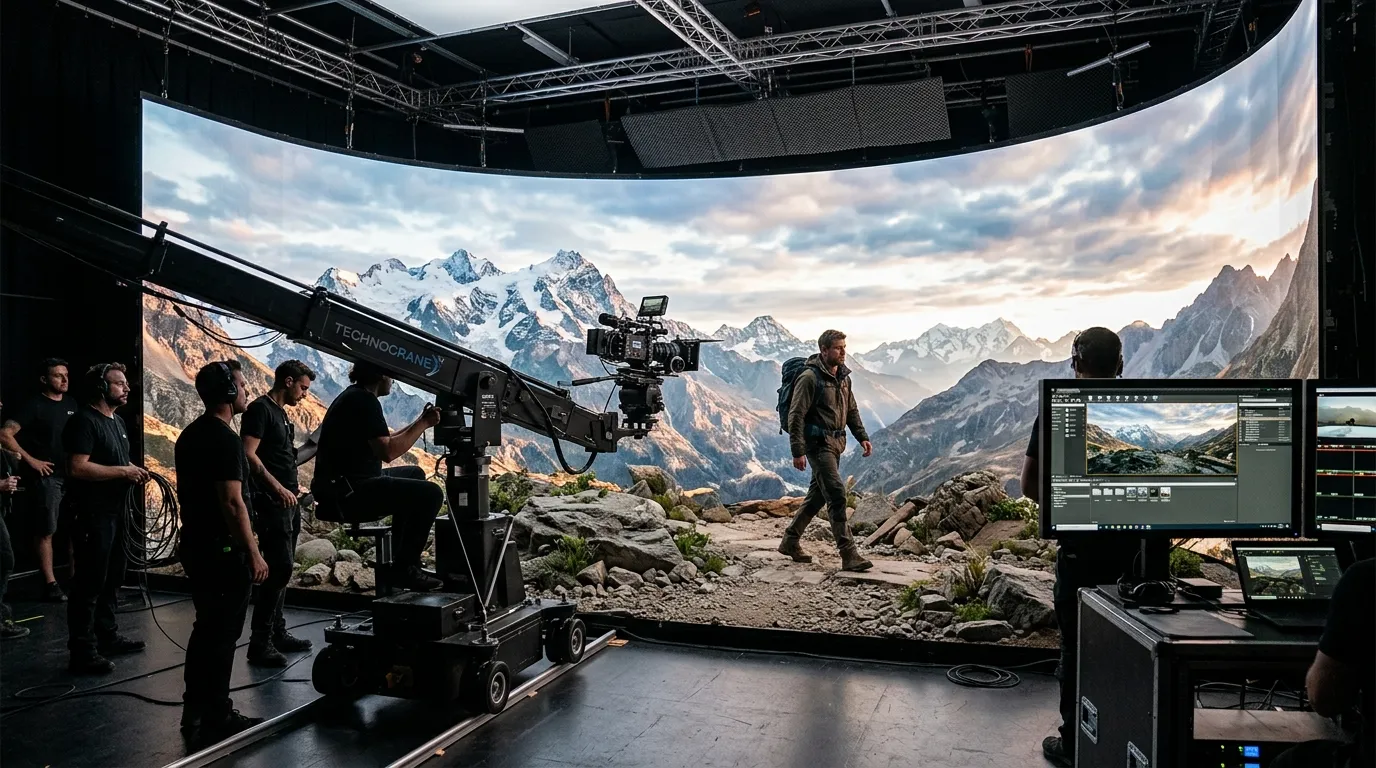
The technology works by replacing physical locations or post-production VFX with photorealistic 3D environments rendered in real time on massive LED walls. Actors and products are filmed in front of these walls, which react to camera movement, update lighting dynamically, and display environments indistinguishable from location footage – during the shoot, not after it. Game engines like Unreal Engine handle the rendering. What you see on the LED wall is what ends up in the final frame.
Brands are adopting this for ad campaigns, product launches, brand films, and social content, and the reasons go beyond novelty. The practical advantages around cost, speed, and creative control are so real that virtual production is moving from a technique associated with major Hollywood productions toward something mid-tier and even smaller brand productions are starting to use.
This piece covers what the technology actually offers, where the costs and trade-offs sit, and where it’s heading.
Understanding Traditional Production vs. Virtual Production
The traditional path to shooting in a specific environment involves a list of logistics, each with their own cost.
Location scouting takes time. Permits take time. Travel and accommodation for crew add up fast for anything outside a home market. Physical set builds for environments that don’t exist in the real world are expensive and inflexible. Once built, they’re expensive to modify. And for anything requiring VFX environments, the work doesn’t even start until post, which means weeks or months between the shoot and knowing whether what you captured actually works with the environment you planned.
Green screen addressed some of this but created its own problems. Lighting a subject correctly for a background that doesn’t exist yet requires experience and guesswork. Reflections, shadows, and the natural interaction between subject and environment are hard to replicate. Results vary, and the variance shows.
Virtual production brings the environment into the room. The 3D world is built in the game engine before the shoot. On the day, the director can see the final composite in real time. If the environment isn’t working, it gets changed on set, not flagged six weeks later in post. Camera tracking means the LED wall perspective adjusts as the camera moves, producing the depth and parallax that makes virtual backgrounds appear as physical space rather than flat imagery behind the subject.
How Real-Time Virtual Production Accelerates Brand Content Creation
The speed advantage comes from a few different directions.
Real-time rendering means creative decisions that previously required post-production review can be made on set. A director who wants to see how a different time of day looks in the environment changes it immediately. A product that needs to be shown in multiple settings can be shot against different virtual environments in the same day. Without multiple locations or multiple shoot dates. Lighting in the physical space responds to the LED content, which means the practical lighting on the subject matches the virtual environment automatically rather than needing to be rebuilt from scratch for each setup.
For brand campaigns that need multiple executions – different markets, different seasonal versions, different product configurations – that flexibility is significant. What previously required separate shoots becomes a single production day with variations handled digitally.
Post-production timelines compress substantially when VFX work has already been done before the shoot rather than after it. Industry estimates for VFX time savings from virtual production workflows typically run between fifty and seventy percent for projects where environment creation would otherwise be the main post-production task. For campaigns with fixed launch dates, this compression makes timelines achievable.
Reshoots are a real cost in traditional production. When the environment or VFX work in post doesn’t match the creative vision, going back means reassembling crew, talent, and location. In a virtual production workflow, the equivalent change happens in the engine before the next shoot day or during the shoot itself.
Key Benefits of Virtual Production for Brands
The cost structure is different from traditional production rather than simply cheaper, which is worth noting.
Upfront costs are higher in some areas – LED stage rental, 3D environment creation, technical crew with game engine expertise. These are real line items. But they remove tons from the budget: location travel, physical set construction, the VFX work that would otherwise happen in post, and the reshoot risk.
The creative freedom argument is the more compelling one for many brands. Environments that are physically impossible or prohibitively expensive to access become straightforward production decisions. A product shown against a photorealistic cityscape that doesn’t exist yet. A campaign that needs the same subject filmed against ten different environments can do it in a single day. These are genuine expansions of what’s creatively possible within a given budget.
Digital asset reuse is a longer-term advantage that compounds. A 3D environment built for one campaign doesn’t disappear after the shoot. It can be modified and reused for subsequent campaigns, with the amortised cost of the original build dropping across each use. For brands with ongoing content needs in consistent visual worlds, that’s a massive plus.
Core Technologies Powering Virtual Production in 2026
The LED volume is the most visible component, but it’s one part of a system.
LED walls have improved significantly in pixel density and brightness, to the point where the camera can’t distinguish between the physical environment and the LED display at normal shooting distances. The walls are typically curved to wrap around the shooting space, which reduces the edge-of-frame problems that flat screens create and allows wider camera movements.
Unreal Engine is the dominant game engine in production virtual environments, though others are in use. What matters about game engines in this context is that they render complex 3D scenes in real time at frame rates fast enough to work with camera shutters – a technical requirement that only became reliably achievable relatively recently. The photorealism of the output has developed to the point where distinguishing virtual from practical photography requires deliberate effort.
Camera tracking is what makes the parallax effect work. Sensors on the camera communicate position and movement to the engine in real time. This adjusts the perspective of the virtual environment accordingly. Without this, the LED background would look like a flat image regardless of how good the rendering is. With it, depth and space read convincingly as the camera moves.
AI-assisted color grading sits alongside all of this in post. It handles the finishing work on footage that arrives from the shoot much closer to complete than traditional production delivers.
Virtual Production Applications for Different Brand Content Types
The technology adapts to formats in ways that make it genuinely useful across a range of production types.
Commercial ad films are the most obvious application. A single shoot day can produce footage for multiple campaign executions with different environments, lighting moods, and product contexts. For seasonal campaigns or product variants, the efficiency gain is significant.
Product demos benefit from the ability to show products in environments that don’t exist. A consumer electronics product in a photorealistic architectural space designed specifically to complement the product’s design language. A vehicle shown in landscapes built to match the brief exactly. The environment becomes an extension of the product presentation rather than a neutral backdrop.
Brand films are where video storytelling through virtual production becomes most interesting. Emotional narratives that need specific visual worlds – particular light, particular scale, particular atmosphere – can be planned and executed precisely rather than approximated through “good enough” locations or expensive post-production work.
Social content production is moving in this direction partly because the iteration speed suits the format. Multiple visual styles for different platforms, different versions for different audience segments, rapid adaptation when campaign direction shifts – virtual production handles volume and variation in ways that traditional production doesn’t.
Cost and ROI Considerations for Brands Adopting Virtual Production
The ROI case is strongest for brands producing content at regular volume where the digital assets built for one project carry value into the next.
A one-off brand film is a harder case to make purely on cost grounds. LED stage rental, Unreal Engine artists, technical crew with specific expertise, and 3D environment creation all add much more to the day than a straightforward location shoot. For a single project, that premium may not justify the reduction in post-production budget.
For brands running quarterly campaigns, seasonal content refreshes, or ongoing product marketing, the calculus changes. Reusable digital environments and assets mean the effective cost of each subsequent use is lower. Faster post-production timelines mean campaign launches don’t slip. The ability to test multiple creative directions in a single shoot day reduces the cost of making a wrong call.
Starting with hybrid workflows is practical advice for brands exploring this. Using virtual production for specific shots or sequences within a larger production, rather than committing fully to an LED stage workflow from the outset, lets teams build familiarity with the technology and its constraints before it becomes the primary production method.
Virtual Production Workflows for In-House Teams vs. Agencies
How a brand accesses virtual production depends on volume, budget, and how central it becomes to ongoing content strategy.
In-house capability makes sense for brands producing enough content to justify the investment in game engine expertise, 3D artists, and either LED stage access or ownership. It requires building a technical team that sits alongside the creative team, and the ramp-up time is real. But for brands where virtual production becomes a core content channel, the control and efficiency of in-house capability has clear advantages.
Agency partnerships are the more common starting point. Production companies that specialise in virtual production bring the technical infrastructure, the expertise, and the LED stage access without the brand needing to build any of it internally. For episodic campaigns and high-end brand films, this is often the most practical route. The corporate video production services landscape has developed significantly in this direction as more production companies invest in virtual production capability.
Hybrid models are increasingly common – in-house teams handling social content and quick-turn iterations using more accessible virtual production tools, while agencies manage the complex LED volume work for flagship campaigns.
Future Trends: What Virtual Production Will Look Like by 2030
The direction is toward more accessible, more AI-integrated, and more connected to the rest of the production and post workflow.
LED volume costs are coming down as the technology matures and more stages open. What currently requires a significant budget commitment is moving toward something mid-tier productions can access as standard. Smaller, more modular LED setups are making the technology viable for productions that couldn’t justify a full volume stage.
Real-time ray tracing – the rendering technique that produces the most photorealistic lighting and reflection behaviour – is improving in performance to the point where it’s becoming practical for live production use rather than just offline rendering. The visual quality ceiling is rising.
AI-generated 3D assets and environments are developing alongside the production technology. Text-to-environment generation, where a production designer describes a space and the game engine produces a draft 3D environment automatically, is moving from early capability toward something viable. AI camera angle suggestions and automated lighting setups are reducing the specialised technical knowledge required to operate these workflows. The latest video editing trends show how thoroughly AI is becoming embedded across every production stage, and virtual production is no exception.
Cloud-based rendering is making remote collaboration on virtual production sets more practical. Teams in different locations working on the same virtual environment in real time is a workflow that’s available now in limited form and developing quickly.
Conclusion: Embracing Virtual Production for Your Brand’s Future
Virtual production is not a niche technology for major studio productions anymore. The tools are more accessible, the expertise is more widely available, and the cost-benefit case is increasingly clear for brands producing content at meaningful volume.
What it offers is creative freedom unconstrained by practical location limits, production speed that compresses timelines, and a reusable asset base that becomes more valuable over time.
Understanding how virtual production fits into a broader brand video funnel is the strategic question worth working through.
The goal is still the same one it always was: corporate videos that connect with audiences in ways that matter to the brand. Virtual production is a faster, more flexible path to that outcome for the brands willing to learn it.
Curious what virtual production could do for your next campaign? Kween Media works with brands on production strategies that match ambition to budget. Reach out to explore your options!.