
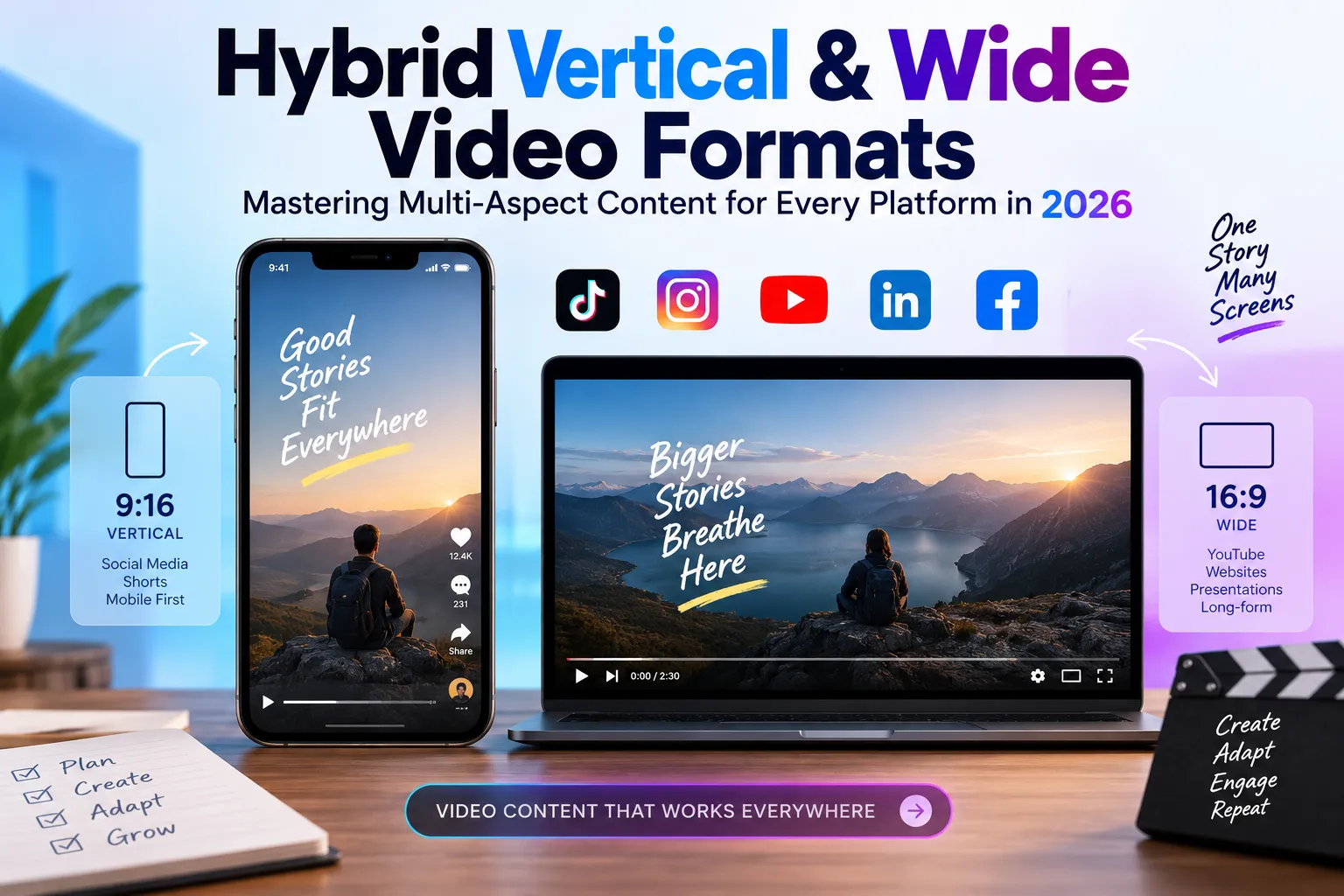
A brand shoots a product video. Looks great on YouTube. Then someone posts it to Instagram Reels and the subject’s head gets cropped out. This is still how a lot of video production works. One format, multiple problems. Hybrid video production with hybrid vertical & wide formats is the fix.
The idea is straightforward: plan every shoot so the footage can be safely reframed for different aspect ratios without losing what makes the shot work. One master asset, platform-ready outputs for everywhere it needs to go. Widescreen for YouTube and websites. Vertical for Reels, Shorts, and TikTok. Square or portrait for LinkedIn and paid ads.
The efficiency argument is obvious. The quality argument is what most brands miss – content that’s been planned for multi-aspect delivery looks better on every platform than content that’s been forced into a format it wasn’t designed for.
What Are Hybrid Vertical & Wide Video Formats?
Every screen a viewer uses has a different shape, and platforms have built their content experiences around those shapes.
Vertical (9:16) is the native format for mobile-first platforms – TikTok, Instagram Reels, YouTube Shorts. Landscape (16:9) is the standard for YouTube long-form, websites, presentations, and broadcast. Square (1:1) performs well in social feeds where it takes up more screen space than landscape. Portrait (4:5) sits between square and vertical – taller than square, narrower than 9:16 – and works particularly well for Instagram feed posts.
Hybrid production doesn’t mean shooting four separate videos. It means framing shots so the critical visual information – faces, products, text, action – sits in a safe zone that survives being reframed for any of these destinations. The camera operator and director make this decision before pressing record, not in the edit suite. Video production services built around hybrid workflows bake this thinking into the production brief from day one.
Why Multi-Aspect Content Is Becoming the Industry Standard
Five years ago, a brand could get away with a single 16:9 master and call it done.
That’s not where audiences are anymore. Mobile viewing dominates consumption across most demographics. Smart TVs are pulling viewers back to large screens for long-form content. Corporate presentations, conference screens, website hero videos, paid advertising across multiple placements – each context has its own format preference, and each performs measurably better when the content fits natively rather than being adapted after the fact.
Google recommends supplying multiple creative ratios for YouTube campaigns specifically because 16:9, 9:16, and 1:1 assets together achieve broader reach than any single format alone. Platform algorithms also reward native-format content. A vertical video uploaded natively to Reels performs differently from a landscape video with black bars added to fill the frame. The platform knows the difference, and so does the viewer.
Corporate video strategy that ignores aspect ratio planning isn’t really multi-platform strategy. It’s one platform strategy with degraded repurposing bolted on.
Planning Your Shoot in Hybrid Vertical and Wide Video Formats for Multiple Aspect Ratios
The decisions that determine multi-aspect success happen before the camera rolls.
When shooting in hybrid vertical and wide video formats, safe zones are the starting point. The area that survives all target reframes – typically a centre-weighted rectangle that sits comfortably within both 9:16 and 16:9 crops – defines where the important visual information must live. Faces, products, key text overlays, branded elements: all of it needs to sit inside that safe area. Anything outside it may get cropped depending on the output format.
Headroom is the next consideration. Vertical formats need more space above the subject than landscape compositions typically allow. Shooting with generous headroom gives the reframe somewhere to go without the subject appearing to float in the bottom third of the frame.
Camera movement requires particular care. A pan that works beautifully in 16:9 can exit the safe zone entirely when reframed to 9:16. Shot composition planned with movement across multiple aspect ratios in mind uses slower, more centred movement that survives cropping. Choosing camera lenses also changes in a hybrid workflow – wider lenses give more flexibility for reframing, though they require more attention to background and edge-of-frame elements.
Text and graphic placement is where brands most consistently fail. Lower thirds that sit comfortably in 16:9 disappear below the crop line in 9:16. Plan text placement for the most restrictive format first, then confirm it works in the others.
AI Is Transforming Multi-Aspect Video Editing
Manual reframing used to mean an editor watching every cut and repositioning the crop frame shot by shot.
AI subject tracking has changed that significantly. Modern tools follow the primary subject automatically as they move through the frame, maintaining correct positioning across the reframe without frame-by-frame manual intervention. For talking head content and interviews, this works reliably well. For complex multi-subject scenes or fast movement, human review still catches what automation misses.
Scene expansion – sometimes called outpainting – goes further. Rather than cropping a landscape shot to vertical, it generates new visual content to fill the expanded frame. A 16:9 interview shot can become a 9:16 clip with AI-generated background on either side. The results have improved considerably and are viable for many production contexts, though they require quality checking rather than blind trust.
Smart captions and automated platform exports reduce the post-production tail considerably. AI-assisted color grading applied consistently across all format outputs keeps the visual treatment coherent regardless of aspect ratio. Generative AI in storyboarding helps plan the safe zone logic before the shoot, visualising how compositions will translate across formats.
AI speeds up the execution. It doesn’t replace the thinking that has to happen first.
Platform Guide: Best Aspect Ratios for Every Channel
| Platform | Best Ratio |
| Instagram Reels | 9:16 |
| TikTok | 9:16 |
| YouTube Shorts | 9:16 |
| YouTube | 16:9 |
| LinkedIn Feed | 1:1 / 16:9 |
| Website | 16:9 |
| Corporate Presentations | 16:9 |
| Paid Ads | 9:16, 1:1, 16:9 |
A few things worth knowing beyond the table.
LinkedIn is the format that catches brands out most often. The platform displays 16:9 and 1:1 content differently in the feed – square takes up more space and tends to perform better for awareness content. For thought leadership and longer-form video, 16:9 works better. The right choice depends on the content type, not just the platform.
Paid advertising across Google and Meta placements benefits from supplying all three primary ratios. The platform serves whichever format fits the placement. Supplying only one format means the platform adapts it, which consistently underperforms native assets.
Hero Hub Help video strategy maps content types to platforms – understanding which content goes where makes the aspect ratio decisions follow naturally rather than being made ad hoc.
Common Mistakes Brands Make With Hybrid Vertical and Wide Video Formats
Shooting too tight is the most common production mistake in multi-aspect workflows.
A close-up that fills the 16:9 frame leaves nothing to work with when reframing to 9:16. Faces get cut. Products disappear. The reframe either looks wrong or requires the editor to use a wider take that wasn’t intended as the hero shot. The fix is consistent: shoot wider than the tightest intended output requires.
Ignoring safe areas during graphics and text production is the post-production equivalent. A lower third designed at 16:9 that sits low in the frame will be cropped in vertical formats. All text, logos, and branded graphics need to be placed with the most restrictive target format in mind.
Exporting only one format and relying on the platform to adapt it costs reach and performance. The platforms don’t do this well. They do it adequately. There’s a consistent performance gap between native assets and adapted ones across every major platform.
Pacing in video editing also changes across formats. Vertical content for mobile consumption is cut faster than landscape content for desktop or TV viewing. Applying the same edit across all formats misses how the viewing context affects what pacing feels appropriate. Enhancing video aesthetics for each format – thumbnail design, colour treatment, caption styling – is the detail layer that separates professional multi-aspect output from the rushed version.
Future of Hybrid Content Production
The production tools are getting smarter about format adaptation, and the gap between what can be automated and what requires human judgment is narrowing.
AI-generated reframing that accounts for narrative context – understanding which subject in a multi-person shot is the focus at any given moment – is developing beyond basic subject tracking. Outputs are becoming reliable enough for review-and-approve workflows rather than frame-by-frame correction.
Real-time virtual production changes the multi-aspect equation for brands using LED volumes and game engine environments. Virtual sets can be rendered in any aspect ratio simultaneously, eliminating the reframing problem at the capture stage. The camera sees 9:16. Another output sees 16:9. Both are generated from the same virtual environment in real time.
Interactive video content adds another dimension to the format consideration. Interactive elements – hotspots, choice buttons, navigation menus – need to be positioned with aspect ratio in mind just as much as any other visual element. A clickable hotspot that’s accessible in 16:9 needs to be reachable in the 9:16 version too.
Dynamic content personalisation will eventually mean the format question gets answered at the delivery stage rather than in production. The system knows the viewer’s device and serves the right format automatically. That future is closer than it sounds.
Conclusion: One Shoot, Unlimited Possibilities
The brands wasting budget on separate shoots for separate platforms are solving a problem that good pre-production eliminates.
Plan the safe zones. Brief the director on multi-aspect framing. Place text and graphics for the most restrictive format. Shoot with generous headroom and controlled movement. Then let the edit and AI tools handle the adaptation, with human review before anything goes live.
One production. Platform-ready outputs for every screen. Consistent brand identity across all of them.
Corporate video production services built around hybrid workflows cost less per platform than producing separately and look better on every one of them.
Producing content for multiple platforms and tired of reformatting the same video? Kween Media plans and shoots for every screen from day one. Let’s connect.