
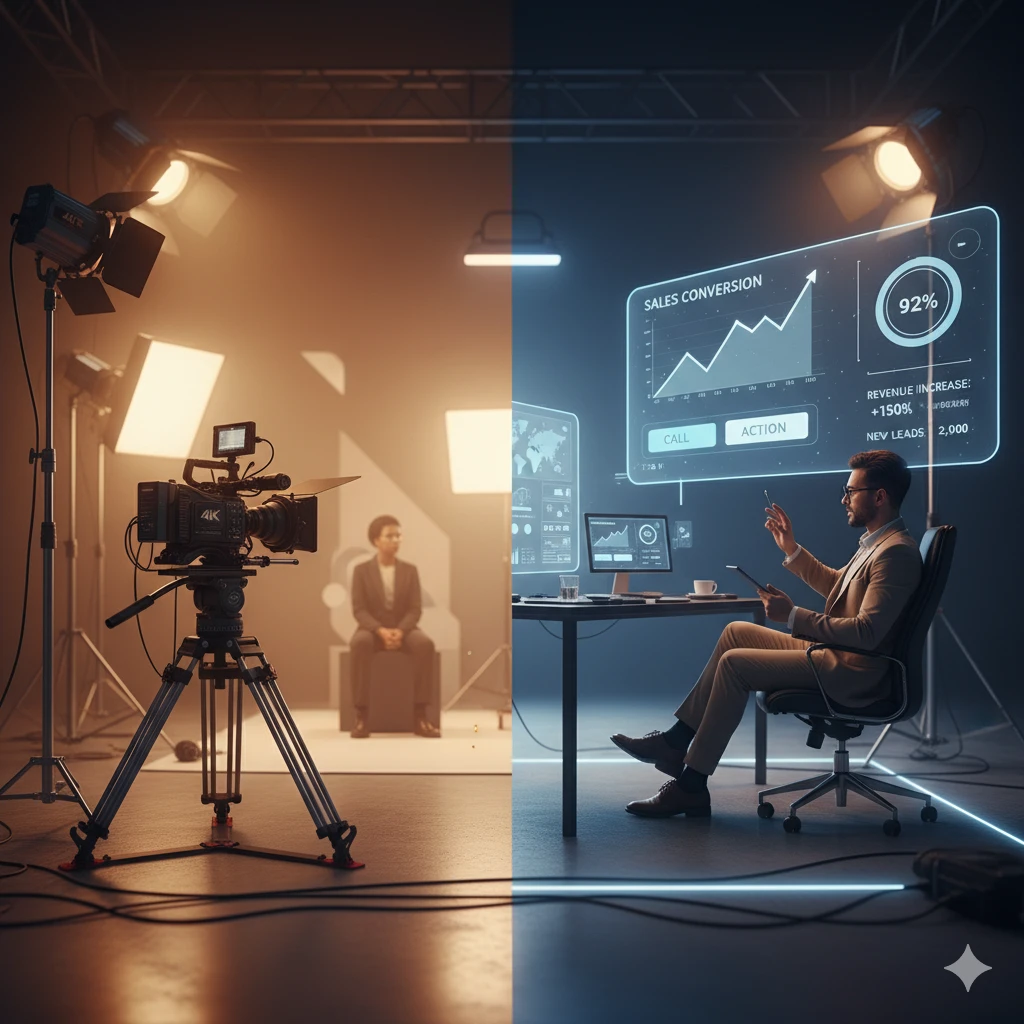
Most marketing teams treat video as a creative exercise. The real question isn’t “Did we make something beautiful?” It’s “Did this move the revenue number?”. Commercial video production that drives sales looks fundamentally different from commercial video production that wins creative awards. Beautiful videos that don’t convert waste budget. Strategically crafted videos that drive measurable results justify investment.
The data makes this clear: Wyzowl’s 2024 research shows 88% of people say they’ve been convinced to buy a product or service by watching a brand’s video. More telling, 78% of marketers say video directly increased sales. Not brand awareness or engagement metrics, actual revenue impact.
This guide focuses on what actually drives conversions: strategic choices in commercial video production that move viewers from awareness to action. Whether working with a commercial video production company or building in-house capability, understanding these principles determines whether video becomes a sales driver or just another content expense.
The Power of Commercial Videos in Driving Brand Sales
Commercial videos work because they compress decision-making time. A 60-second video communicates what would take 3000 words of copy and multiple images to convey. More importantly, it triggers emotional responses that text rarely achieves.
How commercial videos increase brand sales comes down to three mechanisms: they establish emotional connection faster than other formats, they demonstrate product value more clearly than description alone, and they reduce purchase friction by answering questions before they’re asked.
The benefits of using commercial videos for marketing show up across the funnel. Awareness-stage videos introducing brand values see 1200% more shares than text and images combined. Consideration-stage videos showing product use cases reduce sales cycle length by 22%. Decision-stage videos addressing common objections can lift conversion rates by 80% or more.
But effectiveness depends on execution. Commercial storytelling videos for brands that try to do everything, build awareness AND demonstrate features AND close the sale, typically accomplish none of these goals. The videos that drive results focus on one conversion objective per piece.
Statistical proof matters. Videos that include customer testimonials convert 25% better than those showing only product features. Videos demonstrating specific use cases convert 34% better than generic brand messaging. Videos with clear CTAs convert 380% better than videos relying on brand awareness alone.
Exploring Different Types of Commercial Videos That Drive Sales
Not all commercial videos serve the same business function. Choosing the wrong format for your conversion goal guarantees underperformance.
- Brand awareness videos sit at the top of the funnel, introducing your company to audiences who might not know you exist. Creative brand videos at this stage prioritize emotional connection over feature communication. They create recognition that makes subsequent marketing more effective, someone who’s seen your brand video is 3x more likely to engage with retargeting ads. Weakness: they rarely drive immediate sales.
- Product-focused videos serve the middle of the funnel, showing what your product actually does and who it helps. Product video production services focus on demonstration over emotion. They reduce support burden by answering common questions before purchase and shorten sales cycles. Weakness: they feel dry if not executed well. The best product videos embed demonstrations within story structure.
- Corporate commercial videos target B2B buyers making committee-based decisions where trust in the company matters as much as product capability. Corporate videos that drive ROI and engagement typically feature leadership, showcase facilities, or document company culture. They reduce perceived risk for high-consideration purchases. Weakness: they rarely work for B2C audiences who care more about product outcomes than corporate structure.
Format matters as much as content type. Short-form videos (under 60 seconds) work for social platforms where attention is limited. Longer-form videos (2-5 minutes) suit consideration-stage prospects ready to invest time learning about solutions. The brands seeing best results use sequenced video series, someone who watches your awareness video sees retargeting with a product demo, then customer testimonials. Each video moves them one step closer to purchase.
Strategic Approaches to Crafting Commercial Videos That Convert Viewers into Customers
Video production quality matters less than strategic alignment with conversion goals.
Commercial video production strategies for businesses start with defining exactly what action you want viewers to take. Not vague goals like “increase engagement”, specific actions like “click to trial,” “request demo,” or “add to cart.” This specificity shapes every production decision.
- CTAs that actually work: The weakest videos end with generic “learn more” CTAs. The strongest end with specific, benefit-driven calls-to-action tied directly to content viewers just watched.
Weak: “Visit our website to learn more.” Strong: “Click below to see if you qualify for the same results Sarah achieved.”
The difference: specificity about what happens next and connection to the story just told. ROI-driven video campaigns consistently show that CTAs referencing video content convert 3x better than generic CTAs. CTA placement matters too, mid-roll CTAs appearing at natural transition points capture the 35-40% of viewers who drop off before the final frame.
- Aligning production with marketing goals: Crafting videos that convert viewers into customers requires matching production complexity to conversion value. A product with $50 average order value can’t justify $50,000 commercial production. But enterprise software with $100,000 annual contracts absolutely can. Calculate customer lifetime value, estimate realistic conversion rates, and work backward to appropriate production budgets.
- Measuring and optimizing: The videos driving best sales results rarely achieve that performance on the first version. Track watch-through rate by segment (where do people drop off?), click-through rate on CTAs (are people taking action?), and conversion rate from click to outcome (does traffic actually convert?). If 60% drop off at 30 seconds, your hook isn’t strong enough. If viewers watch fully but don’t click, the CTA isn’t compelling. This data reveals what needs fixing.
Navigating the Commercial Video Production Workflow
The production process determines whether final output serves business goals or just satisfies creative preferences. Working with professional commercial video makers starts with alignment on conversion objectives before discussing creative concepts.
- Concept development should skip brainstorming “what would be cool to make?” and start with: what specific action do we need viewers to take, what barriers prevent that action, and what information would remove those barriers? This constraint focuses creativity toward effectiveness.
- Scriptwriting for videos that drive sales follows a specific structure: establish the problem viewers recognize, present your solution as the obvious answer, demonstrate credible proof it works, and close with a specific next step. Business video production companies with track records will challenge any script elements that don’t serve conversion.
- Production execution requires filtering every creative impulse through conversion impact. Does this choice make the desired action more or less clear? Production value matters only insofar as it supports conversion goals.
- Editing and optimization isn’t just making footage look good. It’s testing different versions, different hooks, CTA placements, proof points emphasized. A/B test versions with small audiences before committing marketing spend. The ad film production approach many follow emphasizes polish over performance. Smarter approach: find what drives results, then polish that.
Integrating Video Production Within a Comprehensive Marketing Strategy
Commercial video works best as part of an integrated system, not standalone content. Integrating video production with marketing strategy means planning a video’s role before production begins, where in the customer journey does it appear, what channels will distribute it, what content comes before and after it?
Video marketing for brands fails most often at distribution. Companies invest in production, post once to YouTube, and wonder why views disappoint. Strategic distribution requires matching video format and content to platform requirements.
- Platform-specific optimization: YouTube audiences tolerate longer educational content. Instagram and TikTok demand hook-driven short content optimized for silent viewing with captions. LinkedIn responds to thought leadership. Video production services that understand these differences create versions optimized for each environment rather than forcing single videos across all channels.
- Sequenced nurture campaigns: The most sophisticated strategies use sequential targeting. Someone who watches 75% of your awareness video gets retargeted with a product demonstration. Someone who watches the demo gets testimonials. This sequencing mimics sales conversations, progressive information based on engagement level.
- Integration with other marketing assets: Video amplifies every other channel when strategically integrated. Email campaigns with video thumbnails see 200-300% higher click rates. Landing pages with video convert 86% better. Social ads with video outperform static image ads by 20-30% on cost per conversion. But integration requires alignment, video messages should match email copy, landing pages, and sales talking points.
Choosing the Right Partner: Selecting a Reliable Commercial Video Production Company
Production partner selection matters more than most companies realize. Every commercial video production company has a showreel highlighting creative work. That matters less than evidence they understand marketing performance.
Ask: Can they show examples where video directly impacted sales metrics? Do they discuss conversion goals before creative concepts? Do they recommend testing approaches? Do they understand platform-specific optimization?
Questions that reveal capability:
- How do you measure success for commercial videos?
- Can you show videos that drove measurable business results?
- What’s your process for aligning content with conversion goals?
- How do you handle underperforming videos, optimization or just delivery?
Answers reveal whether they focus on business outcomes or creative output. Be skeptical of partners promising high-end production at discount rates or unrealistic timelines. Work backward from customer value. If converting 100 customers generates $500,000 in revenue, spending $50,000 on video production makes economic sense. Let the math drive budget decisions.
Choose partners interested in performance data and willing to optimize based on results. Video that drives sales rarely achieves peak performance on first version. Partners committed to success will refine based on what actually works.
From Views to Revenue — The Real Finish Line
Commercial video production that drives modern brand sales starts with a fundamental mindset shift: video isn’t a creative deliverable, it’s a conversion tool.
This doesn’t mean videos should be boring. It means every creative decision should serve moving viewers toward purchase. Beautiful cinematography that supports product demonstration? Absolutely. Beautiful cinematography that distracts from the message? Waste of budget.
The benefits of using commercial videos for marketing compound when production aligns with strategy. Videos that drive measurable results justify increased investment. Videos that look good but don’t perform eliminate future budgets.
Organizations winning with commercial video share common practices: they define conversion goals before creative concepts, test multiple versions, distribute strategically across platforms, and measure performance honestly. Most importantly, they recognize that production quality matters less than strategic alignment with business goals. A moderately produced video that drives 500 conversions outperforms a beautifully shot video that drives 50 conversions.
Investing in professional creative video concepts becomes a competitive advantage when those concepts serve conversion objectives. From concept to conversion isn’t just a process, it’s a philosophy. Every decision should trace back to one question: does this choice make the desired action more likely? Answer that honestly, and video becomes one of your highest-performing marketing investments.
Ready to turn video into your highest-converting sales asset? Partner with Kween Media and build campaigns designed to influence decisions and drive measurable revenue!