
If you’re throwing random videos into the void and hoping something sticks, we need to talk. Video marketing in 2026 isn’t about pumping out content constantly and praying the algorithm gods smile upon you. It’s gotten way more strategic than that. The brands actually winning? They’re using frameworks that make sense, not just posting because “everyone says you should post videos.” Enter the hero-hub-help video strategy. It’s not new, but the way it’s being used now is totally different from even a year ago.
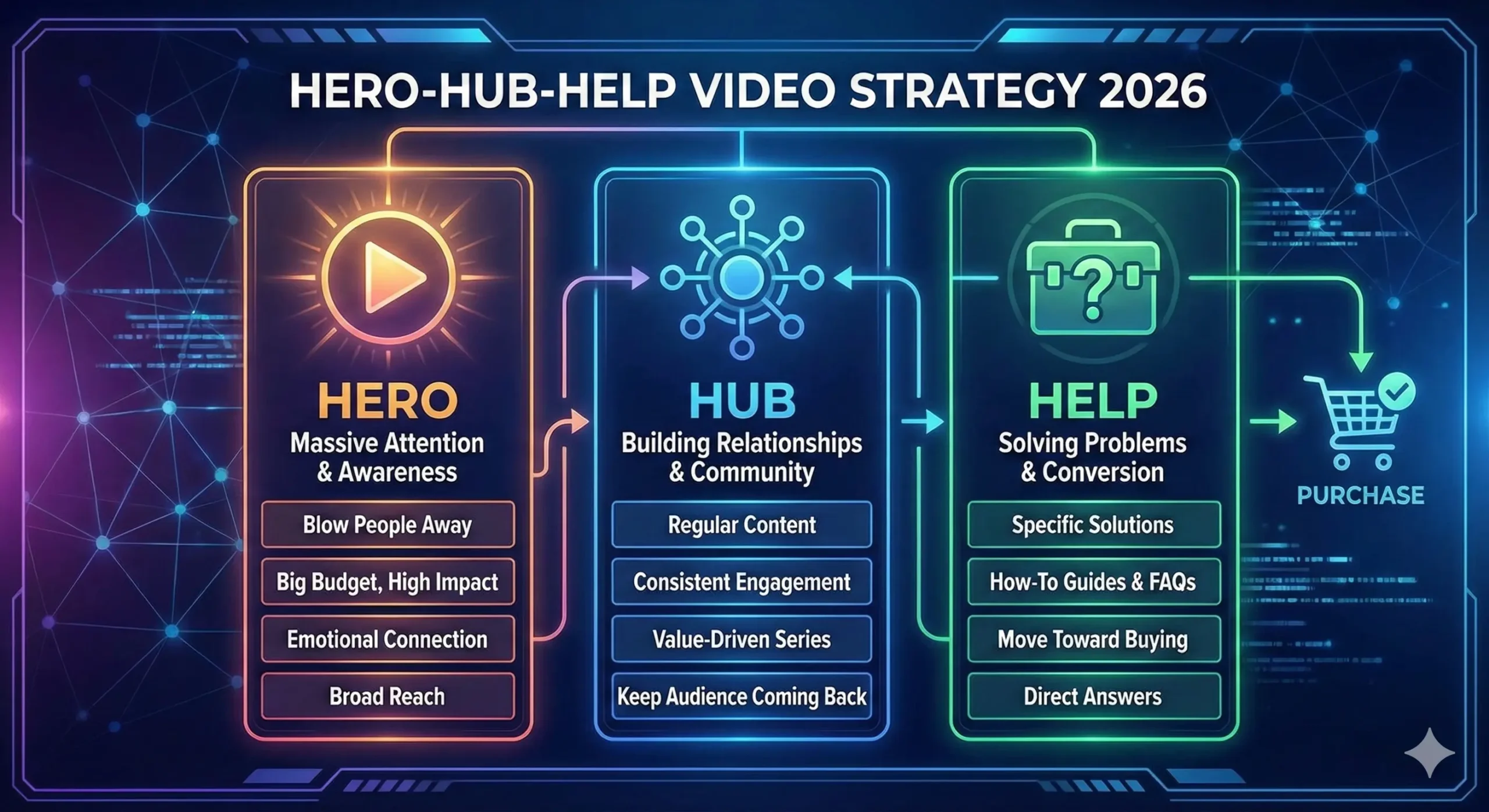
This framework basically gives every video you make a specific job to do. Some videos are there to blow people away and get massive attention (Hero). Others keep your audience coming back regularly and building that relationship (Hub). And some are just there to help people solve specific problems and move them toward buying (Help).
When you actually understand how these three types work together, your entire video strategy starts making a lot more sense. Let’s break it down.
Understanding the Hero-Hub-Help Video Strategy Framework
Think of the hero-hub-help video strategy framework like a pyramid. At the top, you’ve got your Hero content – those big, flagship videos designed for maximum impact and brand visibility. These are your World Cup commercials, your viral campaigns, the videos you pour serious budget and creativity into because they need to make waves.
Hero content is all about awareness. Getting your brand in front of as many eyeballs as possible and making sure those eyeballs remember you. Think major product launches, brand films, or those emotionally charged campaigns that get shared everywhere.
Then you’ve got Hub content in the middle. This is your bread and butter – episodic, regular videos that keep your audience engaged over time. Think weekly series, consistent content drops, behind-the-scenes looks. Hub content builds the relationship. It’s where trust happens because people keep coming back and seeing you show up consistently.
Brand storytelling videos work incredibly well as Hub content because they create ongoing narratives people want to follow.
At the base, there’s Help content. These are your practical, educational videos that answer specific questions and solve real problems. Tutorials, how-tos, FAQs, product demos. Help content targets people already searching for solutions, which means they’re closer to actually buying something.
Each tier plays a different role in your content funnel. Hero gets attention, Hub builds relationships, Help drives conversions. When they work together, you’ve got a complete video content ecosystem that covers the entire customer journey. That’s the hero-hub-help video strategy in a nutshell.
The Role of Hero-Hub-Help Video Content Strategy in Business Growth for 2026
Here’s where a lot of brands mess up – they create videos without connecting them to actual business goals.
A solid corporate video strategy ties everything back to what you’re trying to achieve. Are you trying to increase brand awareness? Build a loyal community? Drive more sales? Your video strategy should directly support those objectives.
The beauty of the Hero–Hub–Help video strategy is that it naturally creates a full-funnel approach. Your Hero content brings people in at the top, Hub content nurtures them through the middle, and Help content converts them at the bottom.
It’s about creating a cohesive system where every piece of content has a purpose and feeds into your long-term growth strategy. When you plan your video marketing this way, you’re building a growth engine.
The brands seeing real results in 2026 aren’t the ones posting the most. They’re the ones posting strategically, with each video serving a specific function in their overall business strategy.
Adapting the Hero-Hub-Help Model to Short-Form Video Trends in 2026
Let’s be real – short-form video absolutely dominates right now. TikTok, Instagram Reels, YouTube Shorts – if your video is longer than 60 seconds, you better have a really good reason.
The challenge is adapting the Hero–Hub–Help video strategy to these quick-hit formats. Good news? It totally works, you just need to rethink how you execute.
Your first three seconds are everything. And I mean everything. If you don’t hook someone immediately – through shock, empathy, insight, or pure curiosity – they’re gone. The scroll continues and you’ve lost them.
Even in 30-second videos, you can tell a complete story using a three-act structure. Setup, conflict, resolution – it’s just compressed. A good Hero video might show a stunning visual that makes people stop scrolling. Hub content could be a quick tip or insight that provides value in under a minute. Help videos? Micro-tutorials that solve one specific problem fast.
Platform-Specific Content Tailoring and Production Efficiency
You know what I see all the time? Brands shoot one video and then just… post it everywhere. Same video, same format, LinkedIn to TikTok to Instagram. No changes.
That’s honestly just lazy. And trust me, your audience notices.
Each platform has its own thing going on. LinkedIn people want professional insights and thought leadership. TikTok? They’re there for quick entertainment and authenticity. Instagram sits somewhere in between. Trying to use the exact same video across all of them is like wearing a tuxedo to the beach – technically you’re dressed, but you’re completely missing the vibe.
Now, does this mean you need to film completely different content for every single platform? No way. That would be exhausting and expensive. This is where getting smart about production actually saves you.
Batch shooting changes everything. Set aside one day, film a bunch of stuff in one go, but think about it differently while you’re shooting. Get that long-form interview that’ll work as Hero content. But also grab some quick 15-second soundbites from the same conversation for Hub content. Shoot wide, shoot tight, get different angles. You’re creating options without multiplying your shoot days.
Templates are the other game changer. Build editing templates for each content type – one for your weekly Hub videos, one for Help tutorials, whatever you need. This way you’re not reinventing the wheel every single time you edit. Your brand stays visually consistent, but your editor isn’t starting from a blank timeline each time. That speeds things up massively.
Corporate videography that’s efficient doesn’t mean cutting corners on quality. It means working smarter so you can maintain high production standards without burning out your team or budget.
The goal is customization without sacrificing efficiency. Understand each platform’s unique requirements, but build production systems that let you serve multiple platforms without quadrupling your workload.
Leveraging Data Analytics to Optimize Video Storytelling and Conversion
If you’re not looking at your video analytics, you’re basically flying blind.
The data tells you everything – what’s working, what’s flopping, where people are losing interest, which videos actually drive action. Retention rates show you the exact second viewers drop off. Watch time tells you if people are actually consuming your content or just clicking away. Shares and saves indicate whether your content resonated enough for people to want to revisit or show others.
This is actionable intelligence that should shape your entire content strategy.
Notice that people drop off at the 15-second mark consistently? Your hooks aren’t strong enough. Seeing high watch time but low conversions? Your CTAs probably need work. Getting lots of views but minimal engagement? The content might not be resonating emotionally.
The really sophisticated approach is integrating video engagement data with your CRM systems. When you know exactly which videos someone watched before converting, you can optimize your content funnel and create better retargeting campaigns. You can even score leads based on their video engagement – someone who watched three Help videos is probably more qualified than someone who only saw one Hero video.
Data-driven storytelling is about using these insights to make your creative work even more effective.
Emphasizing Authenticity and Human Connection in Video Content
Here’s something interesting happening in 2026 – people are getting tired of overly polished, perfect content.
The videos that actually connect feel real. Slightly imperfect. Human.
This is especially true for Hub content where you’re building ongoing relationships. People don’t want to feel like they’re watching an ad every time. They want to see the humans behind the brand.
Featuring real employees or actual customers in your videos builds trust way more effectively than hired actors reading scripts. Behind-the-scenes content that shows how your company actually operates? That authenticity resonates in ways perfectly scripted content just can’t match.
Corporate videos that connect prioritize genuine connection over slick production. Don’t get me wrong – production quality still matters. But authenticity matters more.
This is where authority-building happens too. When subject matter experts from your team share their knowledge in a natural, conversational way, it positions your brand as trustworthy and knowledgeable. That’s way more powerful than generic marketing speak.
The shift is from “look how amazing we are” to “here’s who we actually are, and here’s how we can help you.” That second approach wins every time.
Incorporating AI Tools While Preserving Human Empathy in Storytelling
AI is changing video production in 2026 – it’s automating the tedious stuff so humans can focus on the creative and strategic work that actually matters.
Automated captions? That’s a perfect job for AI. Analyzing which emotional tones perform best with your audience? AI can crunch those numbers. Predicting which content trends might be worth jumping on? AI tools can help spot those patterns.
Personalized CTAs that change based on viewer behavior? AI can handle that dynamically. Even editing assistance that suggests cut points based on retention data – that’s where AI shines.
But where AI falls short is telling a story that genuinely connects on an emotional level. Understanding the nuanced context of your brand’s unique situation. Creating content that feels authentically human.
The winning approach combines AI’s efficiency with human empathy and creativity. The brands that figure out this balance early are going to have a serious competitive advantage.
The Future Outlook: Personalized Growth Channels Through Adaptive Video Content
We’re heading toward something pretty ground breaking in video marketing – actual viewer-level personalization at scale.
Imagine this: someone visits your website, watches a few videos, and the next video they see is dynamically generated based on their specific interests, where they are in the buying journey, even their past behavior with your brand. Not just a different CTA, but actually different content.
That’s not science fiction anymore. The technology exists and it’s getting more accessible. In 2026 and beyond, we’re shifting from broad audience targeting to genuine one-to-one communication through video.
This doesn’t mean every video needs to be completely unique. But the framework adapts in real-time. Maybe your Help content changes based on which Hub videos someone watched. Or your Hero content’s messaging shifts slightly based on how someone found your brand.
The Hero–Hub–Help video strategy actually becomes more powerful with this kind of personalization because it gives you clear content pillars to adapt and remix based on individual viewer needs.
The brands that master this combination – a solid Hero–Hub–Help foundation plus intelligent personalization – are going to build incredibly strong, lasting relationships with their audiences.
A Hero-Hub-Help Video Strategy is the Key to Brand Growth in 2026
The video marketing landscape keeps evolving, but the fundamentals of good strategy stay pretty consistent. Know what you want to achieve, understand your audience, create content that serves specific purposes, and measure what works.
The Hero–Hub–Help framework gives you a structure that makes sense and actually works in 2026’s fast-paced, short-form dominated environment. Hero content gets attention, Hub content builds relationships, Help content drives conversions – when you nail all three, you’ve got a complete system.
Add in the trends shaping this year – short-form content dominance, AI-assisted production, increased demand for authenticity, data-driven optimization, and growing personalization – and you’ve got a roadmap for actually cutting through the noise.
This isn’t about doing more. It’s about doing the right things strategically. Quality, intentional content will always beat random volume.
Whether you’re working with commercial video production teams for your Hero campaigns or creating educational brand videos for your Help content, having a clear framework makes every decision easier.
The brands thriving in 2026 aren’t the ones with the biggest budgets. They’re the ones with the clearest strategies, the most authentic voices, and the willingness to adapt as the landscape shifts.
Your audience is out there waiting for content that actually speaks to them. Give them Hero videos that grab attention, Hub videos that build trust, and Help videos that solve their problems. Do that consistently with corporate video production services that understand strategy as much as production, and you’re set up for long-term growth.
At Kween Media, we help businesses create Hero–Hub–Help content frameworks that drive real results. From big-impact Hero campaigns to consistent Hub content to conversion-focused Help videos, we’ve got the expertise to bring your vision to life. Let’s strategize your video content together.