
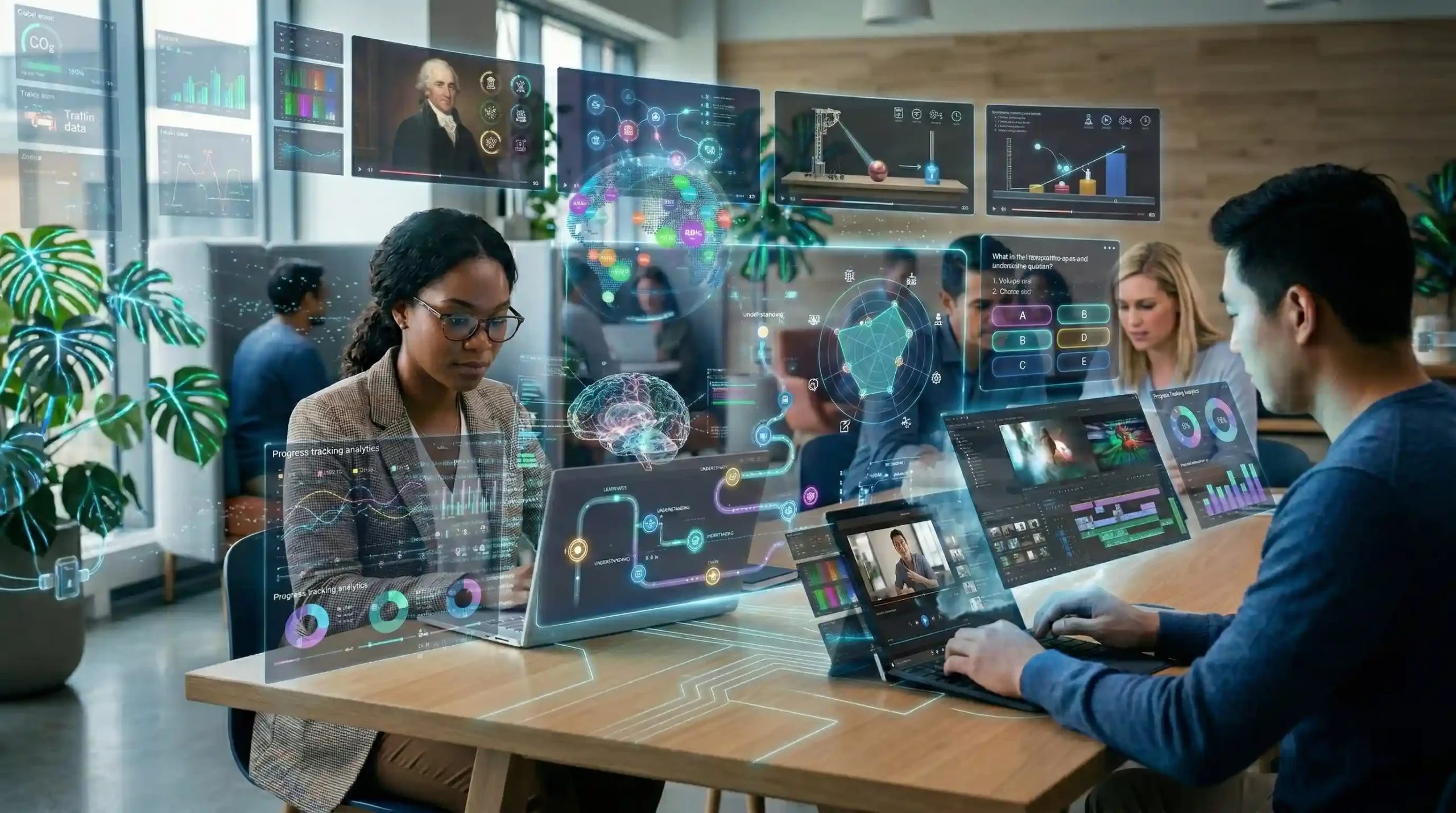
Remember sitting through those painfully long training sessions? Death by PowerPoint, someone droning on for three hours, everyone checking their phones under the table – pretending to take notes? Yeah, that’s not working anymore. Actually, it probably never worked that well to begin with. Training and e-learning videos are completely transforming how companies teach their teams. And it’s not just about digitizing the same boring content – the entire approach to corporate learning is shifting.
The businesses getting this right aren’t just uploading recordings of classroom sessions and calling it done. They’re using video strategically to create training that people actually want to engage with. Shorter formats, interactive elements, better storytelling, mobile access – all of it designed around how people actually learn, not how training departments wish they learned.
Here’s what matters – companies adopting modern video-based training see higher retention rates, faster onboarding, and measurably better performance. When training is actually engaging, people remember what they learned.
Why Traditional Training Methods Are Losing Effectiveness
Traditional training has some serious problems that nobody likes to admit.
- Classroom-based training is expensive and hard to scale. You need a trainer, a room, equipment, and everyone has to be there at the same time. For distributed teams or companies with multiple locations, it’s a logistical nightmare.
- Text-heavy training materials are boring. Reading through 50-page PDFs or clicking through endless slides of dense text doesn’t work for most people.
- Consistency is impossible with live training. Every trainer delivers content slightly differently. What the Mumbai office learns might be different from what the Bangalore office learns. That inconsistency creates problems.
Retention rates are terrible. Studies show people forget most of what they learned in traditional training within days. All that time and money – and most of it is forgotten.
Video-based learning solves a lot of these issues. It’s accessible anytime, anywhere. Everyone gets the exact same training. It’s way more engaging than text. And honestly? It fits how people actually consume information in 2026.
A solid corporate video strategy treats training videos as core business assets, not afterthoughts. When learning and development align with how people actually learn, everyone wins.
Trend 1 – Microlearning Videos for Faster Knowledge Retention
Short-form content is revolutionizing not just social media but corporate training as well.
Microlearning videos are bite-sized training modules – usually 2-5 minutes – that cover one specific topic or skill. Instead of a 45-minute module covering everything about customer service, you get ten 3-minute videos each tackling one aspect.
This works because attention spans are real. Nobody wants to sit through hour-long training videos. But a 3-minute video on handling refund requests? That’s totally doable, even during a busy workday.
Completion rates shoot up with shorter content. When someone sees a 3-minute video versus a 30-minute one, they’re way more likely to actually finish it. And finishing matters because partial training is basically no training.
Information recall improves too. Focused, short videos targeting one concept are easier to remember than sprawling sessions covering multiple topics.
Busy professionals love microlearning because it fits their schedules. Got 5 minutes before a meeting? Knock out a quick training module. Waiting for a call? Learn something new. It removes the “I don’t have time for training” excuse.
Trend 2 – Interactive E-Learning Videos That Encourage Participation
Passive watching is fine for entertainment. For learning? Not so much.
Interactive training and e-learning videos turn viewers into participants. Instead of just watching, they’re clicking, answering questions, making choices that affect what they see next. That active engagement makes all the difference.
- Quizzes embedded right in the video check comprehension as you go.
- Clickable elements let learners explore at their own pace.
- Scenario-based interactions put learners in realistic situations.
- Branching narratives create personalized learning paths.
Interactive content transforms passive viewers into active learners, which is exactly what training needs to be.
Trend 3 – Animated and Motion Graphic-Based Training Content
Some concepts are just hard to show with regular video. That’s where animation comes in.
Animated training videos excel at simplifying complex processes. Trying to explain how your supply chain works? Animation can visualize the entire flow in ways live-action video can’t. Abstract concepts that are tough to film become clear when animated.
Motion graphics maintain visual clarity and focus. Text appearing at the right moment, arrows highlighting key information, smooth transitions between topics – these elements guide attention exactly where it needs to be. No distractions, just clear learning.
For technical training, animation can show the inside of machinery, the flow of data through systems, microscopic processes – things you literally can’t film. This makes it perfect for manufacturing, tech, healthcare, and any field with complex technical concepts.
Working with teams that ace 2D and 3D animation services means getting training content that’s clear and actually engaging to watch.
Graphic design and motion graphic services become crucial for creating visual aids, on-screen prompts, and text overlays that enhance learning without overwhelming viewers. The interesting visuals also help people remember what they see.
Trend 4 – Story-Driven Training Videos for Real-World Application
Facts and procedures are important. But stories? Stories stick with people.
Story-driven training and e-learning videos use real-life scenarios and narratives to teach concepts. Storytelling bridges the gap between theory and practice. You can tell someone the proper protocol for handling customer complaints, or you can show them a story where someone actually deals with the situation like a pro. The second one teaches way more effectively.
Real-world application becomes obvious when training is narrative-driven.
Video storytelling for brands applies equally to training content. The same principles that make brand stories engaging – relatable characters, clear conflicts, satisfying resolutions – make training stories memorable and effective.
Story-based training also creates emotional connection. When learners feel something while watching – whether it’s empathy for a struggling customer or pride in seeing a problem solved well – that emotional component enhances memory formation.
Nobody remembers bullet points. But they remember stories. Use that to your advantage.
Trend 5 – On-Demand and Mobile-Optimized Learning Videos
On-demand training means employees can learn when it fits their schedule, not when HR schedules a session. Working remotely? Different timezone? Night shift? Doesn’t matter – the training is available whenever you need it.
Mobile-first design is non-negotiable now. People watch videos on phones constantly. If your training videos don’t work well on mobile – if text is too small, if interface elements are hard to tap, if it drains battery like crazy – people won’t engage with them.
Flexible learning fits modern work environments way better than rigid schedules. Someone waiting for a flight can knock out a training module. Commuting on the train? Perfect time for microlearning. Sitting in a coffee shop? Why not learn something new?
The accessibility piece matters too. On-demand video training is available to everyone at the same time. No waiting for the next scheduled session. No missing out because you were sick that day. No advantages for people in headquarters versus remote workers.
Cloud-based training platforms make this possible. Upload once, accessible everywhere, automatically synced across devices. This flexibility allows your team to consume the content in a way that fits their schedule – leading to better results.
How to Choose the Right Format for Your Training and E-Learning Videos
Different training needs require different video formats. Figuring out which one fits your goals matters.
- For onboarding new hires, you probably want a mix. Microlearning modules for specific procedures and tools. Story-driven videos showing company culture and values. Maybe some interactive content testing comprehension of key policies.
- Compliance training often needs precision and documentation. Traditional structured videos with clear narration, maybe some quizzes embedded to confirm understanding. You need proof people completed it and understood the content.
- Soft skills training benefits from story-driven and scenario-based formats. These skills are contextual, so showing them in realistic situations helps more.
- Technical training for complex systems or equipment might need animation or screen recordings with detailed walkthroughs. The format should match the complexity of what you’re teaching.
- Sales enablement often works well with a mix of formats. Product demos, customer success stories, objection-handling scenarios, quick reference videos for common questions.
Budget matters too. Animated videos cost more upfront but can explain complex concepts better. Live-action might be cheaper initially but could need reshooting if anything changes. Interactive elements add development time and cost but dramatically improve engagement.
Scalability is another consideration. Will this training need to be updated frequently? Choose formats that are easier to modify. Will it be used across thousands of employees globally? Invest more upfront for higher quality that delivers long-term value.
When to Invest in Professional Training and E-Learning Video Production
DIY training videos may work in some situations. But there are clear signals when it’s time to level up to professional training video production.
When engagement metrics are terrible. If people aren’t finishing your current training videos, or test scores show they’re not retaining information.
When you’re scaling training across large teams. Once you’re training hundreds or thousands of people, the per-person value of professional production becomes totally worth it.
When compliance or safety is at stake. Training on workplace safety, regulatory compliance, or other critical topics needs to be crystal clear and professionally executed.
When you need training that’ll last years. If this content will be used for a long time, invest in quality. DIY videos often look dated fast. Professional production creates training assets that remain effective and on-brand for years.
Professional teams bring expertise in instructional design, not just video production. They understand learning theory, engagement techniques, accessibility requirements – all the stuff that separates effective training from just recording someone talking.
They also handle the technical complexity of interactive elements, animation, motion graphics, and platform integration that might be beyond your in-house capabilities.
The ROI usually justifies itself through improved learning outcomes, higher completion rates, and reduced need for remedial training.
Making Training Videos That Actually Work
Training and e-learning videos are only valuable if people actually engage with them and learn from them.
The trends shaping corporate training right now – microlearning, interactivity, animation, storytelling, mobile-first design – all center on one thing – making learning match how people actually consume and retain information.
Whether you’re working with podcast recording and editing services for audio-first microlearning content, or creating fully animated training modules, the principle stays the same – meet learners where they are, not where you wish they were.
Start evaluating your current training. Where are completion rates low? Where are people struggling to retain information? Where is traditional delivery just not working? Those pain points show you exactly where video-based learning can make the biggest difference.
Training videos should make learning easier, not harder. At Kween Media, we create corporate training and e-learning videos that help teams upskill without it seeming like a task. Does your team sigh at the name of another training?Let’s give your training content an overhaul so that learning doesn’t seem like a burden anymore!.