
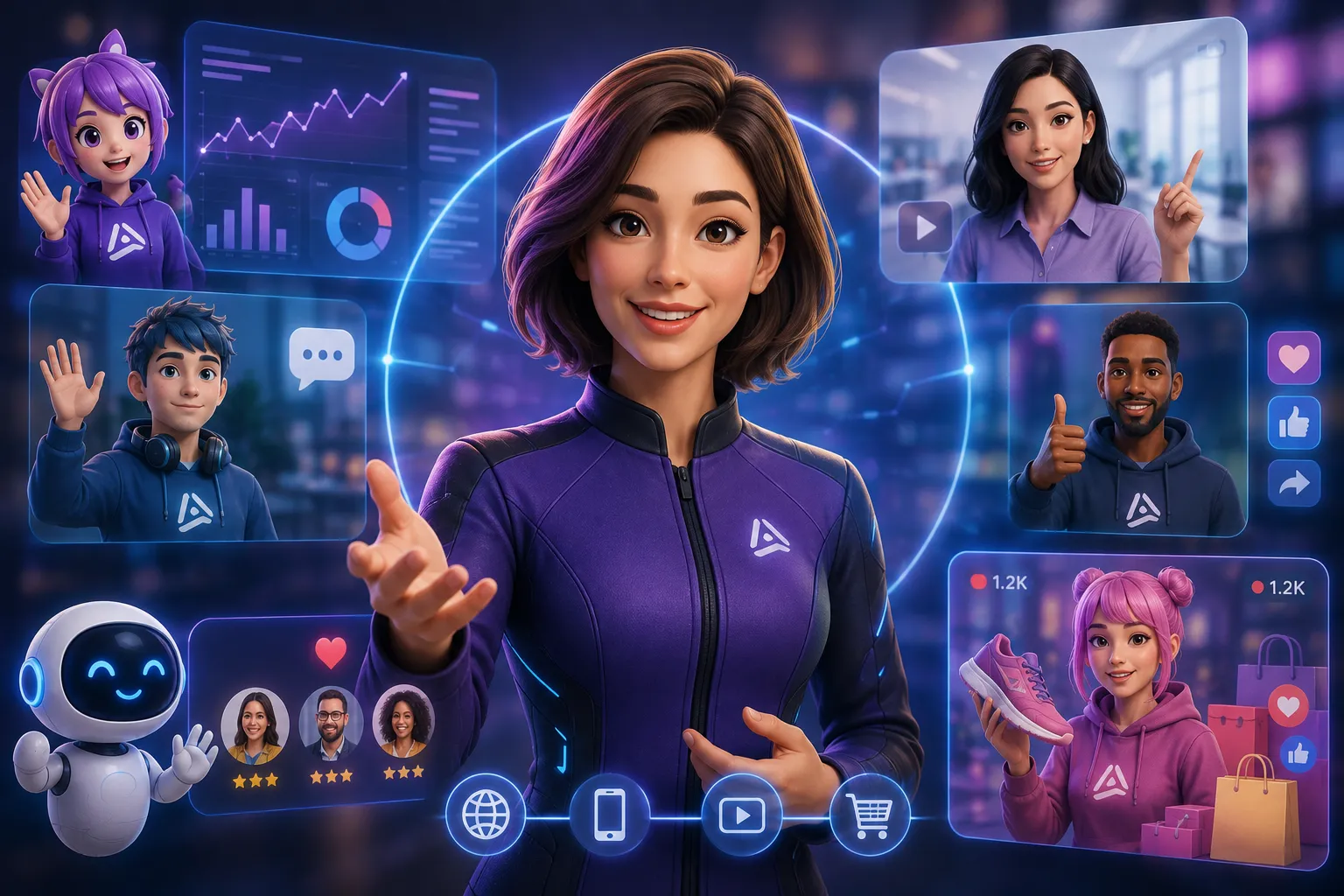
Logos don’t speak. Taglines don’t make eye contact. For decades, brands have tried to build emotional connection through static identity systems, and it’s always been a partial solution. AI-generated brand mascots and digital humans are changing that.
Brands now have the tools to build virtual characters that talk, explain, respond, and show up consistently across every piece of content they produce. Not a cartoon slapped on a product. An actual character with a voice, a personality, a visual identity that scales. Financial services brands are using digital humans to explain complex products without the compliance headaches of using real advisors on camera. Tech companies are building mascots that walk users through onboarding in thirty different languages. Retail brands are letting virtual characters host live shopping events around the clock.
The brands doing this well aren’t just creating characters. They’re building brand assets that compound in value the more they’re used.
What Are AI-Generated Brand Mascots and Digital Humans?
These are two distinct formats that often get lumped together.
An AI-generated mascot is a fictional character – illustrated, animated, or rendered – built to represent a brand’s personality visually and verbally. It can be stylised and obviously non-human, like a geometric creature or an abstract figure, or it can sit closer to a recognisable human form. What defines it is that the character exists as a brand property, used consistently across content.
A digital human is different. Photorealistic, designed to be indistinguishable from a real person on camera. These are used as virtual presenters, brand spokespeople, or customer-facing representatives in video content. The goal is presence without the cost, scheduling constraints, or reputational risk of a real person in that role.
Both feed into video storytelling in ways that static brand identity can’t. A character gives audiences something to follow, recognise, and over time, feel something toward.
Why Voice and Character Matter in Modern Marketing
There’s a reason people still remember the Amul girl and forget most of the ads they saw last week.
Characters are how memory works. A face, a voice, a distinctive way of speaking – these create hooks that abstract brand messaging doesn’t. When a character delivers information, the brain stores it differently than when a voiceover reads copy over b-roll. The character becomes the container the message lives in, and the container is stickier than the words alone.
The psychology of brand videos has consistently shown that trust transfers through personality. We trust people more than institutions. A brand character that has a consistent voice and emotional register gives audiences someone to trust, which is a proxy for trusting the brand. That’s a meaningful mechanism, and it’s been underused in digital marketing partly because building and maintaining a character used to be expensive.
AI has changed the cost structure significantly. The barrier to creating and deploying a consistent brand character is lower than it’s ever been.
How AI Makes Brand Characters Scalable
Traditional character production had a ceiling. A mascot that needed to appear in a product demo, a social reel, a recruitment video, a training module, and a customer support FAQ was a significant production undertaking each time. Most brands settled for using the character sparingly, which undermined the consistency that makes characters work.
AI voiceovers let the character speak in any script, at any length, in any language, without a recording session. AI scriptwriting tools produce character-voiced content at volume. Animation and rendering tools generate expressions and movements from the same character model without rebuilding from scratch. The character shows up everywhere because producing those appearances no longer costs what it used to.
The scalability argument is also a consistency argument. When a digital human or mascot appears across every touchpoint using the same visual identity, voice, and tone, audiences accumulate exposure. Recognisability builds. The character starts to do brand work passively – viewers see it and know immediately who they’re dealing with, before a single word is spoken.
Where Brands Can Use AI-Generated Brand Mascots and Digital Humans
The use cases are broader than most brands initially map out.
Explainer videos are the obvious starting point. A character walking through how a product works keeps viewers more engaged than a voiceover over slides. Product demo videos with a consistent digital presenter build familiarity across a product range – the viewer knows the character, and that makes the new product feel less unfamiliar.
Website welcome videos are underused. A digital human greeting a visitor, explaining what the site offers and where to go, adds a layer of personalisation that static pages don’t produce. It’s a low-cost deployment with a meaningful impact on first impressions.
Onboarding content is where character-led video earns its keep over time. A new customer working through a series of onboarding modules with the same character guiding them builds a relationship with the brand in a way that text documentation simply doesn’t.
Recruitment campaigns benefit from a character that humanises the employer brand. Rather than a generic “we value our people” video, a mascot or digital human that tours the culture, introduces teams, and answers common candidate questions creates a more memorable and honest impression.
Event screens, social reels, training content, personalised sales outreach – each is a deployment opportunity that costs less per use the longer the character has been in development.
Building Authenticity and Trust with AI Characters
Generic AI characters are immediately obvious, and they undermine the whole exercise.
A digital human or mascot that looks like it was generated from a default template with no brand specificity signals to audiences that the brand didn’t invest much thought in the experience. The uncanny valley problem is real – a character that’s almost convincing but slightly off creates discomfort rather than connection.
Getting this right starts with definition before production. What is the character’s background? How do they speak – formal or conversational, dry or warm, technical or accessible? What do they care about? What don’t they do? These questions sound like creative indulgence. They’re actually corporate video strategy doing its job. A character built without that framework will feel hollow in production and inconsistent across deployments.
Visual identity needs the same rigour as the brand’s other design systems. Colour, proportion, expression range, how the character moves – these should be documented and fixed, not improvised each time a new piece of content is produced.
The brands whose AI characters actually build trust are the ones that treated character creation as a strategic exercise, not a production shortcut.
AI-Generated Brand Mascots and Digital Humans in Animated and Motion-Graphic Storytelling
Photorealistic isn’t always the right direction. For many brands, a stylised mascot deployed in animation and motion graphics is more appropriate and often more effective.
Animated characters carry content that would be dry or abstract in live action. A mascot walking through a data comparison, appearing inside an infographic, or guiding a viewer through a branching explainer video brings energy to formats that typically lose audiences halfway through. Animation services built around a defined character create a visual consistency that generic stock animation never achieves.
Motion graphics integrated with a mascot identity give brands a way to make data and process content watchable. A character reacting to a stat, pointing to a chart, or expressing surprise at a trend adds personality to content categories that usually have none. That personality is what viewers remember.
For B2B brands especially – where the content is often complex, the audiences are sceptical, and the production budgets are limited – an animated mascot deployed consistently across explainer content is one of the higher-return investments available.
Challenges Brands Should Avoid
The biggest mistake is creating a character without a clear role.
A mascot that appears once in a launch campaign and then disappears doesn’t build anything. Characters need sustained deployment to accumulate the recognisability that makes them valuable. That requires a commitment at the brand level, not just a production decision.
Unrealistic expressions in digital humans erode trust faster than no character at all. Audiences have finely tuned instincts for when a face doesn’t quite work – the eyes don’t track right, the smile breaks too early, the lip sync drifts. These details require quality control at every deployment. Cutting corners on the rendering to save production time is false economy.
Generic AI voices undermine the whole character. If the voice sounds like every other AI narrator – pleasant, neutral, interchangeable – the character doesn’t have a personality. Voice design deserves as much attention as visual design.
Ignoring cultural context when deploying across markets is a consistent blind spot. A character’s expressions, speaking style, and references that work in one market can land badly in another. Emotional continuity across a character’s deployments also needs to be monitored – a mascot that’s warm and approachable in one video and cold and corporate in another confuses audiences rather than building familiarity.
The Future IS Character-Led Brand Marketing
Most brands have a logo. Fewer have a voice. Almost none have a character that audiences actually look forward to encountering.
That gap is an opportunity. AI has made character-led marketing accessible at a scale that changes what’s viable for brands beyond the largest advertisers. A consistent digital human or mascot, deployed across every content touchpoint, built on a clear creative strategy, creates a brand presence that’s harder to ignore and easier to remember than most digital marketing manages.
The work is in the setup. Define the character properly. Build the visual and voice identity with the same rigour as any other brand asset. Then deploy consistently and let the familiarity accumulate.
Corporate video production services built around character-led content start with a different creative brief than standard production. The character is the brand. Everything else is context.
Ready to give your brand a face people actually remember? Kween Media builds AI character strategies from concept through production. Work with us.