
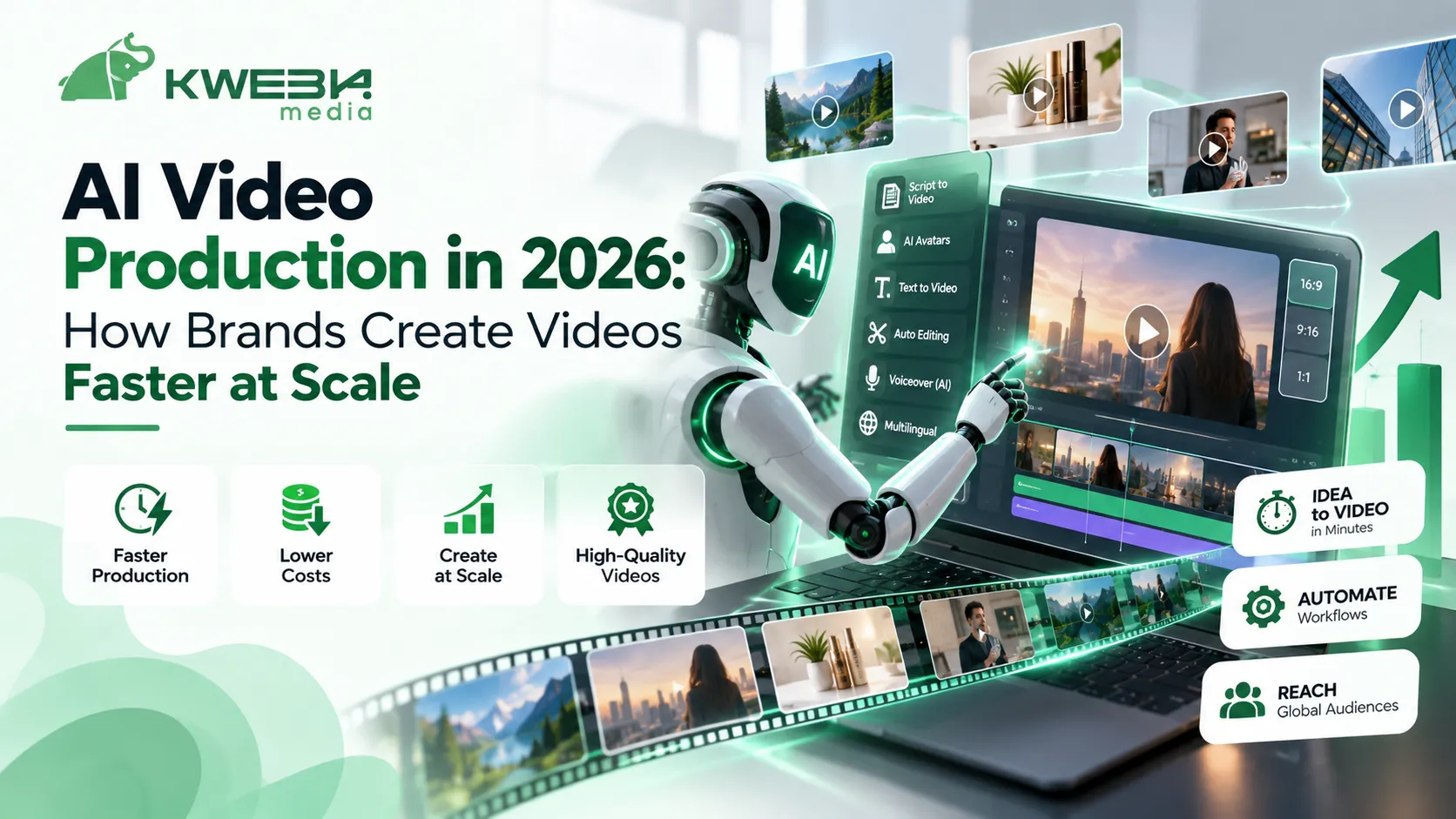
In 2026, the demand for video content has outpaced what traditional production can supply. More platforms, more formats, shorter attention spans, higher output expectations – and the same budgets, the same timelines, the same crew sizes. A solution was much needed. AI video production for brands is what changed the equation.
The brands using AI-powered workflows are producing more videos faster, without the proportional cost that used to come with scale. Understanding how brands can use AI for video production starts with knowing which parts of the workflow it actually optimizes.
What Is AI Video Production?
AI video production, or AI-powered video production, refers to using artificial intelligence tools across the video creation process – from scripting and storyboarding through editing, localization, and distribution. It covers a wide range of applications, and no single tool does all of it.
Generative AI video tools can produce footage from text prompts. AI editing software makes decisions about cuts, pacing, and assembly without manual intervention. AI voiceovers generate narration that sounds like a human speaker. AI-enabled color grading applies consistent visual treatment across an entire project in minutes.
The workflow looks different depending on the brand, the budget, and the content type. What it has in common- production moves faster and scales without requiring proportionally more people.
How AI Is Used Across the Video Production Workflow
Scriptwriting and Concept Development
AI scriptwriting tools handle first drafts, structural variations, and adaptation across formats. A human writer still shapes the brief and reviews the output. What changes is how long the early-stage iteration takes. Getting from brief to approved script used to eat a week. With AI in the loop, that’s down to a day or two in many workflows.
The tools work better with more specific input. A vague brief produces generic output. A detailed brief – audience, tone, call to action, format constraints – produces something workable.
Pre-Production and Storyboarding
Generative AI in storyboarding has reduced the time between script approval and production start. Directors and producers use AI-generated visual references to align on look and feel before a single frame gets shot. Client approvals happen earlier in the process, which reduces costly changes during production.
For brands running multiple campaigns simultaneously, this matters. Pre-production used to be where projects queued up and stalled. AI-assisted storyboarding removes much of that bottleneck.
AI Video Generation and Footage
Generative AI video tools can now produce short sequences from text descriptions. Quality is still uneven, and it remains more useful for certain applications than others- background elements, abstract sequences, motion graphics-style content. For anything requiring real faces, real products, or real environments, traditional production still dominates.
Where AI-generated video earns its place is in reducing the need for stock footage, extending what a small production budget can produce, and filling visual gaps in post without additional shooting days.
AI Video Editing and Post-Production
AI-directed production workflows have changed what post-production looks like. Automated rough-cut assembly, AI-driven color correction, smart audio cleanup, automated subtitle generation – these tasks used to account for a significant chunk of editor time. Now they’re handled faster, freeing editors for the decisions that actually require a creative eye.
Hybrid vertical and wide format production is another area where AI is doing real work. Automatic reframing for different aspect ratios, AI-driven subject tracking during format adaptation, smart cropping – these functions used to mean multiple rounds of manual export and review. AI compresses that.
How AI Helps Brands Produce Faster
The benefits of AI video production show up most clearly in three areas. Speed gains are the most immediate.
Iteration is faster. When a client requests changes to a script, or a brief evolves, AI tools regenerate alternatives quickly without starting from scratch. Rounds of feedback that used to take days get resolved in hours.
Parallel production becomes manageable. A team that previously handled two or three projects simultaneously can run four or five with AI handling the repetitive execution tasks. Capacity goes up without headcount going up.
Approval cycles shorten. AI-generated storyboards and animatics let stakeholders see the direction earlier. Fewer surprises in final delivery means fewer revision cycles. The project doesn’t slow down in the back half while everyone waits on approvals.
How Brands Can Scale Video Content with AI
Knowing how to create videos with AI at scale means building the process around AI from the start, not retrofitting it after the fact.
How to scale video content with AI comes down to one principle- build modular. Scalable video production requires a production system built for reuse, not one-off execution. The brands scaling content effectively are building modular production systems. A hero video gets shot once. AI tools generate variations- shorter cuts for paid ads, reformatted versions for different platforms, localized versions for different markets. The creative asset gets more mileage per production day.
Hyper-personalized video marketing extends this further. Dynamic video tools swap out elements – spokesperson, offer, location context – to produce hundreds of variations from a single shoot. Personalization at scale, which used to require budgets most brands didn’t have, is now operationally feasible.
The process requires upfront thinking. Safe zones, consistent visual templates, modular scripts – these decisions made during production determine how many useful outputs come out the other end. Brands that plan for AI content creation from the brief stage get significantly more from the same production investment.
AI Video Localization for Brands
AI video localization is one of the more practically useful developments in automated video production. Dubbing into multiple languages, subtitle generation, lip-sync adjustment – these used to be expensive enough that most brands localized selectively. AI tools have brought the cost down substantially.
For brands with regional audiences across India, or international markets, this changes the math on localization. A campaign that might have been localized into two languages can now be localized into six. The quality still varies by tool and language, and human review remains essential. But the baseline has improved enough that AI localization for brands is now standard practice rather than an experiment.
AI Video Production vs. Traditional Video Production
| AI-Assisted Production | Traditional Production | |
| Speed | Significantly faster on iteration and post-production | Slower, especially through revisions |
| Cost at scale | Lower per-output cost as volume increases | Costs scale linearly with volume |
| Creative control | Requires clear briefs and human oversight | More direct control throughout |
| Quality ceiling | Strong for defined formats; variable for complex creative | Higher ceiling for high-craft work |
| Personalization | Excellent – variations at low marginal cost | Expensive to produce at volume |
| Localization | Fast and increasingly accurate | Resource-intensive |
| Unique/brand-specific content | Depends heavily on human direction | Better suited for distinctive work |
The AI vs traditional video production comparison isn’t about which is better universally. It’s about which fits the job. Scalable content production benefits most from AI. High-concept brand films benefit from traditional production. Most brands are learning to use both.
Where AI Works Best in Video Production
AI video production for marketing performs well in specific contexts. AI video marketing is most effective when the format is defined and volume is the challenge.
High-volume, repeatable formats – product demos, social ads, localized variants, testimonial compilation – are where AI earns the most. The output requirements are defined. The quality bar is consistent. Volume is the challenge, and AI solves volume.
Explainer content, FAQ videos, and educational series also translate well to AI-assisted production. The structure is predictable. Human oversight keeps accuracy intact. AI accelerates execution.
Campaigns requiring multiple regional or language versions are a natural fit. AI localization tools handle the adaptation while keeping the master creative intact.
What AI Can’t Replace
The brief needs a human. AI generates what it’s told to generate, and the quality of the output tracks directly with the quality of the input. Strategic decisions about what the video should accomplish, who it’s for, and how it should feel – those still require a person.
On-camera talent, real product interaction, and authentic customer stories aren’t things AI generates convincingly. A customer testimonial carries weight because it’s real. An AI-generated equivalent doesn’t carry the same credibility.
Post-production judgment – knowing which take has the energy the editor wants, when a sequence is landing wrong, when color is fighting against tone – this is still human territory. AI video editing handles the mechanical work. The aesthetic decisions stay with the editor.
Virtual production and high-craft brand filmmaking work best when AI handles the operational load and humans direct the creative. The collaboration between the two is where the best work gets made.
How to Build an AI Video Production Workflow for Your Brand
Building an AI video production workflow for brands requires mapping the existing process before changing it. Start with inventory. List all the video content your brand produces regularly. Identify which types are high-volume, repeatable, and format-defined. These are your AI candidates.
Evaluate tools by use case. No single AI tool covers the full workflow. Scriptwriting tools, storyboarding tools, editing tools, and localization tools are often separate products. Match tools to the specific tasks they do well.
Build modular creative assets. Plan hero shoots so they produce the raw material for AI variation. Consistent backgrounds, consistent lighting setups, and clear safe zones give AI tools what they need to generate clean outputs.
Keep human review in the process. AI video creation produces output fast. Fast output still requires quality review. Build review checkpoints into the workflow, not as a bottleneck but as a quality gate.
Pilot before scaling. Run one campaign format through an AI-assisted workflow. Measure time, cost, and output quality against traditional production. Use real data to decide where to expand AI involvement.
The Future of AI Video Production Beyond 2026
Understanding how AI is changing video production requires looking beyond the current tools. The current generation is focused on acceleration – doing existing tasks faster. The next generation is likely to shift toward genuine creative assistance- tools that flag strategic gaps in a brief, suggest structural approaches based on audience data, or generate campaign-level thinking rather than individual asset execution.
Generative AI video production in 2026 is already producing footage, voiceovers, and motion content from prompts. Within two to three years, the gap between AI-generated and traditionally-shot content will narrow for many format types. Brands building AI literacy now will be better positioned to use those tools effectively when they mature.
Real-time personalization – video content that adapts dynamically based on viewer behavior and context – is the direction the personalization work is heading. The infrastructure for it exists. The content systems to support it are being built.
FAQs
Q. Is AI video production suitable for brand films and high-end campaigns?
A. For high-concept brand films where craft and originality are central, traditional production remains the right approach. AI works best as a support layer – handling scripting, pre-visualization, and post-production tasks – rather than as the primary creative engine.
Q. How does AI video production affect costs?
A. Upfront costs depend on tool subscriptions and workflow setup. The cost advantage shows up at scale- producing more variants, more formats, and more localized versions without proportional increases in time or crew. Brands running high volumes of content see the most meaningful cost reduction.
Q. Can small brands benefit from AI video production?
A. Yes, particularly for social media content, product explainers, and localization. Many AI tools are accessible without enterprise-level budgets. The benefit is speed and output volume more than cost reduction at small scale.
Q. What’s the risk of AI-generated content looking generic?
A. The output reflects the input. AI working from underdeveloped briefs produces underdeveloped content. The brands getting strong results from AI are investing more in the brief and creative direction, not less, because that’s where differentiation happens.
Q. How do I know which parts of my workflow to automate first?
A. Start with the tasks that are high-volume, repetitive, and format-defined – social ad variations, subtitle generation, rough-cut assembly. Leave creative judgment, brand voice, and any work requiring real-world authenticity with humans.
AI + Human Creativity- The Future of Video Production
AI video production is changing the economics of content at scale. Brands that would have produced four videos a quarter are producing twenty. Localization that required a separate budget line is happening as a standard part of every campaign. Post-production timelines that stretched to three weeks are compressing to one.
The creative work still requires creative people. The difference is how much of their time goes to execution versus judgment. AI handles the execution. That’s where the efficiency comes from.
Looking to build an AI-assisted video production workflow for your brand? Explore Kween Media’s corporate video production services.