
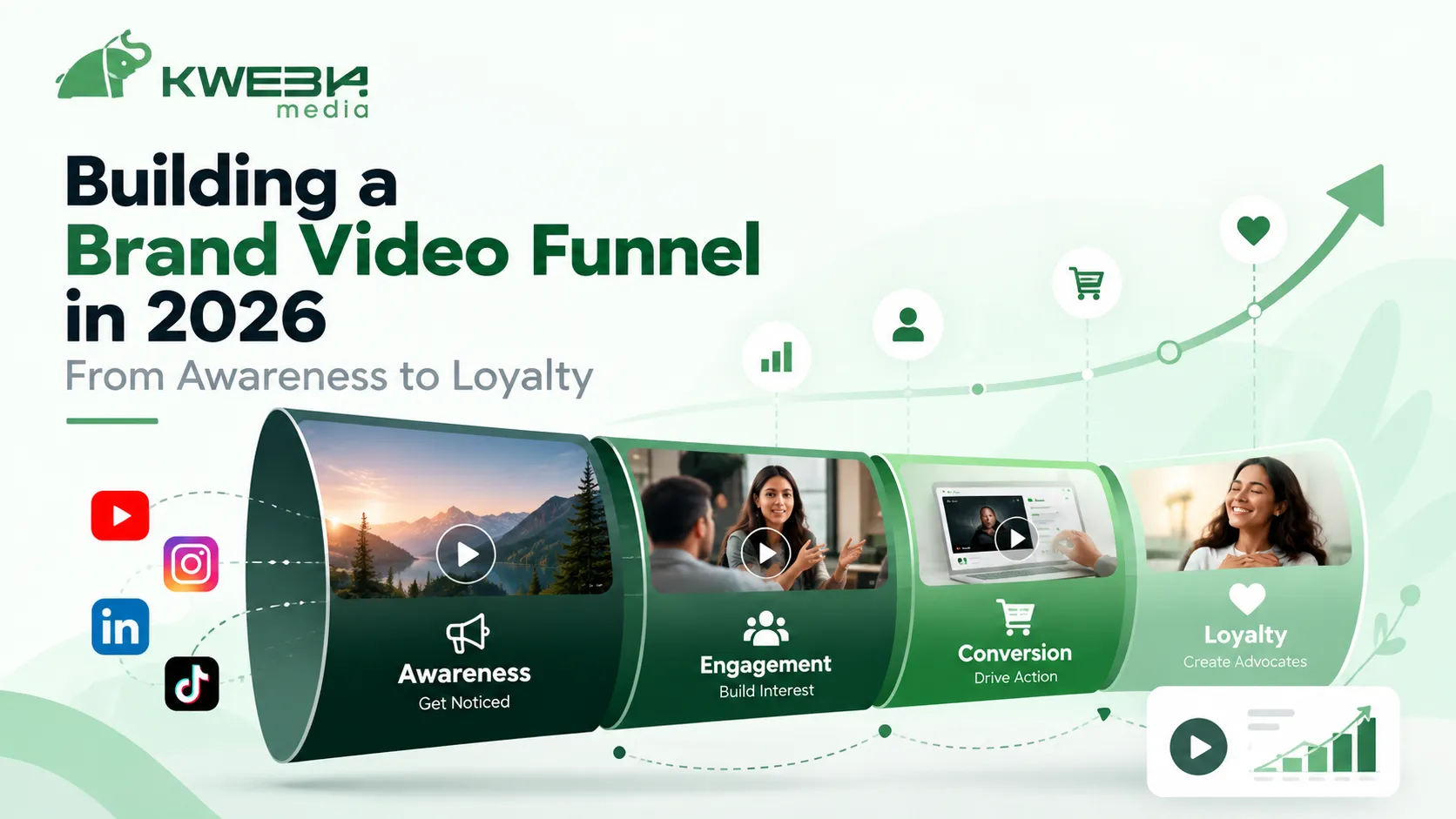
Most brands approach video production as a one-time event. Commission a corporate video. Publish it. Expect it to do everything – generate awareness, build trust, convert prospects, and retain customers – all from a single piece of content. It rarely does any of those things well. A brand video funnel strategy 2026 demands much more than producing one-off videos.
A structured video marketing strategy changes what each piece of content is asked to do. Instead of one video trying to serve the entire customer journey, it uses specific video assets at each stage – from the first moment someone discovers a brand through to becoming a repeat customer and advocate. Understanding how to use video throughout the customer journey – across awareness, consideration, conversion, retention, and loyalty – means each stage gets content built for it, different messaging, and a different measure of success.
What Is a Brand Video Funnel?
A brand video funnel is a strategic system of video assets designed to move audiences through the customer journey – from discovering a brand to purchasing, returning, and recommending it.
The distinction from randomly publishing videos is intent. Every asset in a video content funnel has a defined audience stage, a specific goal, and a measurable outcome. Content that works at the awareness stage will typically underperform at the conversion stage, because the viewer’s needs have changed.
| Funnel Stage | Audience Goal | Video Goal |
| Awareness | Discover | Capture attention |
| Consideration | Evaluate | Educate and build trust |
| Conversion | Decide | Remove objections |
| Retention | Continue | Increase value |
| Loyalty | Advocate | Strengthen connection |
A useful corporate video strategy maps assets to this table before a single brief is written.
The 5 Stages of a High-Converting Video Marketing Funnel
1. Awareness: Video Content That Gets Your Brand Discovered
At this stage, the viewer has no relationship with the brand. They don’t yet trust it – they may not have heard of it. The job of awareness video content is to earn attention and create a strong enough impression to stay memorable.
Short-form videos, Reels, brand films, and micro-videos are among the best videos for awareness at this stage. The emphasis is on emotion and positioning, not product information. Someone who just discovered a brand doesn’t want a feature list. They want to feel something that makes the brand worth a second look.
Metrics to track: reach, impressions, video views, and watch time. A high view count at this stage is a signal worth paying attention to, but watch time tells the more honest story.
2. Consideration: Videos That Educate and Build Trust
The prospect now knows the brand exists. The question shifts to: why choose this one?
Consideration stage video content does the work of education and trust-building. Explainer videos, product demonstrations, behind-the-scenes content, founder interviews, and case studies all serve this stage. The viewer is actively evaluating – they want information and evidence, not just impressions.
This is where video storytelling earns its value. A well-structured case study or a genuinely honest behind-the-scenes film gives the viewer the material they need to make a decision. Pushing for the sale here is premature and often counterproductive.
Metrics: engaged views, website visits from video content, returning visitors, product-page engagement.
3. Conversion: Videos That Turn Prospects Into Customers
Bottom-of-funnel content has one job: reduce the uncertainty that’s keeping someone from buying.
Customer testimonial videos are the most reliable asset at this stage because they answer the question the prospect is actually asking – “has this worked for someone like me?” Case studies, detailed product demos, FAQ videos, personalised sales outreach, and shoppable video stories all remove friction at the decision point.
The video content funnel at this stage should make the next step obvious. A weak CTA here means the work of the previous two stages gets wasted.
Metrics: leads, CTA clicks, booked calls, purchases, and conversion rate.
4. Retention: Video Content That Keeps Customers Engaged
Most video funnel strategy stops at conversion. The retention stage is where comprehensive strategies pull ahead.
A customer who has just purchased needs different content from a prospect who’s still deciding. Onboarding videos, product tutorials, feature update content, and FAQ videos help customers get more value from what they’ve bought. That value realisation leads to repeat purchase and reduces churn.
This is also where the cost of bad onboarding shows up. Customers who don’t understand how to use a product properly blame the product. Video removes that gap efficiently.
Metrics: repeat usage, customer retention rate, support ticket volume, and repeat purchases.
5. Loyalty: Turning Customers Into Brand Advocates
A loyal customer who recommends a brand to others is the highest-value outcome of any marketing system. Video content that supports this stage looks different from anything earlier in the funnel.
Customer spotlight videos, community content, user-generated style content, and exclusive behind-the-scenes stories speak to customers who already trust the brand and want to feel part of something. Lo-fi authentic storytelling is particularly effective here – polished commercial content feels out of place once someone has moved past the purchase stage. Genuine, informal content reinforces the relationship rather than restarting the sales cycle.
Metrics: referrals, reviews, user-generated content volume, and community engagement.
How to Build Your Brand Video Funnel in 2026
Knowing how to build a video marketing funnel is less about production and more about planning. The assets follow from the strategy, not the other way around.
Step 1 – Map the Customer Journey
Identify what your audience is thinking, asking, and objecting to at each stage. Customer journey video content is only as strong as the audience understanding behind it., asking, and objecting to at each funnel stage. The content decisions follow from this – without it, you’re producing videos and hoping they land somewhere useful. This is the foundation of any video content strategy.
Step 2 – Audit Existing Video Assets
Most brands already have content. Check what exists, identify which funnel stages it serves, and map the gaps. A brand with strong awareness content and no conversion assets has a specific problem. A brand with strong conversion assets and nothing at the awareness stage has a different one.
Step 3 – Produce a Master Content System
A video asset library built around connected assets generates more output from each production. One hero video becomes a series of short clips, social assets, testimonial extracts, website content, and ad variants. Plan shoots to produce multiple funnel assets, not individual videos.
Step 4 – Match Distribution to Funnel Stage
Awareness content belongs on social platforms and video channels where discovery happens. Consideration content belongs on YouTube, your website, and email where people go to research. Conversion content lives on landing pages and in sales campaigns. Retention content goes to existing customers through email and customer portals. Loyalty content lives in community spaces and social.
Step 5 – Measure and Optimise
Every video needs a KPI tied to its funnel stage, not a universal view-count target. An onboarding video success is measured in support ticket reduction and product adoption, not reach.
Brand Video Funnel Example
A hypothetical B2B software brand running a video marketing funnel might move a prospect through these touchpoints:
LinkedIn short video (awareness) ↓
Brand explainer video (consideration) ↓
Customer case study (consideration/conversion) ↓
Client testimonial (conversion) ↓
Product demo video (conversion) ↓
Onboarding tutorial series (retention) ↓
Customer spotlight (loyalty)
The viewer isn’t seeing the same video at every stage. The content changes as their intent changes. Each asset serves a specific job, and the sequence moves the prospect forward rather than repeating the same message in different formats.
Common Video Funnel Mistakes to Avoid
Producing one video and mapping it to every funnel stage is the most common problem. A brand film that works for awareness rarely converts a prospect who’s ready to decide.
Making awareness content promotional is the second. Top-of-funnel video that leads with features and pricing pushes people away at the stage when they should be pulled in.
Skipping retention entirely leaves customers without support at the moment they most need it.
Producing content without a distribution plan means the video sits unplayed on a drive.
Measuring every video on views alone produces misleading data. A conversion video with fifty views and twelve purchases is outperforming an awareness video with fifty thousand views and no follow-through.
Build a Scalable Video Content Engine, Not One-Off Videos
The brands producing the most effective video content aren’t commissioning individual videos. They’re building connected content systems where one production generates assets for multiple funnel stages simultaneously.
That’s what makes brand video strategy scalable – footage from a product shoot becomes awareness content, consideration material, and conversion assets with planning built into the brief.
Corporate video production services built around this thinking deliver more from every budget.
FAQs
Q. What is a video marketing funnel?
A. A video marketing funnel is a strategic approach to video content where different video assets are used at different stages of the customer journey – from first discovery through to purchase and beyond. Each video serves a specific audience intent rather than trying to do everything at once.
Q. What videos work best at each stage of the marketing funnel?
A. Choosing the right video content for each stage of the marketing funnel depends on audience intent. Awareness benefits from short-form videos, brand films, and social content. Consideration responds to explainer videos, product demos, and case studies. Conversion performs best with customer testimonials, FAQ videos, and shoppable content. Retention needs onboarding videos and tutorials. Loyalty works with customer stories and behind-the-scenes content.
Q. How do you build a video sales funnel?
A. Map the customer journey first. Identify what your audience needs to see at each stage. Select or produce the right video assets. Distribute them through the right channels for each stage. Then measure against stage-specific KPIs rather than universal view counts.
Q. Can one video be used across the entire marketing funnel?
A. Generally, no – the audience’s needs shift too significantly from stage to stage. However, one production day can generate multiple funnel-specific assets. A single shoot can produce awareness clips, consideration content, and conversion testimonials with the right planning upfront.
Want to build a video content system that works across the full customer journey? Kween Media produces strategic video assets designed for every stage of your funnel. See what we build.