
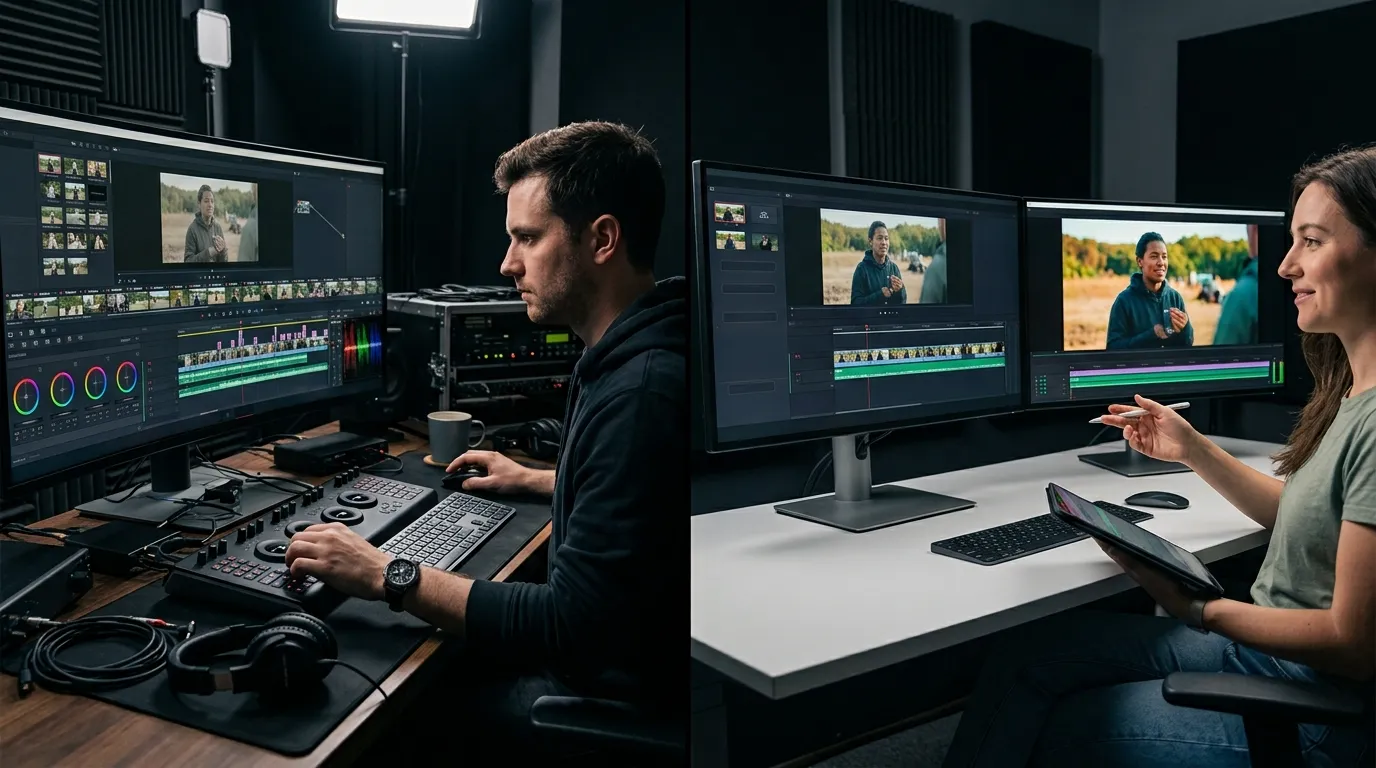
Is AI replacing editors? The question is everywhere right now. And we have the answers!
AI video editing tools have moved fast enough in the last two years that brands who weren’t paying attention have suddenly found themselves in conversations about automated rough cuts, AI color grading, and post-production pipelines that barely involve a human until the final approval. The hype cycle has been loud. So has the anxiety on the other side from editors worried about their livelihoods.
Neither the hype nor the anxiety is giving clients a particularly clear picture of what’s actually happening.
Here’s what’s true: AI is now standard in post-production. Rough cut assistance, auto-subtitling, noise cleanup, smart reframing for different formats. Editors are using these features on real projects today. The question “Is AI replacing editors?” is the wrong one, though. A more useful question is what AI is actually taking over, what it isn’t, and how that changes what clients should be looking for and asking for when they hire a video production company.
That’s what this piece covers.
Understanding the Traditional Role of Editors
Before getting into what AI changes, it’s worth being specific about what editors actually do – because “cutting clips” is only about twenty percent of it.
The traditional editing pipeline starts with ingesting and organising footage, often hours of raw material for a finished piece that runs minutes. Assembly comes next – building a rough structure from that material. Then the real work: shaping the narrative arc, refining pacing, managing continuity across shots, balancing audio, and working toward something that functions as a coherent story rather than a sequence of clips.
The skills that make editing genuinely difficult are mostly invisible. Knowing when a pause should breathe and when it’s dragging. Reading a performance accurately enough to choose between two takes where the difference is subtle but the impact on how an audience receives the moment is significant. Translating client feedback that’s vague or contradictory into actual editorial decisions. Maintaining brand voice across a piece that was shot over multiple days in multiple locations.
Editors also carry a function that rarely gets named: risk management. When a testimonial edit misrepresents what someone said. When a cut creates an accidental implication that creates legal exposure. Or when the tone of a piece is slightly off in a way that won’t be obvious until it’s been seen by the wrong audience. Catching those things before delivery is part of the job, and it requires judgment that’s harder to automate than assembly.
When the editorial role gets undervalued, clients end up with videos that technically work but don’t convert, don’t represent the brand accurately, or create problems that cost more to fix than the editing savings were worth.
What AI Editing Tools Can Actually Do in 2026
The honest answer is quite a lot, for certain things.
Scene detection, rough cut generation, silence removal, smart trimming – AI handles these quickly and reliably. Auto-subtitling has become accurate enough that the human review pass is now a check rather than a rebuild. AI-assisted color grading has developed to the point where a consistent, professional look across a full piece can be achieved with AI doing the initial grade and a colorist refining rather than building from scratch.
Integration with major editing platforms has deepened significantly. Premiere and DaVinci Resolve both have AI-driven features built in now. Object tracking, automated reframing for different aspect ratios, background removal – tasks that used to take time proportional to the amount of footage now take time proportional to the complexity of the decision, which is different.
For simple formats – talking head interviews, basic social clips, internal announcements – some platforms can now take a script or brief and produce a watchable first cut with minimal human input. That capability is real, and it’s worth clients knowing it exists.
Where AI reliably struggles is with the subtler work. Complex emotional beats. Performance choices where the difference between two takes isn’t technical, it’s human. Cultural nuance that a model trained on broad data patterns will miss or get wrong. Continuity problems that are obvious to a person who’s watching for them and invisible to automated detection. These aren’t edge cases – they come up on most meaningful projects.
How AI Is Changing Editing Workflows (Without Replacing Editors)
The shift isn’t that AI is replacing editors. It’s that editors are doing less of the time-intensive mechanical work and more of the work that actually requires their judgment.
Assembly used to consume a significant portion of editing time on any project. AI now handles a first pass quickly, giving editors a starting point rather than a blank timeline. The time that used to go into organising footage and building initial structure is freed up for the decisions that determine whether a piece works – story shape, pacing, emotional continuity, the choices that separate a functional video from a memorable one.
There’s a scalability shift happening too. Editors working with AI assistance can handle more projects without the quality drop that comes from being stretched too thin. More iteration cycles become viable within the same budget. Multiple versions for different platforms or audience segments stop being luxury decisions and become practical ones.
The caveat is that this only works when there’s genuine human oversight at the stages that matter. AI-first workflows that skip human judgment on story and emotional register produce content that looks professional and feels empty. Clients on the receiving end notice this more quickly than they might expect.
Where AI Excels: Practical Benefits for Clients
The time savings on the mechanical side of post-production are substantial and they translate directly into client-facing benefits.
Rough cut timelines that previously ran a week now run a day or two for many formats. That means first drafts for client review arrive earlier. Feedback rounds can start sooner. Changes that would previously have pushed a delivery date can be absorbed without crisis.
For pacing in video editing, the AI-assisted workflow creates a specific advantage: when repetitive trimming and timing adjustments are handled automatically, editors spend more of their focused attention on the pacing decisions that actually shape how an audience experiences a piece. The result is often tighter, more rhythmically considered work rather than less of it.
Cost efficiency at scale is meaningful for clients with ongoing content needs. Consistent visual standards across a large content library – uniform color treatment, audio levels, format specs – that previously required painstaking manual work can be maintained automatically. A/B testing different edits for different platforms becomes operationally viable when AI can produce variant versions without the same time cost as a full re-edit.
The practical upside for clients is more iteration, faster delivery, and human editorial attention concentrated where it has the highest impact.
Where AI Isn’t Replacing Human Editors Anytime Soon
This is the part that gets flattened in conversations about AI efficiency, and it’s worth being direct about.
Video storytelling that actually works emotionally depends on judgment that AI cannot currently replicate. Reading a performance accurately enough to feel which take carries the weight the scene needs. Knowing when the edit should break the expected rhythm because the moment calls for it. Building an arc that earns its emotional payoff rather than just following a structural template. These are human skills, and they’re what determine whether an audience connects with a piece or just watches it.
Brand and cultural nuance is another area where automation hits real limits. Subtle brand voice requirements – the specific register a company has built over years that can be undermined by one slightly wrong cut – require someone who understands the brand, not just the brief. Cultural sensitivities that vary across markets require judgment that models trained on broad data patterns frequently miss.
The psychology of brand videos is relevant here in a specific way. Audiences build trust with brands whose communication feels considered and human. That quality is detectable even when viewers can’t articulate what’s different about it. Editors who understand how to build that trust through editorial choices are providing something that doesn’t have an automated equivalent yet.
Ethical and legal judgment sits entirely with humans. Testimonial cuts that might misrepresent a speaker. Documentary material involving sensitive subjects. Deepfake-adjacent techniques where what’s technically possible and what’s responsible are different questions. These require oversight that can’t be delegated to a tool.
Best Hybrid Editing Models for Brand and Corporate Clients
The workflows that are producing the best results right now are hybrid ones, with AI and human attention applied to different parts of the process.
A practical model: AI handles rough cut assembly and initial cleanup. A human editor takes the structure pass, making story and pacing decisions. AI-assisted finishing covers noise reduction, captions, and format exports. Human QC and approvals close the process. That division keeps human attention on the stages where it changes the outcome.
Tiered approaches make sense for clients with varied content needs. Fully AI-assisted workflows are appropriate for low-stakes internal content – staff updates, basic training videos, internal announcements. Higher human involvement is justified for external brand films, customer testimonials, product launches, and anything where the emotional register and brand representation carry real stakes. Corporate video production services that are honest about this distinction are worth more than ones promising full AI efficiency across everything regardless of context.
For clients commissioning work, the most useful thing to specify isn’t the tool set but the outcomes: what emotional response the video needs to produce, what the brand constraints are, what the risk tolerance is for content that reaches external audiences. Editors working within a clear brief can make better decisions about where automation serves the work and where it doesn’t.
What Clients Should Ask Their Editors and Vendors About AI
As AI becomes standard, the right questions to ask have changed.
Which parts of the edit are AI-assisted? That’s a fair question, and a vendor who isn’t willing to answer clearly is a flag. Understanding where automation sits in the workflow lets clients assess where human judgment is actually being applied.
How is footage stored and processed when AI tools are involved? Some platforms process footage on third-party servers, which creates data handling and confidentiality questions that matter for certain clients and content types.
What does human review look like? “We use AI” and “AI handles it” are different claims. Knowing specifically at which stages a human editor is making decisions rather than approving AI output is important for understanding what you’re actually buying.
IP and licensing questions are increasingly relevant. Who owns AI-generated elements? What training data is involved? Depending on the tools being used, the answers to these vary and some create compliance issues in certain industries or regions.
Transparency is the baseline expectation. Clients in 2026 aren’t anti-AI. Most are fine with AI-assisted workflows when they understand what that means. What creates trust problems is discovering the extent of automation after the fact.
If AI Is Replacing Editors, What Editing Will Look Like by 2030?
The direction is toward AI being present at every stage rather than just specific ones.
Voice-activated editing commands are in active development. Predictive cut suggestions based on audience performance data – where an AI recommends structural changes based on where viewers are dropping off in similar content – are moving toward production viability. Integration between AI-generated visuals, AI voiceover, and AI-assisted editing is tightening in ways that will increasingly allow automated production of certain content formats end-to-end.
The latest video editing trends are already showing how quickly this is moving, particularly for social and digital content where volume and speed are primary constraints. AI proficiency is becoming a baseline competency for editors rather than a specialism.
The editor role by 2030 looks more like a post-production director: supervising AI tools, making narrative and brand decisions, managing multi-channel adaptation, and taking responsibility for the judgment calls that automation can’t make. That’s a different job description than cutting timelines manually. It’s not a lesser one.
Clients who work with editors and vendors building these competencies now are better positioned for what comes next than those treating AI as either a threat to avoid or a cost-cutting shortcut.
Conclusion: AI vs. Video Editors, How to Make the Right Call for Your Brand
AI replaces tasks. It hasn’t replaced editorial judgment, and for most meaningful brand content, it isn’t close.
The practical framework is simple enough. AI-heavy workflows make sense for high-volume, lower-stakes content where speed and consistency are the primary requirements. Human-led editing with AI assistance makes sense for brand films, customer testimonials, product launches, and anything where emotional resonance and brand representation are what’s being paid for.
The brands getting this right aren’t picking a side. They’re being specific about what different content needs and building workflows accordingly. That’s what produces corporate videos that connect rather than just corporate videos that exist.
The smartest move in 2026 isn’t figuring out if AI is replacing editors. It’s knowing when you need which, and working with partners who can tell the difference.
Want a production partner who knows where AI helps and where it doesn’t? Kween Media builds workflows around what your content actually needs. Let’s talk.