
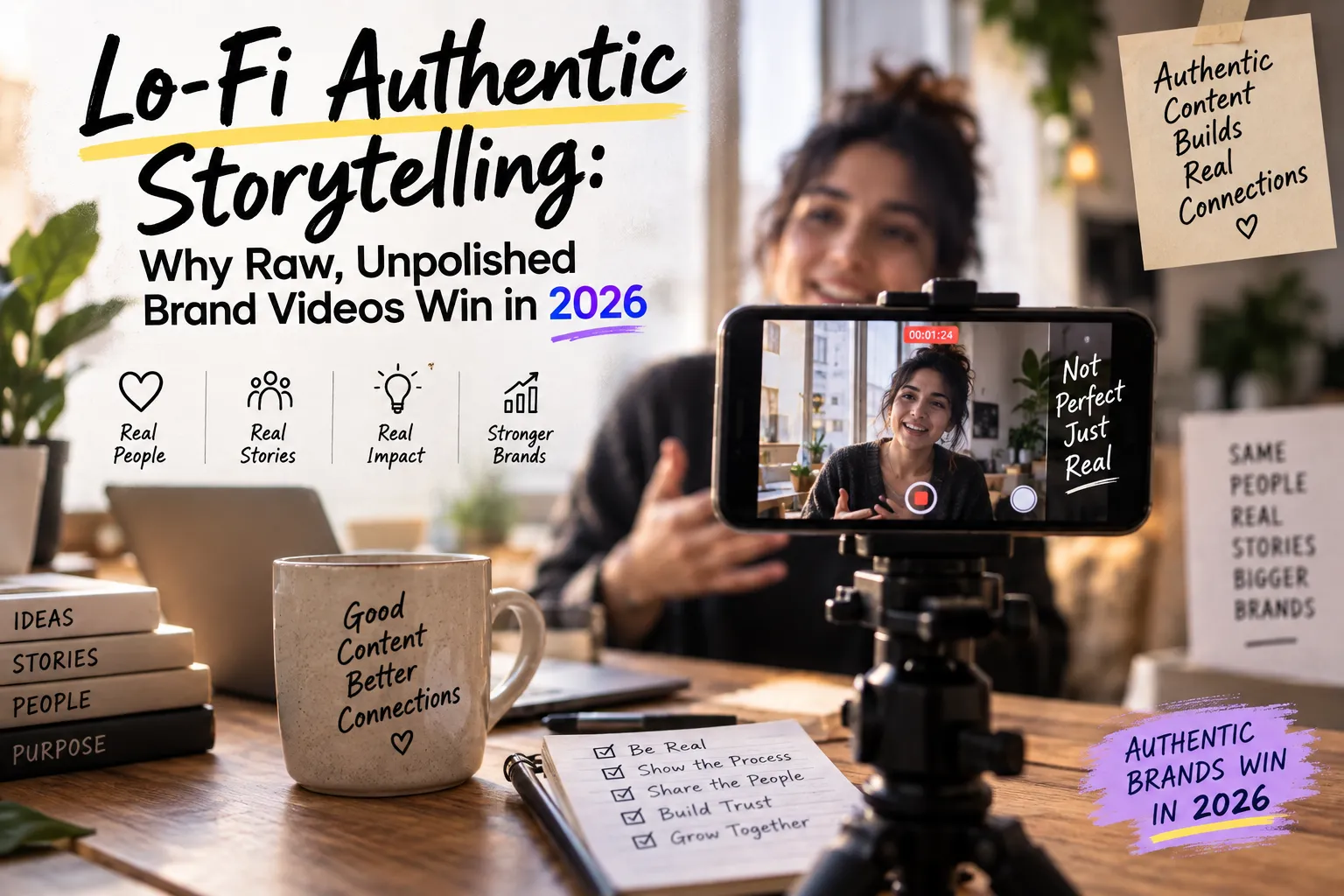
Pull up any brand’s Instagram right now. Scroll past the colour-graded product shots, the perfectly lit talking heads, the ads that look like ads. Then notice what actually stops you scrolling. Nine times out of ten, it’s something rougher. A founder filming from their car. A customer talking about a product with zero rehearsal. A behind-the-scenes clip. Something that feels like it wasn’t trying to impress you. That’s lo-fi authentic storytelling.
Years of exposure to polished commercial content have made viewers better at detecting when they’re being sold to, and faster at disengaging when they feel it. Raw, unpolished video doesn’t trigger that reflex. It reads as honest, and honest is what builds attention right now.
What Is Lo-Fi Authentic Storytelling?
Lo-fi authentic storytelling is a creative approach, not a cost-cutting measure. A badly shot video with weak audio and no story structure isn’t lo-fi storytelling. It’s just poorly produced content. Lo-fi storytelling uses deliberate creative choices – natural lighting, real people, minimal scripting, documentary-style moments – to create content that feels genuine rather than constructed.
Think of it as the visual equivalent of a candid photograph versus a studio portrait. Both can be well-executed. Both serve different purposes. The candid one feels like a moment. The studio portrait feels like a presentation.
Micro-storytelling sits at the heart of this approach. Small, specific, human moments communicate more than sweeping brand statements. A founder admitting what didn’t work in the first year. An employee showing what their morning actually looks like. A customer describing a problem the product solved in their own words, not the brand’s.
These aren’t accidental. They’re planned. The difference is that the planning goes into creating conditions for genuine moments, not scripting what those moments will look like.
Why Raw Videos Build More Trust With Lo-Fi Authentic Storytelling
Viewers can easily spot a script. The giveaways are subtle. Eye movement that tracks invisible cue cards. Responses that are too complete, too smooth, too on-message. Energy that doesn’t quite match the supposed emotion of the moment. Audiences pick all of this up before they’ve consciously processed it, and when they do, the content stops working. It becomes advertising they’re watching, rather than something they’re actually watching.
The psychology of brand videos is consistent here: trust transfers through authenticity. A spokesperson who stumbles slightly over a word, recovers, and keeps going is more believable than a flawless delivery that sounds rehearsed.
This matters commercially. Trust drives the conversions that polished advertising often claims credit for. A viewer who trusts a brand is more likely to buy and more likely to come back.
Where Lo-Fi Authentic Storytelling Videos Perform Best
Some platforms were built for this format of lo-fi authentic storytelling. Others have adapted to it because the content performs.
TikTok and Instagram Reels reward lo-fi content structurally. The algorithm surfaces videos based on completion rate and engagement, and authentic content consistently outperforms polished content on both. A genuine customer reaction gets watched to the end. A produced brand spot gets scrolled past at the three-second mark.
LinkedIn has shifted more than most marketers expected. Founder updates filmed on a phone – direct to camera, no graphics, no production – regularly outperform produced brand content on reach and engagement. The platform’s audience responds to professional honesty. Behind-the-scenes glimpses into how decisions get made. Honest takes on what’s working and what isn’t.
Corporate videos that connect often use exactly this register – real employees, real culture, real working environments rather than aspirational versions of them. Recruitment content that shows what a team actually looks like beats recruitment content that shows what the brand wishes it looked like.
Customer testimonial videos are where authenticity does its most direct commercial work. A customer talking genuinely about a result they experienced is more persuasive than a produced case study with graphics and music. The rough edges are part of what makes it believable.
The Creative Elements Behind Great Authentic Videos
Creating videos with lo-fi authentic storytelling still requires craft. The craft is just applied differently.
Strong lo-fi content starts with story structure. The absence of a script doesn’t mean the absence of a plan. It means the plan is about creating the conditions for something real, not controlling every frame of what happens.
Audio is where authentic content most often fails. Natural lighting is forgiving. Bad audio is not. A slightly shaky camera reads as genuine. Muffled dialogue or constant background noise reads as careless. Lo-fi doesn’t mean audio deserves less attention – it means the approach to audio changes. Lapel mics for interviews. Awareness of ambient sound. Simple but reliable recording.
Documentary editing is the discipline that turns genuine moments into coherent content. Finding the line in a twenty-minute interview that carries the whole story. Structuring a behind-the-scenes clip so it has a beginning, a point, and an end. Expert editing of corporate interview videos turns raw footage into something that feels effortless – which is a different thing from feeling accidental.
Camera movement in authentic content is typically handheld but controlled. Not shaky for effect. Held carefully but not locked off. The slight instability of a person holding a camera reads differently from the deliberate steadiness of a tripod. That difference communicates something.
Common Mistakes Brands Make with Lo-Fi Content
The most common mistake is confusing lo-fi with unedited videos. Raw footage is material. Lo-fi content is what you make from it. They’re not the same thing. Uploading an unedited phone clip for the sake of “authenticity” isn’t a creative strategy.
Weak audio is the fastest way to undermine genuine content. Viewers will watch imperfect visuals. They won’t endure unclear audio. This holds across every format and platform.
No story structure is the version of this mistake that’s harder to diagnose. A genuine moment with no narrative direction is just footage of something happening. The editing needs to find the arc – the setup, the tension or shift, the resolution or reveal. Pacing in video editing for authentic content is often tighter than for produced content because there’s no visual spectacle to sustain interest. The story has to do the work.
Inconsistent branding is a longer-term problem. Lo-fi content that looks like it came from a different company in every video doesn’t build recognition. Visual consistency – even in informal content – keeps the brand coherent across touchpoints. Video aesthetics in lo-fi production are defined by what you keep consistent rather than by what you produce.
Excessive improvisation without any structure produces content that meanders. Real people left entirely to their own devices on camera frequently say interesting things in ways that don’t edit into a coherent story. Some structure – even just a starting point and an ending direction – gives the edit somewhere to go.
How Brands Can Blend Authenticity with Professional Production
A professional crew filming authentic content isn’t a contradiction. The job changes but the skill is still needed. Instead of controlling the environment to produce a perfect shot, the crew creates conditions where real things can happen and captures them well. Real employees rather than actors. Natural locations rather than dressed sets. Conversations guided by a few questions rather than dialogue from a script.
The production value shows up in what the audience doesn’t notice. Clean audio that sounds effortless. Lighting that feels natural but is actually controlled. An edit that moves with the rhythm of what was said rather than against it. A professional crew shooting lo-fi content produces something that audiences experience as genuine and that actually is – while also being watchable.
Corporate video production services that understand this are producing work that competes with organic creator content, because the approach has more in common with documentary filmmaking than commercial production.
Conclusion: Authentic Stories Create Lasting Brand Connections
Polished content gets seen. Genuine content gets trusted. Brands building trust through honest, human video content are developing something that takes longer to create than a campaign but outlasts it significantly. A customer who trusts a brand because they’ve seen real employees, real results, and real conversations doesn’t need to be reached by every ad. They’re already paying attention.
Video storytelling for brands at its best has always been about finding what’s true and presenting it well. Lo-fi storytelling makes the the “what’s true” part truly shine.
The brands that feel most human in 2026 aren’t the ones with the biggest production budgets. They’re the ones with the clearest sense of what they actually are, and the confidence to show it.
Want to create brand content that actually feels like your brand? Kween Media builds authentic video strategies that hold up. Start here.