
A customer lands on your product page. The images look good, the description covers every feature, and the price is reasonable. But something is still missing. They can’t quite picture how the product works, how big it actually is, or whether it’ll solve the problem they’re buying it for.
So they leave. Not necessarily because your product wasn’t right, but because there wasn’t enough information to make a confident decision.
That’s exactly where product video production makes a difference. A well-made product video shows what photographs and written descriptions often struggle to communicate. It demonstrates how something works, reveals details from different angles, and helps people imagine using it themselves.
But producing a video that looks attractive and producing one that drives sales are two different things. The real value comes from understanding what your buyers need to see, how to present it, and where the video fits into their purchasing journey.
This guide covers the complete product video production process, the different formats businesses can use, and the practical decisions that turn product videos into valuable marketing assets.
What Is Product Video Production?
Product video production is the process of planning, filming, editing, and delivering videos that showcase a product’s features, functionality, benefits, or real-world applications.
The goal isn’t simply to display a product on camera. It’s to communicate why the product matters and give potential customers enough information to take the next step.
Depending on the business, a product video might involve a studio shoot with controlled lighting, a lifestyle setting with professional actors, an animated product demonstration, or a detailed walkthrough of how something works.
For example, a skincare brand might need close-up visuals that communicate texture and application. A machinery manufacturer may need footage showing equipment operating under real production conditions. A software company might rely on screen recordings and motion graphics instead of traditional filming.
Each requires a different creative approach.
Professional video production services bring together storytelling, cinematography, lighting, editing, and marketing strategy to create videos suited to the product and the audience.
Why Product Videos Matter for Sales and Conversions
People rarely buy products based on specifications alone. They want to understand what they’ll receive and whether it will meet their expectations.
Product videos can help answer those questions before someone contacts sales or reaches checkout.
1. They Reduce Uncertainty Before Purchase
A photograph captures one moment. A video can show the product moving, opening, operating, or being used in different environments.
Consider someone buying a premium office chair online. Dimensions and materials are helpful, but watching someone adjust the chair, change the recline position, and move the armrests gives a much clearer understanding of its functionality.
The same principle applies to electronics, industrial equipment, cosmetics, furniture, and countless other product categories.
When buyers understand what they’re purchasing, there’s less room for incorrect assumptions.
2. They Make Complex Features Easier to Understand
Some products are difficult to explain through written descriptions.
A technical product might have several components working together. A medical device might require a demonstration of its operating sequence. A SaaS platform might solve a complicated workflow problem.
Rather than asking customers to imagine the process, a demonstration video can show it.
For products involving internal mechanisms, invisible processes, or complex systems, 2D and 3D animation can make technical information easier to understand.
3. They Build Trust Through Demonstration
Anyone can write that their product is durable, comfortable, or easy to use.
Showing those qualities is more convincing.
A product video can demonstrate actual operation, manufacturing details, materials, or practical use cases. This gives viewers something specific to evaluate instead of relying entirely on promotional claims.
For higher-value purchases, this additional confidence can be particularly important.
4. They Support Multiple Marketing Channels
A single well-planned product shoot can generate content for product pages, social advertisements, marketplace listings, email campaigns, sales presentations, and product launches.
Different platforms require different edits, but the original footage can often support several formats.
This makes product video content valuable beyond a single campaign.
Types of Product Videos Every Business Should Know
Not every product needs a cinematic advertisement. Sometimes a straightforward demonstration communicates more than an elaborate commercial.
Choosing the right format depends on what the customer needs to understand.
Product Demonstration Videos
A product demonstration video shows how an item works in practice.
It might explain installation, demonstrate individual features, compare operating modes, or walk viewers through the product’s main functions.
Product demo videos are particularly useful for electronics, appliances, software, machinery, and products requiring some explanation before purchase.
The strongest demonstrations focus on actual customer questions rather than simply listing specifications.
Product Promotional Videos
Promotional product videos focus on generating interest.
They typically use dynamic camera movements, appealing visuals, music, and concise messaging to introduce a product or highlight its strongest selling points.
These videos work particularly well for advertising campaigns, launches, and social media promotions.
Unlike a detailed demonstration, the objective is often to create enough interest for someone to visit the product page and learn more.
Brands planning a campaign can also explore commercial video production to combine product visuals with a stronger advertising narrative.
eCommerce Product Videos
eCommerce product videos help online shoppers evaluate products without seeing them physically.
Common formats include 360-degree product videos, close-up detail shots, sizing demonstrations, unboxing videos, and short feature walkthroughs.
These videos should be direct and informative.
For example, a clothing brand might demonstrate fabric movement and fit, while a furniture brand could show scale, finishes, and assembly features.
The closer the video comes to answering real purchase questions, the more useful it becomes.
Lifestyle Product Videos
Lifestyle videos show products being used in realistic situations.
Instead of displaying a coffee machine against a plain background, the video might show someone preparing coffee in a modern kitchen.
This helps viewers connect the product with a particular experience or outcome.
Lifestyle product videography works well for fashion, home products, fitness equipment, consumer electronics, and everyday accessories.
3D Product Animation Videos
Some products are difficult, expensive, or impractical to film traditionally.
A 3D product animation can reveal internal components, create exploded views, demonstrate engineering mechanisms, or visualize a product before physical manufacturing is complete.
This approach is valuable for industrial machinery, automotive components, electronics, medical equipment, and technology products.
Kween Media’s video production portfolio includes product-oriented and 3D animation work, illustrating different approaches to presenting products visually.
The Product Video Production Process: Step by Step
Producing an effective product video involves more than choosing a camera and arranging a shoot.
Most successful projects follow a structured workflow, from defining the objective to preparing the final video for distribution.
Step 1: Define the Objective and Target Audience
Before discussing scripts or camera angles, establish what the video needs to accomplish.
Are you introducing a new product? Explaining a complicated feature? Improving an existing product page? Or creating promotional content for paid advertising?
These are different objectives and require different creative decisions.
A video designed for an unfamiliar audience might begin with a problem and introduce the product as a solution.
A video for buyers already comparing alternatives might need to focus on specifications, usability, and differentiation.
It also helps to identify the questions customers regularly ask before purchasing. Those questions are often the best starting point for the video’s content.
Step 2: Develop the Creative Concept and Script
Once the objective is clear, the next step is deciding how the product’s story should unfold.
A useful product video script generally includes four elements:
- Hook: Introduce a problem, benefit, or visual that captures attention.
- Product introduction: Show what the product is and whom it serves.
- Demonstration: Highlight the most relevant features and practical benefits.
- Call to action: Tell viewers what to do next.
The script should sound natural rather than like someone reading a product catalogue.
Instead of saying, “Our appliance features a high-efficiency motor with multiple speed configurations,” show the appliance handling different tasks while explaining the benefit of those settings.
Good product storytelling turns technical information into something meaningful for the customer.
Step 3: Plan the Shoot During Pre-Production
Pre-production is where the practical decisions are made.
This includes developing storyboards, selecting locations, planning lighting arrangements, preparing products, arranging talent, and building a shot list.
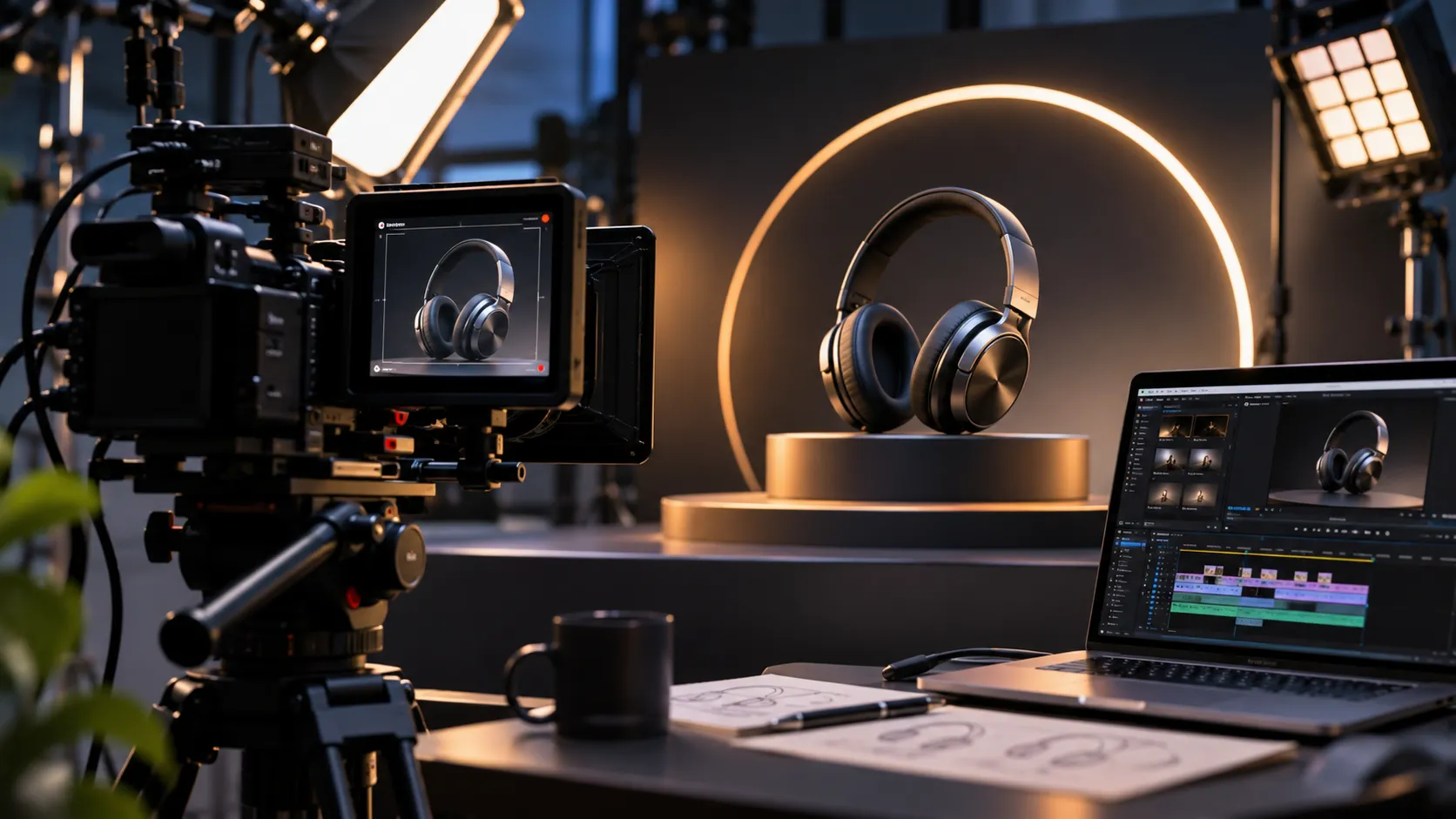
For studio product videography, the team also considers backgrounds, surfaces, reflections, and camera movements.
A glossy electronic device, for example, needs different lighting from a textured fabric product.
Products should be cleaned, inspected, and prepared before filming. Packaging, accessories, and spare units may also be needed.
Careful pre-production reduces unnecessary retakes and keeps the project aligned with the original brief.
Step 4: Film the Product
Production is where the concept becomes actual footage.
Professional product videography uses controlled lighting, suitable lenses, camera movement, composition, and direction to reveal the product clearly.
Common techniques include close-up shots for important details, rotating shots for product shape, overhead shots for demonstrations, and slow-motion footage for movement.
However, cinematic techniques should support the message rather than distract from it.
If the customer needs to understand how a product is assembled, a clear, uninterrupted demonstration may be more effective than a series of dramatic cuts.
The objective is to create visuals that are both attractive and genuinely informative.
Step 5: Edit and Complete Post-Production
Once filming is finished, the footage moves into post-production.
Editors select the strongest shots, arrange the sequence, adjust pacing, and combine visuals with supporting elements such as music, voiceovers, graphics, and captions.
Color grading helps maintain a consistent visual style, while sound design adds depth and clarity.
Motion graphics can be used to highlight product features, measurements, or technical information.
For certain projects, animation can also be integrated with live-action footage.
The important thing is maintaining a clear connection between the visuals and what the customer needs to understand.
Step 6: Export and Optimize for Distribution
The final video should be prepared for the channels where it will appear.
A product page might need a detailed horizontal video. Instagram Reels may require a vertical edit. A paid advertisement may need a shorter opening and a more direct call to action.
Subtitles, thumbnails, aspect ratios, file sizes, and platform specifications all matter.
Instead of treating distribution as an afterthought, plan the required outputs before the shoot.
For brands producing content across multiple channels, a short-form video marketing strategy can help turn longer production footage into platform-specific content.
How to Create Product Videos That Actually Drive Sales
High production quality alone doesn’t guarantee sales.
A beautifully shot video may attract attention without answering the questions stopping someone from buying.
The following principles help connect creative production with commercial objectives.
Show the Benefit Before Explaining the Feature
Customers care about what a product does for them.
Instead of opening with technical specifications, demonstrate the outcome.
If you’re selling a portable vacuum cleaner, show it removing dirt from a difficult-to-reach area before discussing motor power.
The viewer immediately understands the practical value.
Specifications still matter, particularly for technical products, but they become more persuasive once the benefit is clear.
Demonstrate Real-World Usage
Products are easier to evaluate when shown in realistic conditions.
For industrial equipment, this might mean demonstrating operation on an actual production line.
For consumer products, it could involve showing the item in a typical home or workplace.
Authentic usage helps customers understand scale, performance, and practical applications.
Avoid demonstrations that make products appear capable of something they cannot reliably do.
Keep the Opening Relevant
The first few seconds should give viewers a reason to continue watching.
That doesn’t always require a dramatic visual effect.
Sometimes an interesting product demonstration, a relatable problem, or an unexpected application is enough.
For paid social advertising, the opening may need to establish relevance immediately. For a product page, shoppers may already be interested and prefer a more direct explanation.
Match the hook to the viewing context.
Include a Clear Call to Action
A product video should make the next step obvious.
Depending on the objective, that might be purchasing the product, requesting a demonstration, exploring specifications, contacting sales, or comparing models.
The call to action should match the viewer’s level of readiness.
Someone watching a technical explainer for the first time may not be ready to purchase, but they could be interested in booking a consultation.
This is why video content should be connected to a wider marketing funnel that converts, rather than treated as a standalone creative asset.
How Long Should a Product Video Be?
There isn’t one ideal product video length.
The right duration depends on the product’s complexity, the audience, and where the content will appear.
| Product Video Type | Suggested Starting Length |
|---|---|
| Social media product teaser | 10–30 seconds |
| Product promotional video | 15–60 seconds |
| eCommerce product showcase | 30–90 seconds |
| Product demonstration | 1–3 minutes |
| Technical product explainer | 2–5 minutes or longer |
These are planning ranges, not platform rules.
A complicated industrial product might require several minutes to explain properly, while a simple consumer accessory may need only a short demonstration.
Prioritize the information customers need instead of forcing every video into a predetermined duration.
How Much Does Product Video Production Cost?
Product video production costs vary considerably depending on the requirements.
A straightforward studio shoot for a single product will usually involve fewer resources than a multi-location commercial with actors, elaborate set design, and advanced animation.
The main cost factors include:
- Creative development: Research, scripting, concepts, and storyboards.
- Production requirements: Studio rental, equipment, crew size, and shooting days.
- Product complexity: Special lighting, macro photography, demonstrations, and technical preparation.
- Talent and locations: Actors, presenters, voice artists, props, and location permissions.
- Post-production: Editing, visual effects, motion graphics, sound design, and color grading.
- Deliverables: Multiple formats, alternate edits, language versions, and platform adaptations.
For businesses comparing product video production companies, it’s important to ask exactly what’s included in the quotation.
Two proposals can look similar in price while covering very different production requirements.
A detailed brief and agreed deliverables make it easier to compare costs and avoid surprises.
Where Should Businesses Use Product Videos?
Creating the video is only part of the job. Distribution determines how much value the business receives from it.
Product pages: Place demonstrations near relevant product details so customers can evaluate the product while considering a purchase.
Social media: Use short, visually engaging edits to introduce features, applications, and product benefits.
Paid advertisements: Test different hooks, benefits, and calls to action to understand what generates qualified traffic and conversions.
YouTube: Publish detailed demonstrations, comparisons, tutorials, and product explainers that respond to common customer questions.
Email marketing: Direct subscribers to relevant video content during launches, product announcements, and follow-up campaigns.
Sales presentations: Give sales teams clear demonstrations they can share with buyers evaluating technical or expensive products.
The strongest distribution strategy considers how each audience discovers, researches, and evaluates the product.
How to Measure Product Video Performance
Views can tell you how widely a video was watched, but they don’t explain whether it helped the business.
Start with the objective established during planning.
For awareness-focused videos, useful metrics include reach, watch time, and audience retention.
For product-page videos, look at video engagement, add-to-cart rates, and conversion rates.
For lead-generation campaigns, measure qualified enquiries, demo bookings, and cost per lead.
Where possible, compare performance between similar pages or audiences with and without video. Controlled A/B testing is more reliable than assuming a change in sales came entirely from adding video.
Also pay attention to where viewers stop watching. A significant drop before the main product demonstration could indicate that the introduction is too long.
The goal isn’t simply to produce more videos. It’s to learn which content helps customers make decisions.
Common Product Video Production Mistakes to Avoid
Several recurring problems can reduce the effectiveness of otherwise well-produced videos.
Making the video entirely about features: A long specification list rarely explains why someone should care. Connect features to actual benefits.
Using excessive visual effects: Motion graphics and cinematic transitions should improve understanding, not overwhelm the product.
Ignoring the target platform: A horizontal product film may need substantial editing before it works effectively as a vertical advertisement.
Overcomplicating the script: Trying to communicate every detail in one video can leave viewers remembering very little.
Forgetting mobile viewers: Small text, distant product shots, and unclear captions can make videos difficult to follow on phones.
Skipping performance analysis: Without measurement, brands cannot distinguish effective video content from content that simply looks impressive.
Avoiding these mistakes starts with a clear objective and continues through production, editing, and distribution.
Choosing the Right Product Video Production Company
Finding the right production partner involves more than comparing showreels.
Look for a team that understands your product, your audience, and the business outcome you’re trying to achieve.
Ask how they approach concept development, whether they provide scripts and storyboards, what their production process includes, and how revisions are managed.
Review work similar to your requirements. A company experienced in cinematic brand films may approach a technical machinery demonstration differently from a team specializing in product explainers.
It’s also helpful to evaluate whether the production partner can deliver multiple content formats from one project.
At Kween Media, our work covers corporate films, commercial content, product-oriented videos, and 3D animation. Our approach combines creative storytelling with the practical requirements of presenting products clearly.
Businesses can explore our production portfolio to see examples of different visual styles and production formats.
Final Thoughts: Make Every Product Video Serve a Purpose
A good product video should do more than make a product look attractive.
It should answer a question, demonstrate a benefit, overcome uncertainty, or help someone move closer to a purchasing decision.
That requires more than professional cameras and editing software. It requires understanding the product, the buyer, and the role the video plays in the wider marketing strategy.
Whether you’re producing a short eCommerce product video, a detailed demonstration, or a cinematic product launch film, the starting point should always be the same: What does the customer need to see before they’re ready to act?
Get that right, and the creative decisions become much easier.
Bring Your Product Story to Life With Kween Media
Every product has something worth showing. The challenge is presenting it in a way that makes people understand its value.
At Kween Media, we help brands translate product features, ideas, and experiences into engaging visual content through professional production, editing, storytelling, and animation.
If you’re planning a new product launch, updating your eCommerce content, or looking for a stronger way to demonstrate what you sell, explore our video production services and let’s discuss how to bring your product to screen.
Frequently Asked Questions
What is product video production?
Product video production involves creating video content that demonstrates a product’s appearance, features, functionality, and benefits. It includes concept development, scripting, filming or animation, editing, and delivery for marketing or sales channels.
Do product videos help increase sales?
Product videos can support sales by improving product understanding, reducing uncertainty, and helping customers evaluate their options. Their actual impact depends on video quality, audience relevance, product demand, placement, and the overall buying experience.
What equipment is used for professional product videography?
Professional product shoots may use mirrorless or cinema cameras, macro lenses, studio lights, tripods, sliders, turntables, and controlled backgrounds. Equipment selection depends on the product’s size, material, movement, and intended visual style.
Should I use live-action video or 3D product animation?
Live-action works well when buyers need to see a physical product operating in realistic conditions. 3D animation is particularly useful for showing internal mechanisms, complex engineering, product variations, or designs that are difficult to film physically.
Can one product video be used across multiple platforms?
Yes, provided the footage is planned with different formats in mind. A production can generate separate edits for websites, YouTube, social media, paid advertising, and sales presentations. Each version should be optimized for its intended audience and platform.