
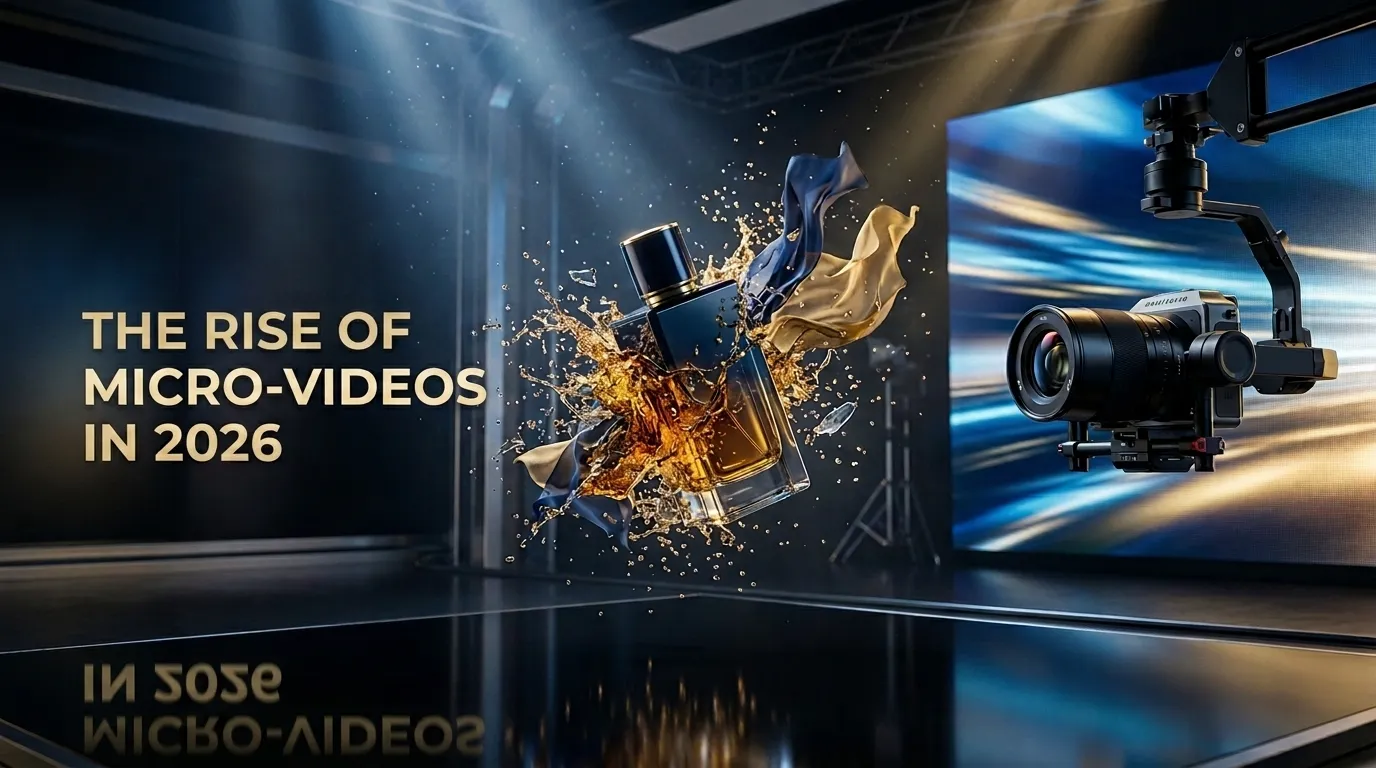
Why are micro-videos rising in 2026? Scroll speed has changed everything about how brands need to show up online.
The average viewer doesn’t pause. They don’t read. They feel something, or they move on. Brands that understand this are building content designed for that split second. Not longer videos cut short, but assets built specifically to land in under three seconds.
Micro-videos are one of the fastest-growing brand content formats in 2026. Platforms reward them. Algorithms surface them. Audiences respond to them, often without realising it. A flash of motion, a sound cue, a colour combination — these register before conscious attention kicks in. That’s the window brands are learning to work with.
This blog covers what micro-videos are, why they work, and how to produce them well.
What Are Micro-Videos?
Micro-videos are 1–3 second clips built around a single sensory idea.
They don’t tell a story or explain a product. They create an impression: a flash of brand recognition that builds over repeated exposure. Think of a product catching light in a specific way. A logo animating with a distinct sound. A texture moving across the frame. One idea. Done.
This is what separates micro-videos from regular short-form content. A fifteen-second Reel still has structure. A micro-video has a moment. That distinction is what micro-storytelling is built on – the idea that small, precise moments create emotional weight without needing duration.
Why 1–3 Second Sensory Experiences Work
The brain processes visuals faster than language. Sound triggers memory before the viewer has formed a conscious thought. Motion pulls attention involuntarily.
Micro-videos work in 2026 because they operate at that pre-conscious level. A colour palette, a movement signature, a recurring sound. Repeated enough times across touchpoints, these become brand signals. The viewer doesn’t need to read a logo. They already know who it is.
This is sensory branding in its most compressed form. Brands that invest in building these associations accumulate something valuable. Recognition that doesn’t depend on the viewer paying attention. The psychology of brand videos supports this — familiarity builds trust faster than any single piece of communication can on its own.
Core Elements of a Strong Micro-Video
Every frame counts when there are only a handful of them.
The first frame does most of the work. If it doesn’t pull attention immediately, the clip is gone. Strong micro-videos open on something visually unambiguous. A product, a movement, a light effect. No build-up. No context-setting. Straight into the moment.
Shot composition becomes more precise at this scale. Clutter kills micro-videos. One subject, one focal point, intentional framing. The background, the depth, the direction of light: all of it communicates immediately because there’s no time for the eye to adjust.
Motion needs to feel complete. A clip that starts mid-movement and cuts awkwardly leaves the viewer with nothing to hold onto. The motion should have a natural arc, even if it’s only two seconds long, so the loop feels intentional.
Sound is the most underused element in micro-video production. Cinematic sound design at this scale means one distinct audio cue. A texture. A tone. A rhythm hit. Something the audience can associate with the brand across repeated exposures.
Looping is worth planning from the shoot stage. A micro-video that loops seamlessly plays longer without the viewer choosing to replay it. That’s additional exposure from the same asset.
Where Brands Can Use Micro-Videos in 2026
Micro-videos are reusable across more touchpoints than most brands currently use them.
On social (Instagram Reels, TikTok, YouTube Shorts, LinkedIn), they work as openers, as paid ad units or as retargeting assets. The algorithm rewards completion rate. A two-second clip gets completed almost every time it’s watched.
On owned channels, the opportunities are wider. Landing page headers. Email campaign headers. Sales decks. Event screens. Product launch countdowns. Each of these is a brand impression opportunity where a micro-video outperforms a static image.
Planned as part of a brand video funnel, micro-videos serve the awareness and retargeting stages particularly well. They’re not the asset that converts. They’re the one that makes the converting asset work better because the audience already recognises the brand.
Produce them as a library, not individually. A single shoot can yield dozens of micro-video assets. That’s a content bank with multiple uses.
How AI Is Making Micro-Video Creation Faster In 2026
AI has made micro-video production significantly more accessible for brands without large production teams.
Concept generation is faster. AI tools can produce visual references, hook variations, and platform-specific framing suggestions from a brief. What used to take a creative session now takes minutes. Teams can evaluate more options and move into production with a clearer brief.
Repurposing longer content is where AI adds consistent value. A two-minute brand film contains dozens of potential micro-video moments. AI tools identify high-motion, visually strong frames and generate clips automatically. The editing time drops considerably.
Generative AI in storyboarding has made it easier to plan micro-video sequences before the shoot. Teams can visualise how a sensory moment will look in motion without committing to production time first.
Testing at scale is now practical. AI-assisted production makes it viable to produce ten variations of the same micro-video concept with different colour grades, different crops, different sound cues, and run them against each other. The data returns quickly at this format length.
Common Mistakes Brands Should Avoid
The most common mistake is treating micro-videos as shortened versions of regular content.
- Cramming in text is the clearest signal that a brand hasn’t understood the format. A viewer watching a two-second clip has no time to read. Text in a micro-video competes with the visual and wins nothing.
- Trying to communicate more than one idea is the same problem at the concept level. One sensory cue. One brand signal. One impression. Multiple ideas create noise, and noise gets scrolled past.
- Ignoring sound is a production error that undermines the whole asset. Muted feeds are common, but sound-on viewing is rising, especially on TikTok and YouTube. A micro-video with strong audio performs better across both contexts than one built only for silent viewing.
- Weak first frames are a conversion problem. The opening image determines whether the viewer stays. Pacing in video editing at this scale means the strongest visual moment leads, not builds toward the end.
- Poor looping breaks the experience. A jarring loop signals low production value. It also cuts the effective view time in half.
- Treating micro-videos as random clips rather than planned brand assets is the biggest strategic mistake. They only build brand recognition through consistency and repetition. One-off clips don’t accumulate.
Conclusion: Small Videos, Big Brand Impact
There’s a version of micro-video strategy that most brands haven’t tried yet: a library of sensory assets, planned from the shoot stage, deployed consistently across every touchpoint.
The brands building this now are accumulating something competitors can’t quickly copy: recognisable brand signals that work before the viewer has consciously engaged. A colour. A sound. A movement. These register fast and stay longer than any copy-led format.
Three seconds doesn’t sound like much. Used well, it’s enough to make a brand impossible to forget.
Start with one strong sensory idea. Build a library around it. Test what lands. The corporate video production services conversation for micro-videos starts earlier than most brands expect – at the concept stage, not the edit.
Want to build a micro-video library that actually builds brand recall? Kween Media produces short-form content designed to work at every stage of the funnel. Connect with us to get started.