
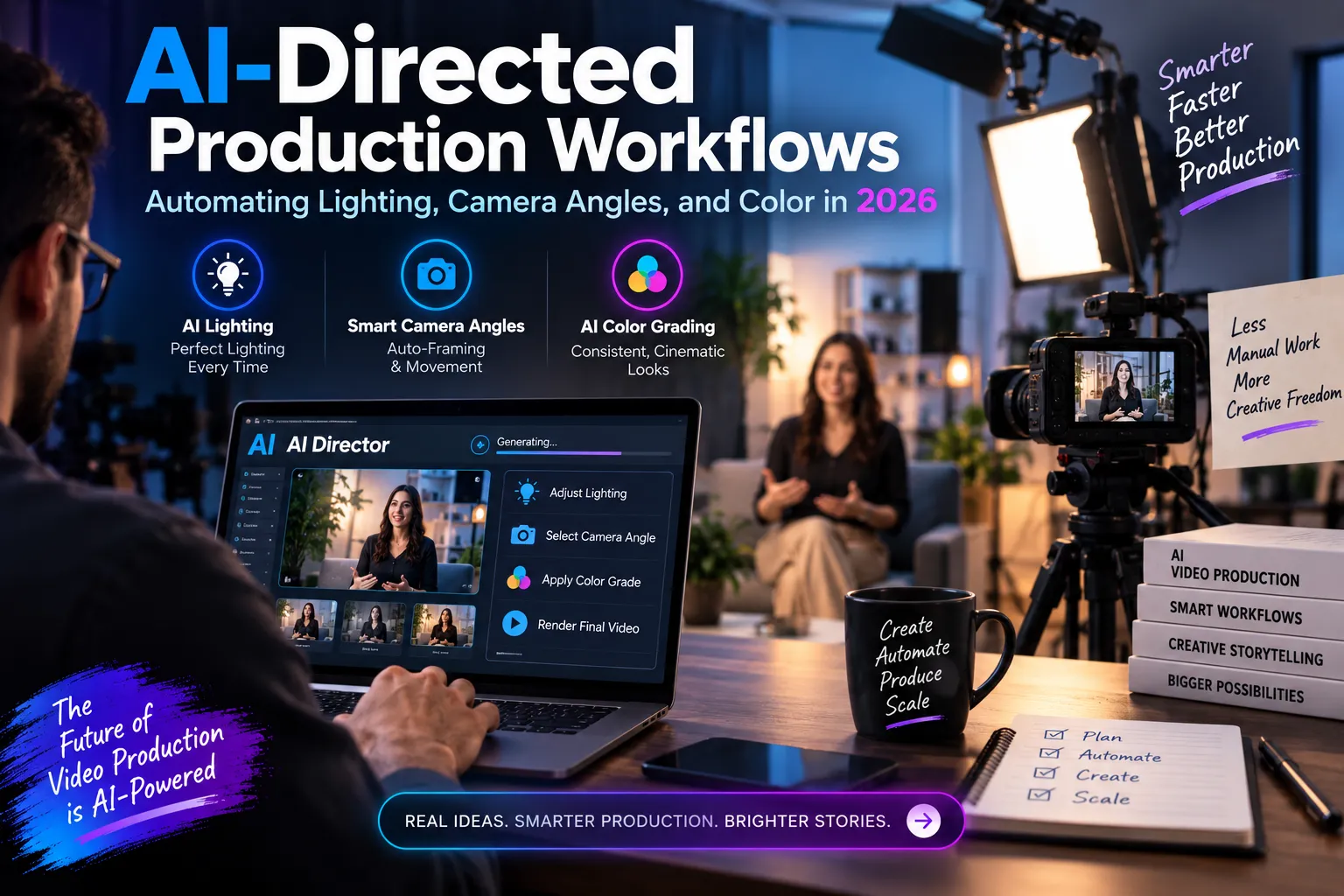
For most of video production history, the technical decisions happened in real time on set. A gaffer adjusting lights by eye. A colorist building grades from scratch in the suite. Experience-dependent at every stage, and slow. But we’re now in the era of AI-directed production workflows – where AI video production tools handle the technical heavy lifting so creative teams don’t have to.
AI filmmaking tools have started to take on the repetitive parts of that process without touching the creative core of it. Lighting recommendations generated from scene analysis, color consistency maintained automatically – capabilities that used to require manual effort at every step are now handled in the background. Automated video production workflows are in active use on professional productions right now, and the teams using them are finishing faster with fewer technical revisions.
Creative decision-making still stays human. What changes is how much time creative people spend on decisions that don’t require creativity.
What Are AI-Directed Production Workflows?
AI-directed production workflows use machine learning to assist across production stages rather than sitting in just one part of the process.
AI pre-production tools analyse scripts and generate shot recommendations, flag potential continuity issues, and support AI production planning for locations before the crew arrives. Generative AI in storyboarding has extended this further, turning written concepts into visual references that directors and clients can review before a single camera rolls.
During production, AI assists with exposure balancing and real-time continuity tracking across takes. In post, the same data collected on set informs color grading, ensuring visual consistency without the colorist having to manually match every cut.
The key distinction is between AI assistance and autonomous filmmaking. No AI system is directing films. What AI is doing is handling the technical groundwork that previously consumed significant time from people whose value lies in judgment calls, not calibrations.
How AI Is Automating Lighting, Camera Angles, and Color
Lighting has historically been one of the most time-intensive parts of any production setup.
Smart lighting systems powered by AI lighting design tools now analyse a scene – subject position, ambient conditions, intended mood – and generate recommended lighting configurations before the gaffer starts rigging. For productions working in familiar formats like interview setups or product shots, this means arriving on set with a starting configuration rather than building from zero. How lighting design shapes emotion in video production is still a deeply human creative decision. The AI handles the technical scaffolding around it.
AI cinematography and AI camera automation tools handle camera positioning and framing suggestions in a similar way. Machine learning video production models trained on cinematographic principles can recommend shot sizes, angles, and lens choices – including automated camera movement paths – for a given scene type. These aren’t mandates – they’re starting points that experienced DPs can accept, modify, or override based on creative intent. The value is in reducing time spent on standard decisions so more attention is available for the non-standard ones.
AI color grading – specifically AI-assisted color grading – has become one of the more mature applications in this space. Scene matching across footage shot over multiple days in varying ambient light conditions – work that previously consumed significant post-production time – is now handled automatically as a first pass. Colorists focus on the creative grade rather than the technical consistency problem.
Multi-camera synchronisation and automated exposure balancing during shooting reduce the number of technical problems that arrive in the edit. Fewer problems in the edit means faster turnaround.
Benefits of AI-Directed Production Workflows
Intelligent video production built around AI creative workflows delivers compounding efficiency gains for brands producing content on a regular schedule.
Production timelines compress when AI handles the technical setup work. A shoot that previously required three hours of lighting and camera preparation might now begin properly in ninety minutes. Across multiple shoot days or regular production schedules, that time saving is substantial.
Visual consistency is harder to maintain manually than most clients realise. A brand video series shot across six months in different locations by different crews will have visual variations unless there’s a strong technical framework enforcing consistency. AI-assisted video production workflows maintain that consistency automatically, so the series looks like a series rather than a collection of individual pieces.
For brands building a content library, this is specifically valuable. Why every startup needs a video asset library is partly an argument about consistency – assets that share a visual language are more useful than assets that happen to feature the same brand. AI production workflows make that consistency achievable without rebuilding the technical brief every time.
Hero, Hub and Help video strategy works better when the production framework supports regular output. AI-assisted workflows reduce the per-video production overhead, making sustained content programmes more viable.
Human Creativity Still Leads the Process
There’s a version of the AI production conversation that implies that creative teams are becoming redundant. Productions that treat it as accurate produce work that shows the gap.
Brand strategy doesn’t come from a model. The decision about what story to tell and why it matters to the audience – that’s creative and strategic thinking that AI can inform but can’t replace. Video storytelling for brands depends on understanding the audience at a level that requires human judgment.
Performance direction is entirely human. An AI can recommend a camera angle. It can’t tell a subject that they’re holding tension in their shoulders or that the energy in the last take was closer to what the scene needed. The director’s relationship with the people in front of the camera is what produces usable footage.
Script interpretation – understanding what a line of copy means for how a scene should feel – is where creative direction lives. The hero’s journey in brand storytelling is a narrative framework, and applying it requires understanding what journey the brand’s audience is actually on. That understanding comes from people, not tools.
Client collaboration, the back-and-forth of understanding what a brand actually needs versus what they think they want, is the part of production that AI has no role in.
Common Mistakes When Adopting AI Production Tools
Over-reliance on automation without human review is where AI-assisted productions go wrong most consistently.
AI lighting recommendations are trained on patterns from previous footage. They perform well in familiar setups and less well in novel ones. A recommendation that makes sense for a standard interview setup might produce something technically correct and creatively wrong for a specific brand’s visual identity. Someone with creative authority needs to evaluate the output, not approve it automatically.
Inconsistent prompts and workflows produce inconsistent results. AI tools need structured inputs to generate reliable outputs. Teams that approach AI tools ad hoc – different prompts for similar scenes, no established workflow framework – don’t get the consistency benefits that make the tools valuable.
Poor quality control in post compounds errors from the shoot. Is AI replacing editors? addresses this directly – AI handles specific tasks reliably and produces technical failures at the edges of those tasks. Human review catches what the automation misses.
Treating AI as a replacement for creative planning is the strategic mistake that produces the most visible failures. AI scriptwriting tools and production automation work well when executing against a clear creative brief. They don’t generate the brief.
The Future of AI-Directed Video Production
Real-time AI production assistants are the near-term development with the most immediate practical impact.
Systems that monitor a live shoot and flag continuity issues or framing problems as they happen – rather than after the footage reaches the edit – prevent problems from becoming expensive fixes. That capability exists in early form now and is developing quickly.
Predictive shot planning is another development in generative AI filmmaking – models that analyse a script and suggest optimal shooting schedules based on location conditions and technical requirements are moving from research towards production-viable tools. The efficiency gains in complex multi-location productions would be significant.
Real-time virtual production integrates naturally with AI production workflows. Virtual environments rendered in real time can be adjusted by AI lighting systems automatically as camera position changes. The production becomes more responsive and less dependent on manual reconfiguration between setups.
Generative AI in scriptwriting connects to the AI video editing workflow more directly as the tools develop. A script generated or refined with AI assistance can feed directly into shot planning and storyboarding tools, creating a more integrated pre-production process.
Conclusion: Smarter Workflows, Better Stories
Production teams that have adopted AI-assisted workflows consistently report the same experience: the technical tasks that used to consume time and attention are faster, and the creative work benefits from that freed attention.
The productions getting the most from these tools aren’t using AI to cut corners. They’re using it to remove the friction between having a creative idea and executing it well – lighting setup in half the time, color consistency handled in the background, shot planning that starts from analysis rather than from scratch.
Human creative direction still determines whether the result is worth watching. The AI just makes it faster to get to a point where that question can be properly answered.
Corporate video production services built around AI-assisted workflows deliver faster without trading quality for speed.
Looking for a production partner who uses AI where it helps and expertise where it counts? Kween Media builds video workflows that combine AI-directed production workflows with human finesse. Find out how.