
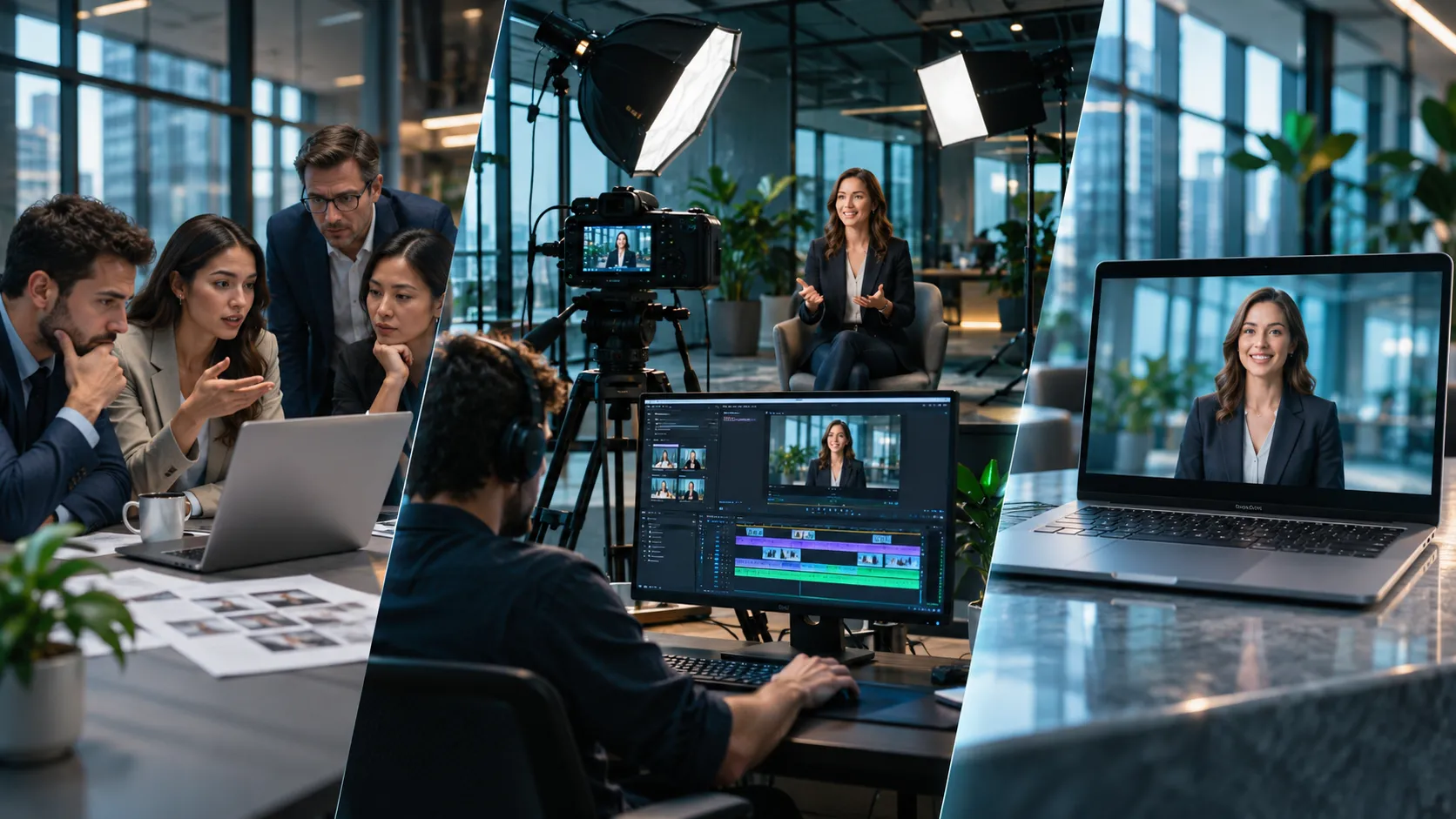
Most businesses commissioning their first corporate video have a rough idea of what they want but almost no idea how it gets made. Then the project starts, things get confusing partway through, timelines drift, revision rounds multiply & the final video comes out differently from what anyone pictured at the start. All of this usually traces back to the same root cause: the client didn’t know what the process involved before they were in the middle of it. Understanding the corporate video production process – what happens at each stage, why it matters & where things tend to go wrong – is what prevents most of the common problems. This is a walkthrough of the full workflow.
What Is the Corporate Video Production Process?
Corporate video production is the structured workflow that takes a business objective and produces a finished video. How corporate videos are made varies – a short social media ad has a leaner process than a ten-minute brand documentary – but the core stages of video production apply across most projects.
The corporate video production steps, in order:
- Strategy and briefing
- Pre-production planning
- Filming
- Post-production and editing
- Review and revisions
- Final delivery
These stages are closely linked. Each one sets up the next. Decisions made in the brief determine what pre-production looks like. Pre-production determines how smoothly filming goes. Filming determines what the editor has to work with. The whole thing is sequential, which is why rushing the early stages costs more time later than it saves.
Kween Media’s corporate video production services handle the full workflow, from initial brief through to multi-format delivery.
Stage 1 – Understanding the Goal and Creative Brief
Production doesn’t start with a camera. It starts with a conversation about what the video is actually for.
Define the Video Objective
Brand awareness, product promotion, internal communication, recruitment, training, customer education, lead generation – these are different goals that need different videos. A recruitment video for graduate hires looks nothing like a product demo for enterprise procurement. Getting specific about the objective before anything else shapes every decision downstream.
The mistake here is being vague. “We want to promote our brand” is not an objective. “We want to introduce ourselves to mid-size manufacturing companies who haven’t heard of us” is an objective.
Identify the Target Audience
Your audience determines the right tone, message, visual style, length & platform for your video. The same company making a video for a technical engineering audience and for an investor audience needs two different videos, even if the underlying content overlaps.
Decide the Main Message
One message per video. What should viewers remember? What’s the problem it solves for them? ? What should they do after watching? If you can’t answer all three in a sentence each, the brief needs more work before production starts.
Define Deliverables
It’s common to think about the “main video” and forget that the brief should also cover social media cuts, vertical formats, a website version, a shorter ad, a presentation cut. Each of these is a deliverable. Identifying them before the shoot means the production is planned to capture everything needed. Adding deliverables after filming means going back, which costs more.
Corporate video strategy covers how to connect these production decisions to broader marketing goals before the brief gets signed off.
Stage 2 – Pre-Production Planning
The shoot will go roughly as well as the pre-production did. That’s not an exaggeration – it’s just how it works.
Concept Development
The creative direction gets established here. What storytelling approach fits? What visual tone is right for this brand and audience? Whether the video follows a narrative structure, a talking-head format, a product demonstration, or something hybrid – that decision shapes everything that follows. Video storytelling decisions made here determine whether the final video has an actual arc or just a sequence of information.
Scriptwriting
The script might cover narration, on-camera dialogue, interview questions, key messages & the CTA – depending on format. A strong script is the single best predictor of a good final video. Weak scripts don’t get saved in the edit. For longer brand films, understanding how narrative arcs work helps scriptwriters build something with real structure rather than a list of talking points dressed up as a story.
Storyboarding and Shot List
A storyboard maps the visual sequence – scenes, camera angles, transitions, B-roll moments. The shot list is the practical document, a scene-by-scene breakdown of everything the crew needs to capture. Both documents mean the team arrives on location with a plan rather than making it up as they go.
Location Planning
Office environments, studios, factories, outdoor locations – each has different lighting conditions, sound challenges & logistical requirements. A boardroom that looks clean to the eye might have fluorescent flicker on camera, HVAC noise, or a window behind the subject that blows out the exposure. Finding these things out on the shoot day is expensive. Finding them out during a recce is free.
Talent and Participants
Founders, employees, customers, professional actors, voice-over artists – whoever’s appearing on camera needs to be briefed properly. First-time on-camera subjects usually need more warm-up time and more takes than experienced talent. Factoring that into the schedule prevents the day from running over because someone needed fifteen takes to settle in.
Production Schedule
Shoot dates, crew, equipment, call times, location timing, interview slots. The schedule is also the document that surfaces conflicts – a location that runs over, an interviewee only available for one hour, equipment needed back by end of day. Better to find those conflicts on paper than on the day.
Stage 3 – Production and Filming
Production is the most visible part of the corporate video workflow – cameras, lighting, crew, the actual recording. How well it goes is mostly determined by what happened in pre-production.
Setting Up the Shoot
Cameras, lighting, microphones, monitors, background elements – all of this gets arranged and checked before recording starts. Audio levels get tested. Framing gets confirmed on monitor. This part takes time. A rushed setup shows up in the footage.
Filming Interviews and Main Scenes
Clear audio, correct framing, consistent lighting, natural delivery from participants – these are the things that make interview footage usable. Multiple takes on key sections give the editor options. Shot composition decisions on the day determine whether the final edit feels considered or like someone pointed a camera at people and pressed record.
Capturing B-Roll
B-roll is the supporting footage that covers narration and interview audio – employees working, products being used, the office environment, machinery, client interactions. It’s what makes a talking-head video watchable and gives the editor material to cut around stumbles, restructure sequences, or cover a transition that isn’t landing. Not capturing enough B-roll is one of the most common production mistakes & there’s no way to fix it without going back.
Shooting for Multiple Platforms
If the deliverables include vertical formats, the shoot needs to account for that. Footage planned only for 16:9 creates real problems when it gets cropped for Instagram or Shorts later. Planning for multiple aspect ratios during production – not in the edit – means every output works cleanly.
Stage 4 – Post-Production and Editing
Post-production is where footage becomes a finished video. For complex projects, this stage takes longer than filming.
Footage Selection
Everything captured gets reviewed, the best takes get selected & interview answers and B-roll get organized by sequence and theme. On a multi-day shoot this step alone takes significant time. Good organization here makes the build faster.
Creating the Rough Cut
The editor builds the basic structure – sequence, pacing, approximate duration – from selected footage. No final music, no polished graphics, no mixed audio yet. The rough cut is a structural draft. Its job is confirming whether the narrative holds together before refinements start.
Adding Branding and Motion Graphics
Motion graphics and branded elements – logo animations, title cards, lower thirds, charts, text callouts – bring the brand’s visual identity into the edit. On corporate videos these elements often carry important information: speaker names, statistics, key messages. They need to read clearly without cluttering the frame.
Sound Design and Music
Sound design covers dialogue cleanup, music selection and placement, sound effects, background ambience & volume balancing. The difference between a cut with placeholder audio and a finished mix is substantial – bigger than most clients expect when they first see a rough cut. Audio is what makes an edit feel finished.
Color Correction and Grading
Color grading corrects inconsistencies between shots and applies a consistent visual treatment across the whole video. Footage shot across different locations, different times of day & different lighting conditions doesn’t naturally look like it belongs together. Grading is what makes it cohesive.
Stage 5 – Review and Revisions
The first cut goes to the client. How smooth this stage goes depends heavily on how the client manages it on their side.
Collecting all stakeholder feedback before sending a single consolidated response makes a large difference. One organized list of changes is straightforward to action. Five separate emails arriving over three days with contradictory notes creates a revision process that takes twice as long as it needs to.
Pacing, specific graphics or text, music, the order of interview segments, tightening particular sections – these are all reasonable things to address in revisions. Fundamental changes to concept or structure at this stage are much harder, which is why the brief and script stages exist. Getting agreement on direction before filming is the whole point of those stages.
One main decision-maker with sign-off authority speeds up approvals significantly. Productions with multiple stakeholders and no clear hierarchy for final decisions tend to stall.
Stage 6 – Final Delivery
One production generates several final files. Full-length video, website-optimized version, YouTube cut, LinkedIn version, Instagram Reel, YouTube Short, paid ad version, subtitled version, clean version without lower thirds, high-resolution master – the exact list depends on what was agreed in the brief.
Each platform has its own technical requirements: file format, resolution, duration, aspect ratio, audio specs. Confirming these before delivery avoids having to re-export.
For brands running content across multiple platforms, short-form video marketing strategy covers how to approach Reels, Shorts & TikTok so each version works natively on its platform.
How Long Does Corporate Video Production Take?
It depends. Video complexity, number of locations, shoot days, script approval timelines, animation requirements, revision rounds & the number of final deliverables all affect the timeline.
A simplified view of the corporate video workflow from start to finish:
Brief → Script approval → Pre-production → Shoot → Editing → Review and revisions → Final delivery
A straightforward single-location corporate video typically runs three to five weeks from a signed-off brief. More complex productions take longer. Client-side delays – slow script approvals, late feedback, unavailable stakeholders – are usually what extends timelines beyond initial estimates. That’s worth knowing if the video has a hard deadline attached to a launch or event.
What Affects Corporate Video Production Cost?
Crew size, cameras and equipment, shoot duration, locations, travel, on-screen talent, animation requirements, post-production complexity, revision rounds & number of final deliverables all factor in. Full detail on corporate video production costs in India is covered in a dedicated article.
One thing worth noting: more deliverables from the same shoot cost less per asset than producing each separately. Planning all outputs at the brief stage is the most cost-efficient approach.
Common Corporate Video Production Mistakes
- Going into production without a specific, measurable objective
- A script that gets approved too quickly without enough scrutiny
- Underinvesting in pre-production and paying for it in the edit
- Poor audio – often harder to fix in post than bad visuals
- Too many decision-makers with equal input and no clear sign-off authority
- Script changes requested after filming has started
- Ignoring mobile and vertical formats during the shoot
- Producing the video without a distribution plan
- Not capturing enough B-roll on the day
- Revision rounds driven by a changing brief rather than genuine improvements
How to Get More Content From One Video Shoot
A well-planned single production day can generate far more than one video. From the same footage a hero video, customer testimonial clips, founder or leadership clips, employee stories, Reels and Shorts cuts, paid ad versions, behind-the-scenes content, website clips, LinkedIn posts.
The condition is that these outputs get planned before the shoot, not after. Knowing six social formats need to come out of the day changes what B-roll gets captured and how interview segments get structured.
Building a brand video funnel from a single production investment means each shoot covers more of the customer journey. Planning a video asset library from the start makes all of this easier to organize and actually use.
How to Choose the Right Corporate Video Production Company
Look for a strong portfolio in work similar to yours, genuine storytelling ability rather than just technical execution, clear pre-production process & transparent communication about timelines and revision rounds. Relevant industry experience matters – a team that has produced in your sector already understands the tone, the audience & the practical constraints.
Kween Media’s portfolio and video production services cover corporate, brand & commercial production across formats and industries.
Conclusion – Strong Planning Is The Foundation of the Corporate Video Production
The corporate video production process has six stages – briefing, pre-production, filming, editing, review & delivery. Each stage depends on how clearly the previous one was executed.
The technical side – cameras, lighting, editing software – matters but it’s rarely what determines whether a video works. Planning does. Clear objectives, a strong script, thorough pre-production & clean feedback processes are what separate corporate videos that do something from corporate videos that just exist.
If you’re commissioning a video and want to understand what that process looks like in practice, start a conversation here.
FAQs
Q. What are the main stages of corporate video production?
A. The corporate video production process covers six stages: briefing and strategy, pre-production planning, filming, post-production and editing, client review and revisions & final delivery across agreed formats.
Q. How long does corporate video production take?
A. It depends on complexity, shoot days & how quickly approvals move. A straightforward single-location corporate video typically takes three to five weeks from a signed-off brief. Productions with multiple locations, animation, or many deliverables take longer.
Q. What happens during pre-production?
A. Pre-production covers concept development, scriptwriting, storyboarding, shot list creation, location planning, talent briefing & production scheduling. Most of the major creative and logistical decisions get made here – before any filming starts.
Q. How much does corporate video production cost?
A. Cost varies significantly based on crew size, shoot duration, locations, equipment, post-production complexity & number of deliverables. A full breakdown of corporate video production costs in India is in this dedicated article.
Q. How many revisions are normally required?
A. Most productions go through two rounds of revisions after the first cut. That number rises when feedback arrives in fragments from multiple stakeholders rather than as one consolidated list. One clear decision-maker on the client side reduces revision rounds considerably.
Q. Can one video shoot create multiple social media videos?
A. Yes – with the right pre-production planning. A single shoot can produce a hero video alongside Reels, Shorts, paid ad cuts, testimonial clips & website content. The key is deciding which outputs you need before the shoot, not after.