
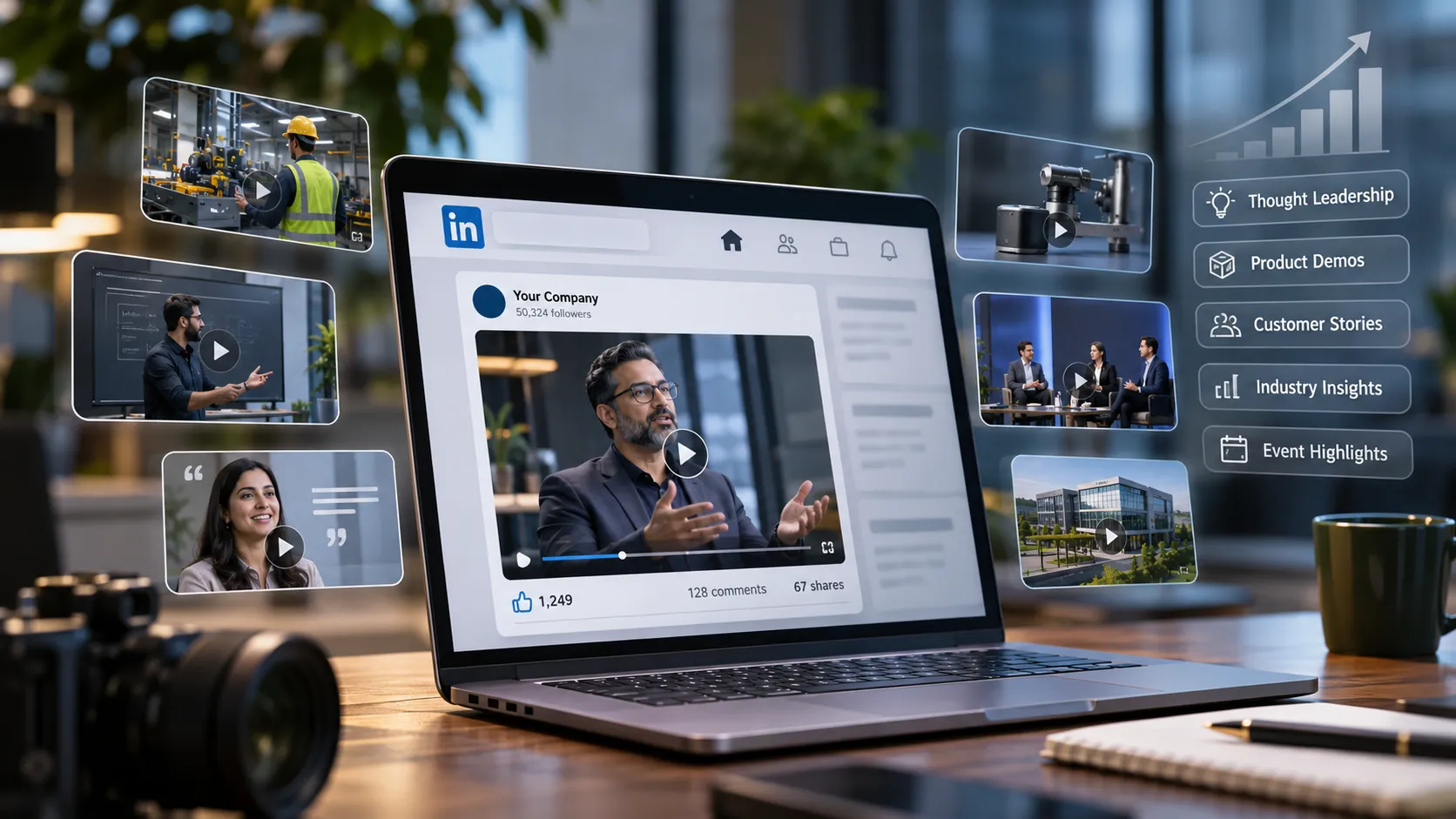
Most B2B brands are posting on LinkedIn. Far fewer are giving people a reason to watch.
You see the same thing repeatedly: a corporate announcement turned into a video, a product walkthrough that starts with a company introduction nobody asked for, or a polished brand film uploaded without considering who it’s meant to reach.
The problem isn’t necessarily production quality. It’s that LinkedIn video marketing works differently from traditional corporate advertising. People aren’t opening LinkedIn to watch commercials. They’re looking for industry knowledge, professional insights, useful ideas, and perspectives that help them make better decisions.
In 2026, the opportunity for B2B brands is to create videos that become part of those conversations. Not louder promotional content, but useful content that makes the right people remember your business.
Here’s what that looks like in practice.
Why LinkedIn Video Marketing Matters for B2B Brands in 2026
LinkedIn has become an increasingly important video distribution channel for companies trying to reach professional audiences.
According to LinkedIn’s 2026 B2B marketing insights, 78% of B2B marketers surveyed were already using video, while 56% planned to increase their use.
That shift makes sense.
B2B purchases rarely happen after one advertisement. Buyers compare providers, investigate solutions, discuss options internally, and evaluate whether a company understands their challenges.
Video helps businesses become familiar and credible during that research process.
A founder explaining an industry problem, an engineer demonstrating a product, or a customer describing an implementation can communicate something that a conventional promotional post often cannot.
There’s also a difference between getting attention and building trust. A video might generate thousands of impressions without influencing a single serious buyer.
The real objective is to reach relevant professionals with information worth remembering.
What Is a LinkedIn B2B Video Marketing Strategy?
A LinkedIn video marketing strategy is a structured approach to creating, publishing, distributing, and measuring video content designed for professional audiences.
For B2B companies, that usually means connecting videos to different stages of the buyer’s journey.
Some videos introduce a problem. Others explain potential solutions, demonstrate expertise, or provide evidence that helps buyers evaluate a vendor.
A manufacturing company, for example, might publish an engineering insight to attract operations managers, a factory walkthrough to demonstrate capabilities, and a customer case study to support purchasing decisions.
Those videos serve different purposes, even though they’re reaching overlapping audiences.
This connects directly to building a brand video funnel that converts. The objective isn’t to make every video sell immediately. It’s to give buyers the right information when they need it.
6 Types of LinkedIn Videos That Work for B2B Marketing
1. Founder and Executive Thought Leadership Videos
People often connect with knowledgeable individuals before they develop a relationship with a company.
A founder explaining an industry change or a CEO discussing a difficult business decision can make a brand feel considerably more approachable.
The strongest thought leadership videos have a clear point of view.
Instead of saying, “Innovation is transforming our industry,” explain what has actually changed, why it matters, and what businesses should do differently.
A confident opinion backed by practical experience gives people something worth discussing.
2. Educational and Industry Insight Videos
Educational videos address the questions your ideal customers are already asking.
A cybersecurity company might explain a common security mistake. A logistics provider could break down an expensive supply-chain problem. A B2B marketing agency might discuss why certain campaigns generate enquiries but not qualified opportunities.
These videos work because they provide value before requesting anything in return.
Keep each video focused on one question or problem. Trying to explain an entire industry in 60 seconds usually produces a collection of disconnected talking points.
3. Customer Testimonial and Case Study Videos
B2B buyers want evidence.
A customer describing the problem they faced, why they selected a solution, and what changed afterward provides far more useful information than another list of product benefits.
Effective B2B testimonial videos should feel like real conversations rather than scripted endorsements.
Show the customer’s actual working environment where possible. Include specific outcomes when they’re documented and approved for publication.
The strongest case studies also acknowledge context. A result achieved for one customer isn’t automatically guaranteed for everyone else.
4. Product Demonstration and Explainer Videos
Product demonstrations work particularly well when the solution is technical or difficult to understand through photographs.
For SaaS companies, this might mean demonstrating a workflow. For industrial manufacturers, it could involve showing machinery operating under real conditions.
The key is explaining the problem the product solves before overwhelming viewers with features.
If the product requires several minutes of explanation, consider dividing the demonstration into multiple videos covering individual use cases.
5. Behind-the-Scenes and Company Culture Videos
Behind-the-scenes content gives potential buyers a clearer picture of the people and processes behind a business.
Factory operations, project discussions, quality checks, production environments, and team experiences can all become useful video content.
These don’t always require elaborate production.
As explored in our guide to lo-fi authentic storytelling, some messages benefit from a more natural, less scripted presentation.
Authenticity doesn’t mean ignoring quality. Clear sound, sensible framing, and a focused message still matter.
6. Event Highlights and Webinar Clips
A single industry event or webinar can provide weeks of LinkedIn content.
Instead of uploading the entire recording, identify the moments that answer useful questions, challenge assumptions, or contain genuinely interesting insights.
A 45-minute discussion might produce several standalone videos, each built around one valuable idea.
This makes event content useful beyond the people who attended.
What Makes a LinkedIn Video Perform Well?
There isn’t one creative formula that guarantees reach or conversions. However, several principles consistently make videos easier to watch and understand.
Start With the Main Point
Avoid opening with a long logo animation, generic company introduction, or unnecessary background.
If the video addresses an expensive industry problem, say that immediately.
For example:
“Most manufacturers underestimate this one maintenance cost.”
That gives the intended audience a reason to keep watching.
Make Videos Understandable Without Sound
Many professionals encounter videos while scrolling through LinkedIn during their working day.
Captions, readable on-screen information, and clear visual demonstrations help communicate the message even when audio isn’t available.
LinkedIn’s own video advertising guidance recommends delivering important information early and designing for sound-off viewing.
Feature Real People When It Makes Sense
An expert speaking directly to the camera can be more appropriate than a cinematic montage, especially when the goal is establishing credibility.
That doesn’t mean every brand should abandon professional corporate videography.
A premium company film and a straightforward employee interview simply serve different communication objectives.
Choose the format based on the message rather than assuming one visual style works everywhere.
Give Every Video One Job
A video introducing your company shouldn’t also try to explain every service, share three customer stories, and generate immediate enquiries.
Choose one primary objective.
When the message is clear, the script, editing, duration, and call to action become much easier to decide.
LinkedIn Video Length and Format: What Works in 2026?
The ideal LinkedIn video length depends on what you’re communicating.
Short videos are useful for quick ideas and attention-building. Longer videos can work when the audience is genuinely interested in a detailed explanation.
| Video Type | Suggested Length |
|---|---|
| Quick industry insight | 15–45 seconds |
| Founder thought leadership | 30–90 seconds |
| Product demonstration | 45–120 seconds |
| Customer testimonial | 45–90 seconds |
| Case study or technical explainer | 1–3 minutes |
| Webinar highlights | 30–120 seconds |
These are practical starting points, not platform requirements.
Vertical and square formats are worth testing for mobile-first feed content, while landscape video remains useful for interviews, demonstrations, and footage requiring wider framing.
If you’re distributing content across several platforms, plan the framing during production rather than relying entirely on cropping afterward.
Our guide to short-form video marketing in 2026 explores how different platforms require different creative approaches.
Organic LinkedIn Videos vs LinkedIn Video Ads
Organic and paid LinkedIn video marketing should support each other, but they don’t serve identical purposes.
Organic LinkedIn videos help build familiarity, share expertise, encourage discussions, and maintain relationships with your professional audience.
They’re particularly useful for founder content, educational insights, company updates, and employee perspectives.
LinkedIn video ads allow businesses to distribute content to defined professional audiences through paid campaigns.
Advertisers can build campaigns around objectives such as brand awareness, website visits, and lead generation, using available targeting and measurement options.
LinkedIn also supports formats such as Thought Leader Ads, which can help businesses amplify eligible content from individual professional voices.
For B2B brands, a practical approach is to develop useful organic content, identify which messages resonate with the intended audience, and test suitable videos through paid distribution.
However, organic engagement doesn’t automatically predict advertising performance. The two should still be measured separately.
How to Build a LinkedIn Video Marketing Strategy
Step 1: Identify Your Ideal Buyer
Start with the people you’re trying to influence.
A business selling enterprise software to CFOs needs different content from a manufacturer targeting procurement managers.
Consider job responsibilities, industry challenges, purchasing objections, and the questions buyers ask before contacting sales.
Step 2: Create Three or Four Content Pillars
Choose repeatable topics that reflect your expertise.
For a B2B technology company, these might include industry challenges, product education, customer results, and expert commentary.
Content pillars make production more consistent and reduce the pressure to invent entirely new ideas every week.
Step 3: Plan Video Production Around Distribution
Before filming, identify where the content will appear and how many versions you’ll need.
One interview could become a longer thought leadership video, several shorter insights, and supporting clips for advertising.
This approach can make professional video production more efficient without sacrificing creative quality.
Step 4: Publish Consistently
A sustainable publishing schedule is more valuable than producing a large batch of videos and disappearing for months.
Start with a manageable cadence, such as two useful videos per week, then adjust based on available resources and performance.
Consistency helps develop recognizable themes and gives your team more opportunities to learn what resonates.
Step 5: Connect Videos to the Sales Funnel
Different videos should support different buyer needs.
| Buyer Stage | Recommended LinkedIn Videos |
|---|---|
| Awareness | Industry insights, educational clips |
| Consideration | Product explainers, expert interviews |
| Decision | Customer testimonials, case studies, demos |
| Retention | Tutorials, product updates, customer education |
This prevents the common mistake of asking every viewer to book a sales call, regardless of their interest or readiness.
How to Measure LinkedIn Video Marketing ROI
Video views are useful, but they’re only one part of performance measurement.
For brand awareness, examine reach, impressions, and the relevance of the audience reached.
For engagement, consider watch time, completion rates, meaningful comments, and shares.
For lead generation, focus on landing-page visits, qualified enquiries, booked meetings, and opportunities influenced by the campaign.
Use tracking parameters and campaign reporting where appropriate, while remembering that not every B2B purchase can be attributed to one video.
A video watched by 500 relevant decision-makers may be commercially more valuable than one watched by 50,000 unrelated people.
Measure whether the content is reaching the right audience and supporting business outcomes, not simply whether the view count looks impressive.
Common LinkedIn Video Marketing Mistakes
Several mistakes repeatedly undermine B2B video performance:
- Opening with lengthy brand introductions instead of useful information.
- Making every video a direct sales pitch.
- Using generic scripts that don’t address industry-specific problems.
- Publishing long webinar recordings without extracting useful highlights.
- Ignoring captions and mobile viewing.
- Producing content without a clear target audience.
- Measuring views without examining lead quality or buyer engagement.
Another common mistake is assuming expensive production automatically makes a video more effective.
Some campaigns require cinematic quality. Others need a knowledgeable person explaining something clearly.
Both can work when the creative approach matches the objective.
LinkedIn Video Marketing Trends B2B Brands Should Watch
In 2026, several developments deserve attention.
Expert-led storytelling: Buyers increasingly value identifiable voices with relevant expertise over anonymous corporate messaging.
Short-form educational videos: Concise, practical insights make complex professional topics easier to consume.
Employee and customer voices: Real experiences can help make technical and corporate messaging more credible.
AI-assisted production: Transcription, captions, editing assistance, and content repurposing can reduce repetitive production work, provided the final content remains accurate.
Full-funnel video strategies: Businesses are moving beyond isolated video campaigns toward connected content supporting awareness, consideration, and purchase decisions.
LinkedIn’s 2026 B2B marketing research reinforces the importance of combining creative storytelling with trust, expertise, and meaningful audience relationships.
FAQs About LinkedIn Video Marketing
Does LinkedIn video marketing work for B2B companies?
Yes. LinkedIn provides access to professional audiences, making it useful for thought leadership, product education, brand awareness, and lead generation. Results depend on content relevance, distribution, targeting, and measurement.
How often should a B2B brand post videos on LinkedIn?
Start with a schedule your team can sustain. One to three useful videos weekly can provide a workable testing cadence. Quality, audience relevance, and consistency matter more than posting simply to fill a calendar.
Are short videos better than long videos on LinkedIn?
Neither format is universally better. Short videos suit quick insights and introductions. Longer videos can be appropriate for technical demonstrations, customer stories, and deeper educational content.
Should B2B brands use professional video production?
Professional production is valuable for brand films, customer case studies, product demonstrations, and campaign assets. Simpler expert-led videos can also work well. Choose production quality according to the communication objective.
Can LinkedIn videos generate qualified leads?
Yes, when the content addresses relevant buyer problems and connects to suitable next steps, such as a demonstration, consultation, resource, or sales conversation.
Final Thoughts: Build Trust Before Asking for the Sale
LinkedIn video marketing in 2026 isn’t about turning every business update into a video or following every new content trend.
It’s about making professional expertise easier to understand, giving buyers useful information, and creating a recognizable presence in the industries you serve.
The brands that benefit most are likely to be those that treat video as an ongoing communication strategy rather than an occasional promotional activity.
At Kween Media, we help businesses turn complex ideas, company stories, and real-world expertise into engaging corporate and marketing videos.
Whether you’re developing founder-led content, customer testimonials, product demonstrations, or a wider B2B video marketing campaign, the right production approach starts with understanding what your audience needs to see.
Explore our corporate videography guide and discover how thoughtful video storytelling can help your brand communicate with confidence.