
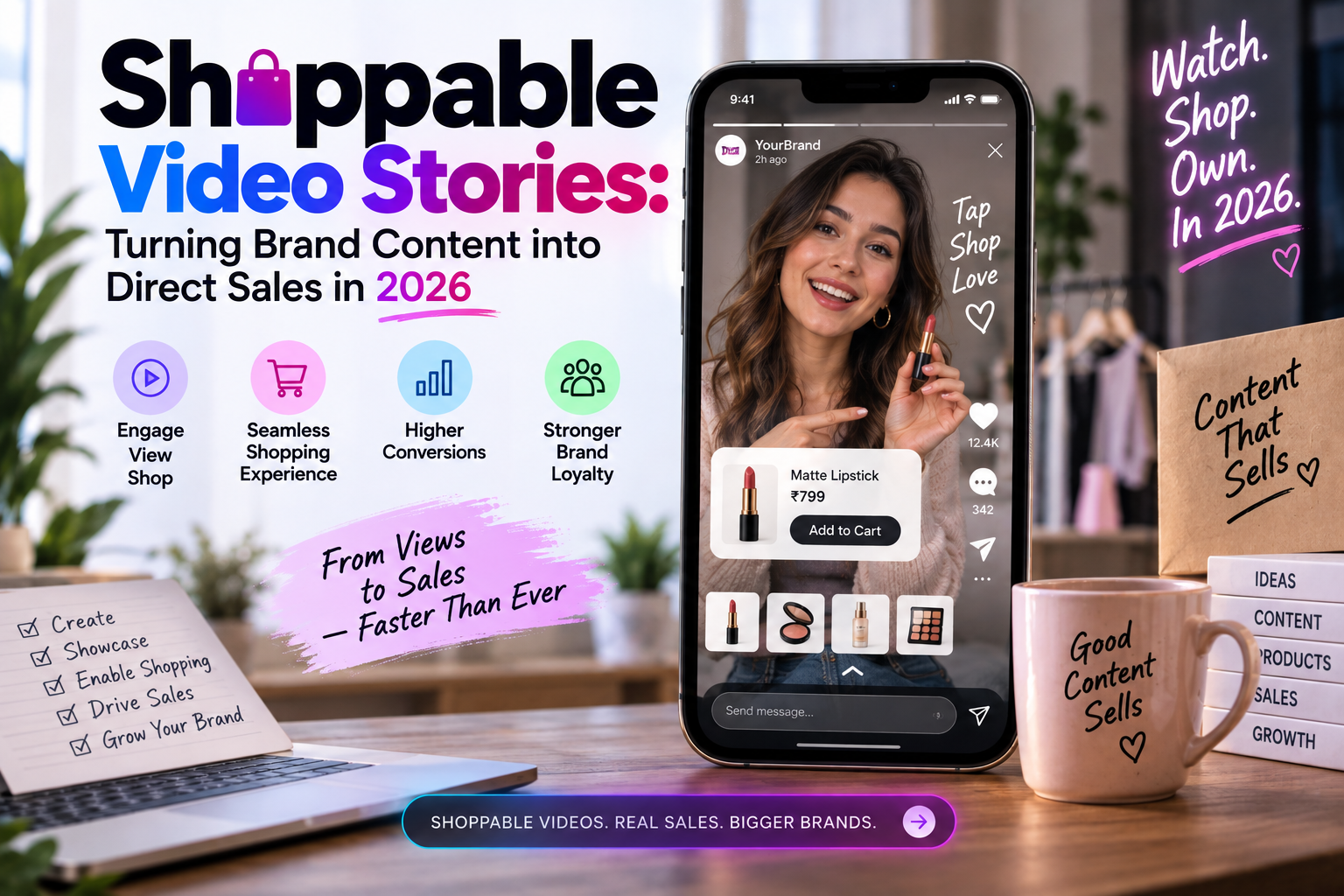
The gap between watching something and buying it used to require several steps. See a product in a video. Go to a search engine. Find the brand. Navigate to the product page. Hope the variant you wanted is in stock. Complete checkout. Each of those steps is a place where customers leave. Shoppable video stories simplify that journey.
Product tagging in videos, embedded checkout, clickable hotspots that open product pages without leaving the content – the buying decision and the buying moment happen in the same place. For brands investing in ecommerce video marketing and product video marketing, this changes what a video is actually for. Content stops being the beginning of the funnel and becomes the funnel itself.
In 2026, the brands getting the most from video commerce are the ones treating shoppable content as a sales channel.
What Are Shoppable Video Stories?
Shoppable video stories are video content with purchasing functionality built directly into the viewing experience.
The mechanics vary by platform. On Instagram and TikTok, product tags appear over relevant items in the video – tap the tag, see the product details, complete the purchase. On brand websites, clickable hotspots open product drawers or add items to cart without redirecting the viewer. In email campaigns and digital catalogues, embedded video shopping links connect content to product pages with a single click.
The result is a fundamentally different relationship between video and purchase. How product demo videos influence buying decisions has always depended on bridging the gap between seeing and buying. Interactive video commerce closes that gap entirely. The viewer doesn’t need to remember the product or seek it out. The purchase path is already there.
What separates shoppable videos from traditional product videos isn’t just the interactive layer. It’s the intent behind the production. Shoppable content is built to convert, which changes decisions about length, pacing, product focus, and where the narrative goes.
Why Shoppable Videos Increase Conversions
Friction kills conversions. Every additional step between interest and purchase is a place where attention drifts, doubt enters, or a competing product appears.
Video-driven ecommerce removes most of that friction. A viewer watching a lifestyle video featuring a product they want can complete the purchase before the video ends. No redirect. No search. No navigating an unfamiliar website. The video sales funnel compresses to its most efficient form.
The brand video funnel traditionally separates awareness content from consideration and conversion content. Shoppable video stories blur those distinctions in useful ways. A single piece of content can introduce a product, demonstrate its value in context, and complete the sale – all without asking the viewer to do anything beyond watch and tap.
The psychology of brand videos supports this. Purchase decisions are emotional before they’re rational. A video that creates genuine desire in the moment of viewing, and then immediately offers the path to act on that desire, catches customers at the highest point of their interest. Waiting for them to find their way to a product page later is a gamble most brands lose.
Impulse purchasing in video shopping is also a real phenomenon. The right product, shown in the right context, at the right moment, converts better when the action is immediate. Interactive shopping experiences that reduce the distance to checkout capture intent that would otherwise evaporate.
Where Brands Can Use Shoppable Video Stories
Social commerce videos on Instagram, TikTok, and YouTube are the most obvious place for deployment – but they’re far from the only one.
Brand websites are underused for shoppable content. A product landing page with a shoppable video embedded at the top outperforms static imagery and traditional product video because it combines demonstration with direct purchase. The customer sees the product in use and can buy without scrolling to a separate section.
Email marketing is another high-intent context. Video marketing for ecommerce in email performs consistently above static content on click-through rates. Adding shoppable elements to embedded video content in email campaigns brings the purchase path directly into the inbox.
Hero, Hub and Help video strategy maps content types to audience stages. Shoppable video stories fit naturally at the consideration and decision stages – moments when the viewer already has product awareness and needs the final push. Building a video asset library around shoppable content means the same asset can be repurposed across website, social, email, and digital catalogues without rebuilding from scratch.
Mobile apps and digital catalogues complete the picture. Anywhere a brand has an audience with purchase intent, shoppable content strategy gives that audience a direct path to act on it.
Best Practices for Creating High-Converting Shoppable Videos
The first three seconds determine whether a shoppable video works at all.
Conversion-focused videos open on something that earns attention immediately. The product in use, a result being demonstrated, a moment of recognisable desire. Social shopping audiences scroll fast. A weak opening means the interactive shopping experience never gets seen.
Product demonstration videos in a shoppable format need to show the product in context rather than in isolation. A viewer watching a bag being styled for different occasions understands the product better than one watching the same bag rotating on a white background. Context creates desire. Desire creates purchase intent.
Keep the buying experience simple. One or two product tags per video performs better than a video filled with hotspots competing for attention. The viewer should know exactly what they can buy and where to tap without having to think about it.
Video storytelling for brands still applies even in conversion-focused content. A shoppable video that feels like an ad converts worse than one that feels like content. The product needs to appear naturally within a story the viewer is actually interested in watching.
Micro-storytelling is particularly effective in shoppable formats. A specific, well-chosen moment – a product solving a recognisable problem, a detail shown in a way that makes someone think “I need that” – does more conversion work than a full product overview. The interactive element should sit at the point of maximum desire, not at the end of a long introduction.
Mobile-first design is where most shoppable videos succeed or fail in execution. Tap targets need to be large enough to hit accurately on a phone screen. The checkout flow triggered by a product tag should complete in as few taps as possible. Any friction in the mobile experience undermines everything the video has done.
Common Mistakes Brands Should Avoid
Too many clickable elements is the mistake that surfaces most often in early shoppable video production.
When every item in a scene is tagged, the video stops feeling like content and starts feeling like a catalogue. Viewers become aware of the commercial intent, which reduces the emotional engagement that makes shoppable video work. Select one or two products per video – the ones most likely to convert – and build the content around showing them well.
Weak storytelling underneath the interactive layer is the deeper problem. Interactive brand videos built on content that wouldn’t hold attention without the shoppable elements don’t convert. The story needs to be strong enough to watch independent of the purchase mechanic. The mechanic then catches the desire the story created.
Long product introductions before getting to the value create drop-off before viewers reach the purchase moment. Pacing in video editing for shoppable content is front-loaded. The product needs to earn interest early, not after a two-minute build-up.
Complicated checkout journeys following the tap are where brands lose customers who were ready to buy. Corporate video strategy tips for shoppable content need to account for the full path from video to confirmation, not just the video itself.
Ignoring analytics is a production mistake as much as a marketing one. Shoppable videos generate specific data: which products got tapped, at what point in the video, by which audience segments. That data should inform the next production, not sit unread in a dashboard.
The Future of Video Commerce in 2026 and Beyond
Live shopping events are the format with the most momentum right now.
A presenter demonstrating products in real time, with viewers able to purchase during the stream, combines the urgency of a limited-time offer with the product demonstration value of video. In several Asian markets, live shopping already accounts for a significant portion of ecommerce revenue. Western markets are following.
AI-powered product recommendations inside videos are developing quickly. Rather than static product tags, systems that identify what the viewer has browsed previously and surface the most relevant product in the video accordingly are moving towards mainstream deployment. Personalised video commerce that adapts which products are highlighted based on viewer data produces higher conversion rates than generic tagging.
AR product visualisation is extending the shoppable experience further. Tapping a product tag that lets you see how a piece of furniture looks in your room, or how a shade of lipstick looks on your face, before purchase reduces return rates and increases purchase confidence.
Interactive video content in 2026 is converging with shoppable formats – branching narratives where different choices lead to different product recommendations represent the logical next step for video-driven ecommerce. Micro-videos are also being used as shoppable units in paid advertising, where the short format and direct purchase path combine effectively.
Voice-assisted shopping integrated with video is earlier stage but developing – the ability to say “buy that” while watching a video without touching the screen is being tested across several platforms.
Conclusion: Turn Every View into a Sales Opportunity
Customer journey videos used to end at desire. Shoppable video stories end at purchase.
Brands that have built the ability to buy directly from videos into their content strategy are operating with a structural advantage over those still separating content and commerce. Every piece of video content becomes a potential sales moment. Every view is an opportunity that doesn’t require the viewer to do the extra work of finding their way to a product page.
The video conversion strategy required to make this work isn’t complicated. Strong content. Focused product integration. A clean purchase path. Consistent deployment across the touchpoints where the audience already spends time.
Commercial video production built around shoppable formats starts with a different question than standard content production. The goal isn’t just to make something worth watching. It’s to make something worth buying from.
Want video content that converts viewers into customers? Kween Media produces shoppable video stories built for real purchase journeys. Partner with us to supercharge your sales funnel!